My dad gave my mom an old grocery coupon shortly before he died. She kept it untouched for three years, until money became so tight that she finally tried to use it. The cashier laughed in her face. But the manager recognized something on the paper, and suddenly he wasn’t laughing at all.
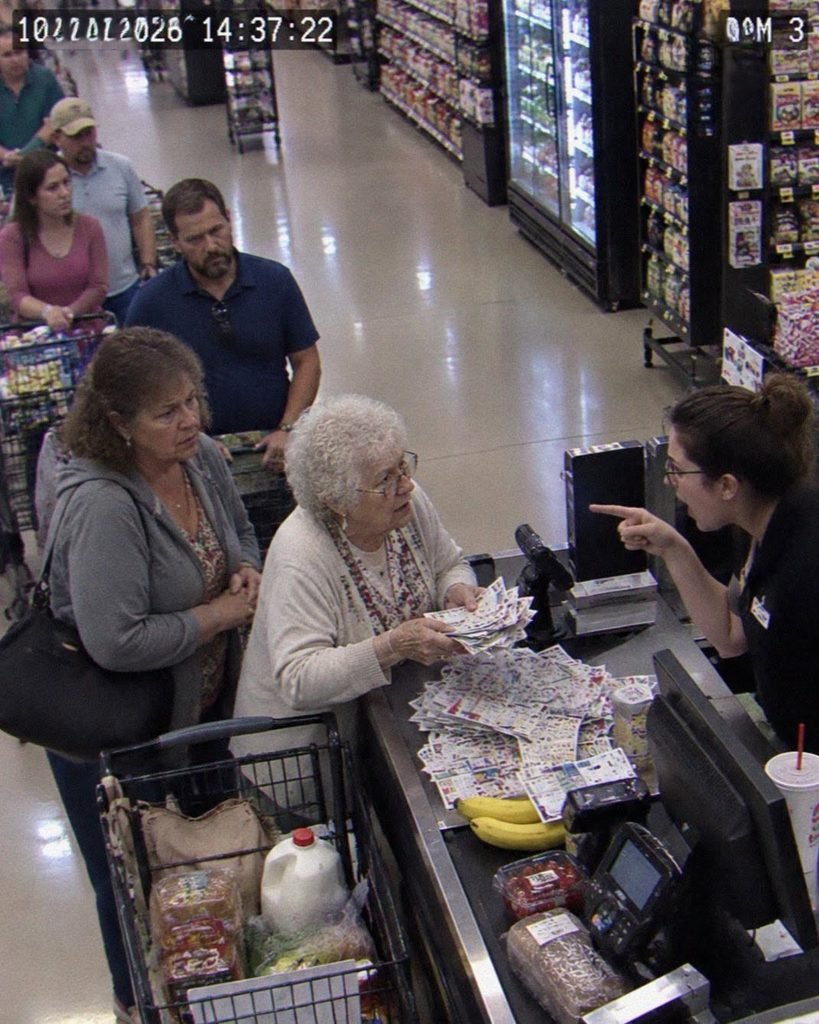
“Maybe you should buy less stuff if you can’t afford it.”
The young cashier said it loudly enough for everyone in line to hear.
My 75-year-old mother stood beside me, staring at the coupons in her trembling hands. Her face had turned bright red.
“There’s no reason to speak to her like that,” I snapped.
The cashier barely looked at me.
“Then maybe you should explain how coupons work.”
My name is Leah, and I had never wanted to drag someone across a grocery counter more than I did that afternoon.
My mother had been widowed for three years. Since Dad died, she’d survived on a small pension, clipping coupons every Sunday and carefully planning her shopping around whatever was on sale.
Last Tuesday, I accompanied her to the grocery store where she’d shopped for almost 40 years.
Everything had been fine until we reached the register.
Mom handed the cashier, whose name tag read Ezra, a small stack of coupons.
He sighed dramatically.
“Seriously? All of these?”
“Please,” Mom whispered. “They help me afford my groceries.”
That was when he suggested she buy less.
Several customers turned around.
One woman shook her head, but nobody said anything.
Ezra started scanning the coupons, complaining whenever one needed adjusting.
Then he picked up a slightly yellowed piece of paper.
“What’s this supposed to be? It’s ancient!”
Mom immediately reached toward him.
“Please be careful with that one.”
He laughed.
“Lady, this isn’t a museum.”
The paper looked different from her other coupons. It carried the store’s old logo, with a handwritten signature across the bottom.
“That was given to my husband many years ago,” Mom explained.
Ezra shook his head.
“Well, your husband should’ve used it back then.”
My mother went completely silent.
I’d seen her cry at Dad’s funeral. I’d watched her struggle through their first anniversary without him. But the expression on her face that afternoon was somehow worse.
“Call your manager,” I demanded.
Ezra rolled his eyes, then picked up the phone.
A few minutes later, a gray-haired man wearing a blue shirt approached.
His name tag read Adrian.
“What’s the problem?” he asked.
Ezra waved the old coupon.
“This woman expects us to accept something from the Stone Age.”
Adrian took it.
At first, he looked irritated. Then his eyes moved to the signature.
His expression changed.
He turned the paper over.
And suddenly, his face went pale.
“Where did you get this?” he whispered.
“My husband gave it to me before he died,” Mom answered.
Adrian stared at her for several seconds.
Then he immediately locked the register.
“Ezra, step away from the checkout, please.”
“But there’s a line.”
“I’ll arrange another cashier. Step away.”
Something in his voice made Ezra obey.
Adrian looked back at Mom.
“May I ask your husband’s name?”
She told him.
He gripped the coupon more tightly.
“I knew that name,” he said quietly. “My father knew your husband.”
Mom looked confused.
“Your father?”
“He founded this store.”
Adrian turned the coupon toward us and pointed to the signature.
“That’s his handwriting.”
I leaned closer. Under the faded store logo was a message written in blue ink.
“For everything you did for our family. Your family will always have a place here.”
Below it, another line promised grocery assistance to Dad’s household whenever it was needed.
I looked at Mom.
“Did you know what this said?”
“Your father told me it would help someday,” she whispered.
Adrian glanced toward the customers watching us.
“Would you mind coming into my office? I’d like to explain something.”
I immediately shook my head.
“We’re not going anywhere until you tell us whether that coupon is valid.”
He nodded.
“Fair enough. Whatever else happens, your mother’s groceries today are covered. I’m honoring that promise.”
Then he looked at the coupon again.
“But there’s something I need to understand.”
Mom agreed to follow him.
His office was small, with shelves of paperwork and framed photographs of the store from decades earlier.
He pulled out chairs for us.
“I’m sorry about what happened at the register,” he began. “Nobody deserves to be spoken to that way.”
“Then why was your employee comfortable doing it?” I asked.
Adrian didn’t defend him.
“That’s something I’ll be addressing.”
He sat across from Mom.
“Did your husband ever tell you about the financial trouble this store had years ago?”
She hesitated.
“I remember he spent several weekends helping your father with repairs.”
Adrian nodded.
“That was about 30 years ago. The refrigeration equipment kept breaking down. We were behind on bills, and my father was afraid we’d have to close.”
Dad had worked as a maintenance supervisor for most of his adult life. He could repair practically anything.
I remembered him coming home exhausted on certain Sundays, his work clothes stained with grease.
I’d always assumed he’d been earning extra money.
“Your husband repaired equipment we couldn’t afford to replace,” Adrian continued. “He found cheaper parts and wouldn’t accept payment for his labor.”
Mom smiled faintly.
“That sounds like him.”
“But I never knew my father gave him something like this.”
Adrian placed the coupon carefully on his desk.
“These weren’t regular store coupons. My father occasionally wrote personal promises when someone had done him an extraordinary kindness.”
“Does that mean you’ll honor it?” I asked.
“Yes. But I’d like to check something in our old records.”
Before he stood, I noticed Mom wiping her eyes.
I reached for her hand.
“Why didn’t you ever tell me about this?”
She looked down.
“Because I didn’t think I’d need it.”
I waited.
Then she told me something she’d never admitted before.
A few weeks before Dad died, when his health was failing, he called her into their bedroom.
He opened the drawer beside his bed and handed her the yellowed coupon.
“If things ever get too hard, take this to the store,” he’d told her.
Mom had asked what it was.
“An old promise,” he answered. “They’ll remember.”
She’d tucked it away with his important papers.
After his death, she occasionally considered using it, especially when groceries became more expensive.
But every time, she put it back.
“I kept thinking I could manage another month,” she admitted.
“Mom, you could’ve told me.”
“I know, sweetheart. But you’ve got your own bills.”
I wanted to argue, but I understood something painful.
She wasn’t only worried about money.
Accepting help meant admitting how much her life had changed since Dad died.
“What made you bring it today?” I asked.
She folded her hands.
“After paying my bills this month, I couldn’t afford everything on my list. I thought your father’s coupon might cover the difference.”
She swallowed.
“I almost didn’t hand it over.”
Before I could answer, Adrian returned carrying a thin folder and an old photograph.
He placed the photograph on his desk.
Two younger men stood outside the grocery store, smiling beside a delivery truck.
I recognized Dad immediately.
His hair was dark, his shoulders broad, and he wore the same crooked grin I remembered from my childhood.
Beside him stood Adrian’s father.
“That’s the day we reopened the refrigerated section,” Adrian explained.
Mom picked up the photograph.
“He never showed me this.”
Adrian opened the folder.
“My father kept records from the years the business nearly failed. I knew someone had lent him money when the bank wouldn’t extend more credit.”
He paused.
“I always thought it was my uncle.”
He unfolded a letter.
“But this has your husband’s signature.”
My mother looked up.
“What letter?”
“A loan agreement.”
I frowned.
“My father lent your family money?”
Adrian nodded slowly.
“Enough to pay overdue supplier bills and keep the doors open while the repairs were being completed.”
Mom pressed a hand against her mouth.
Then she said something that surprised me.
“I knew about the loan.”
I turned toward her.
“You did?”
“Your father told me he wanted to help a friend. We were saving for a bigger house then.”
I remembered that house. Dad had taken us to look at it when I was young. I’d spent weeks imagining a bedroom with two windows.
Then, suddenly, we stopped talking about moving.
“That money was supposed to be for our down payment?” I asked.
Mom nodded.
“Your father said his friend needed it more urgently. We agreed to wait.”
Adrian checked another paper.
“The money was repaid several years later. My father kept the repayment record.”
Mom seemed relieved.
“Yes. We got it back. By then we’d decided to stay where we were.”
“But there’s something else,” Adrian said.
He showed us a handwritten note attached to the agreement.
“My father wrote that without this particular loan, he couldn’t have paid his suppliers that month. The store would have closed before he could finish the repairs.”
Mom stared at him.
“Your father never told us that.”
“He didn’t tell me who helped him, either.”
Adrian leaned back.
“He always said someone had saved this business because he believed the people working here deserved another chance.”
I looked at Dad’s photograph.
For years, I’d remembered him as the man who fixed our leaking faucets, made pancakes on Saturdays, and checked the tire pressure before every family trip.
Now I was discovering he’d quietly helped save an entire store.
“Why didn’t he tell us?” I asked.
Mom ran her thumb along the photograph’s edge.
“Your father didn’t like making a fuss about helping people.”
Adrian nodded.
“My father wanted to thank him publicly after the store recovered. According to this letter, your husband refused.”
He looked at the coupon.
“I think this was my father’s way of making sure he could return the favor someday.”
The office fell quiet.
Then I remembered Ezra’s words.
“Maybe you should buy less stuff if you can’t afford it.”
My father had helped keep that store open.
Three decades later, his widow had been mocked for needing assistance inside it.
“There’s something I want to ask you,” I said.
Adrian looked at me.
“If my father hadn’t helped your family, would you still care about how that cashier treated my mother?”
He didn’t answer immediately.
Then he said, “You’re right to ask.”
I waited.
“What Ezra did was unacceptable before I saw that coupon. Your father’s history doesn’t make your mother more deserving of respect than anyone else.”
“Then I hope you remember that when we’re gone.”
“I will,” he said.
He turned toward Mom.
“My father made your husband a promise. I’d like to honor it.”
Mom straightened.
“You already said you’d pay for today’s groceries.”
“I’m talking about more than today.”
Adrian explained that, with his authority as the store’s current owner and manager, he could establish a household grocery account in her name.
It would provide a generous monthly allowance for ordinary groceries, funded by the store.
She wouldn’t need to present the old coupon again or explain herself at checkout.
Mom shook her head.
“That’s too much.”
“It’s what my father wanted.”
“But I don’t want people talking about me.”
“They won’t need to know. The account will work like any other store credit.”
She looked toward me.
For the first time that afternoon, I didn’t answer for her.
This was her decision.
“Would I still get to choose my groceries?” she asked.
“Of course.”
“And nobody would have to approve my shopping every time?”
“No. We’ll arrange it privately. I’ll give you the details in writing.”
She considered his offer.
Then she nodded.
“All right. If you’re sure.”
Adrian smiled.
“I’m very sure.”
He returned the original coupon to her.
“I think your husband would want you to keep this.”
When we left the office, Ezra was standing near the customer-service counter.
Adrian called him over.
“I’ve reviewed what happened at the register,” he said. “Your behavior toward this customer was unacceptable.”
Ezra glanced at us.
“I thought the coupon was fake. The line was getting long.”
“Then you should have called for assistance,” Adrian answered. “You don’t humiliate someone because a transaction is taking time.”
Ezra looked down.
“That coupon was written by my father. This woman’s husband helped keep our store open when we were struggling.”
Ezra’s expression changed.
“The reason this business is still here, and the reason you have a job here, is partly because of her husband.”
For a moment, nobody spoke.
Adrian told Ezra he was being removed from register duty while his conduct was formally reviewed. Customer-service retraining would be required before he could return to the position.
Ezra turned to Mom.
“I’m sorry. I shouldn’t have spoken to you like that.”
She studied him.
“You didn’t have to know my husband to treat me kindly.”
Ezra nodded.
“You’re right.”
Mom didn’t say she forgave him.
She simply took my arm.
“I’d like to go home now, Leah.”
Adrian personally completed our transaction at another register. He covered the groceries and promised to send the written account details that week.
Before we left, he gave Mom a copy of the photograph.
Outside, I helped load her bags into the car.
She sat quietly while I put the cart away.
On the drive home, she kept the coupon in her lap.
“Are you okay?” I finally asked.
She nodded, then shook her head.
“I wish your father were here.”
“I know.”
“He always told me people would help if I needed them. I thought he was just trying to make me feel better.”
I glanced at her.
“He was trying to take care of you.”
She looked at the coupon.
“For three years, I thought using this meant I couldn’t manage without him.”
“And now?”
Her eyes filled with tears.
“Now I think he just wanted to make sure I wouldn’t have to manage everything alone.”
That evening, we found a small frame in her hallway closet.
Mom placed the yellowed coupon inside and set it beside Dad’s photograph on her bedroom dresser.
She stood there for a long moment, looking at both.
Then she turned to me.
“Do you remember how he always said a good deed should never come with a bill?”
I nodded.
“He helped that family because they needed him,” she said. “And somehow, after all these years, they’re helping me.”
The following week, Adrian sent the promised account information.
Mom called me after her first shopping trip.
She’d bought fresh fruit, vegetables, and the coffee she’d stopped buying because it had become too expensive.
“And Leah,” she added, sounding almost embarrassed, “I didn’t use a single coupon.”
I laughed.
“Good.”
“But I’m still clipping them on Sunday.”
“Of course you are.”
She laughed too.
I knew she’d never stop being careful with money.
That was part of who she was.
But something important had changed.
She no longer felt she had to prove she could survive without anyone’s help.
And the next time she walked into that grocery store, she wasn’t carrying an old promise she was afraid to redeem.
She was carrying the knowledge that her husband’s kindness had never truly been forgotten.