“‘Your Mom Flies Fighter Jets?’ My Son’s Teacher Laughed When He Said His Mother Flew Fighter Jets — Until I Walked Into the Classroom in My Flight Suit”But When I Walked Into The School Auditorium Behind A Line Of Navy SEALs, The Smile Slowly Disappeared From His Face
The Quiet Boy In The Third Row
The first mistake Mr. Davies made was assuming that quiet meant weak.
The second mistake was assuming that a thirteen-year-old boy with a soft voice, secondhand sneakers, and a habit of looking people in the eye only when necessary could not possibly be telling the truth.
By the time he made his third mistake, the entire classroom had already joined him.
Heroes’ Week
Lucas Jensen sat in the third row from the windows, where the late morning sun spilled over the desks in pale gold rectangles and made dust float like tiny sparks in the air. Northwood High’s freshman wing always smelled faintly of floor polish, old paper, and whatever had been served in the cafeteria the day before, but that morning the room felt sharper somehow, more awake, as if everyone inside it sensed that something was about to happen and had leaned forward without knowing why.
It was Heroes’ Week, the annual school tradition that filled the halls with red, white, and blue paper banners, laminated posters of firefighters and nurses, bulletin boards covered in student essays, and a restless atmosphere of performance. For five days, the school celebrated service and sacrifice. Students were asked to interview family members, research historical figures, or speak about people in their lives who represented courage.
For most of the class, it had become a contest.
One student had brought a slideshow about his grandfather, a decorated police officer. Another had spoken about an aunt who worked as an emergency room doctor. Someone else had managed to borrow a firefighter’s helmet and placed it dramatically on the teacher’s desk before giving a speech that ended with half the class clapping, partly because it was good and partly because the helmet looked impressive.
Lucas had not brought a prop.
He had brought one photo.
It was small, slightly creased at one corner, and tucked between the pages of his notebook as carefully as if it were something fragile. In the picture, his mother stood beside a gray aircraft on a sun-blasted runway, wearing a flight suit and sunglasses, one hand resting on the ladder beneath the cockpit. She was younger in the photograph, though not exactly different. Even in stillness, there was something controlled about her, something balanced. She did not smile broadly. She never had, not for cameras. But the corners of her mouth were lifted just enough for Lucas to know she had been happy.
When his name was called, Lucas rose without hurry. He carried his notebook to the front of the room and unfolded his paper with both hands. His classmates shifted, some barely looking up. Lucas was not the kind of student who attracted much attention. He was not loud. He did not make jokes for the approval of the back row. He did not get in fights, did not flirt clumsily across the aisle, did not throw paper, did not talk back.
To most of them, Lucas was simply there.
To Mr. Davies, he was an easy student to overlook and an easier one to correct.
“Go ahead, Lucas,” Mr. Davies said, leaning back against his desk with his arms folded. “Tell us about your hero.”
Lucas took one breath.
“My hero is my mom,” he began.
There were a few soft groans, not cruel yet, just the ordinary impatience of teenagers who had heard too many speeches begin that way.
Lucas continued anyway.
“Her name is Sarah Jensen. She served in the United States Air Force. She was an F-22 pilot.”
That was when the first laugh escaped.
It came from somewhere near the windows, small and sharp, like a match striking. A second followed from the back of the room, then a whisper, then a low chuckle that spread from desk to desk as quickly as water finding cracks in concrete.
Lucas stopped reading.
Mr. Davies raised his eyebrows.
“An F-22 pilot?”
His voice carried the kind of amusement teachers sometimes used when they wanted students to understand that something foolish had just been said. It was not an honest question. It was a performance.
Lucas looked at him.
“Yes, sir.”
“Your mother?”
“Yes, sir.”
Mr. Davies let the silence stretch. He had always enjoyed that particular tool. Silence made students squirm. Silence made them regret. Silence made a classroom look toward him for permission to react.
Then he gave it.
“Lucas, please,” he said, smiling in a way that showed no warmth at all. “Let’s stick to believable heroes for today’s assignment.”
The classroom erupted.
It was not loud at first. It was worse than loud. It came in layers: hands over mouths, shoulders shaking, whispers turned sideways, a few full laughs from students who wanted to be heard laughing.
“No way.”
“His mom flies jets?”
A boy in the back made a soft whooshing noise under his breath, followed by an explosion sound, and the group around him bent over their desks.
Lucas stood very still.
His face warmed from his neck to his ears. He could feel it happening, the involuntary betrayal of blood rushing to his skin, announcing humiliation before he had given anyone permission to see it. His fingers tightened around the edges of his paper. The photograph inside his notebook felt suddenly heavy.
He thought of his mother’s voice.
Not loud. Never loud.
When pressure rises, breathe first. Decide second. Move third.
Lucas breathed.
Mr. Davies mistook the silence for surrender.
“Look,” the teacher said, turning slightly so that he addressed not just Lucas but the entire class. “We all want our parents to be special. That’s understandable. My father was a mailman. A noble profession. Reliable, hardworking, respectable. But I don’t come in here telling you he was a secret agent delivering coded messages to the Pentagon.”
The laughter sharpened.
“There’s dignity in reality,” Davies continued. “You don’t need to invent something dramatic to make your mother worthy of admiration.”
Lucas looked down at the paper he had written the night before at the kitchen table while his mother washed dishes and occasionally corrected his grammar without looking over his shoulder. He had not exaggerated. If anything, he had left things out because his mother had taught him that stories about service were not trophies to wave around.
Tell the truth. Keep it simple.
So he had.
And now the truth was being laughed at.
“Mr. Davies,” Lucas said quietly, “I’m not inventing it.”
A few students made drawn-out noises, the kind that meant someone had just made things worse for himself.
Davies sighed, almost theatrically.
“Lucas, I appreciate commitment to a story, but part of growing up is learning the difference between admiration and exaggeration.”
The word exaggeration landed harder than liar because it allowed everyone to understand liar while letting Mr. Davies pretend he had not said it.
Lucas folded his paper once. Then again. He slipped it back into his notebook with the photo.
He did not argue.
This, too, came from his mother.
Your word is your bond, Lucas, but your actions are your legacy. Let your actions speak when people refuse to hear your words.
So Lucas returned to his seat while the laughter followed him like thrown gravel. He sat down, placed his notebook flat on the desk, and rested both hands on top of it. His knuckles had gone pale.
He stared at the scratched surface of his desk and breathed.
Lucas sat in silence, the laughter still echoing in his ears as Mr. Davies moved on to the next student. The noise slowly faded, but the sting of disbelief lingered. Lucas kept his eyes on his notebook, his mother’s image tucked safely inside, and tried to focus on breathing, just as she had taught him.
The rest of the class went by in a blur. Lucas wasn’t sure how he managed to hold himself together, but he did. When the bell finally rang, he gathered his things and slipped out of the classroom quickly, avoiding eye contact with his classmates.
As he walked down the hallway, his mind raced with thoughts of what he could do to prove them wrong. He didn’t want to embarrass Mr. Davies, but he also couldn’t let the world think his mother was a lie. Lucas knew he had to do something, but he wasn’t sure what.
That evening, Lucas shared the day’s events with his mother. She listened quietly, a thoughtful expression on her face. After he finished, she gave him a reassuring smile. “We can’t control what others believe, Lucas,” she said softly. “But we can show them the truth.”
Her words stayed with him throughout the night. The next morning, Lucas woke up with a sense of determination. He had an idea, one that would require some help from his mother.
“Mom,” Lucas said over breakfast, “Do you think you could visit my school? Maybe talk to Mr. Davies and show him what you do?”
His mother considered his request. There was a pause as she finished her coffee. “I’ll make some calls,” she replied finally, a hint of mischief in her eyes.
A few days later, the school announced a special assembly for Heroes’ Week. The buzz in the hallways was palpable, and Lucas could sense the anticipation building. He sat quietly, waiting for the moment when he could finally set the record straight.
When the day of the assembly arrived, the entire student body gathered in the auditorium. Lucas found a seat in the middle rows, his heart pounding. He had told a few friends about the special guest, but most of the school had no idea what was coming.
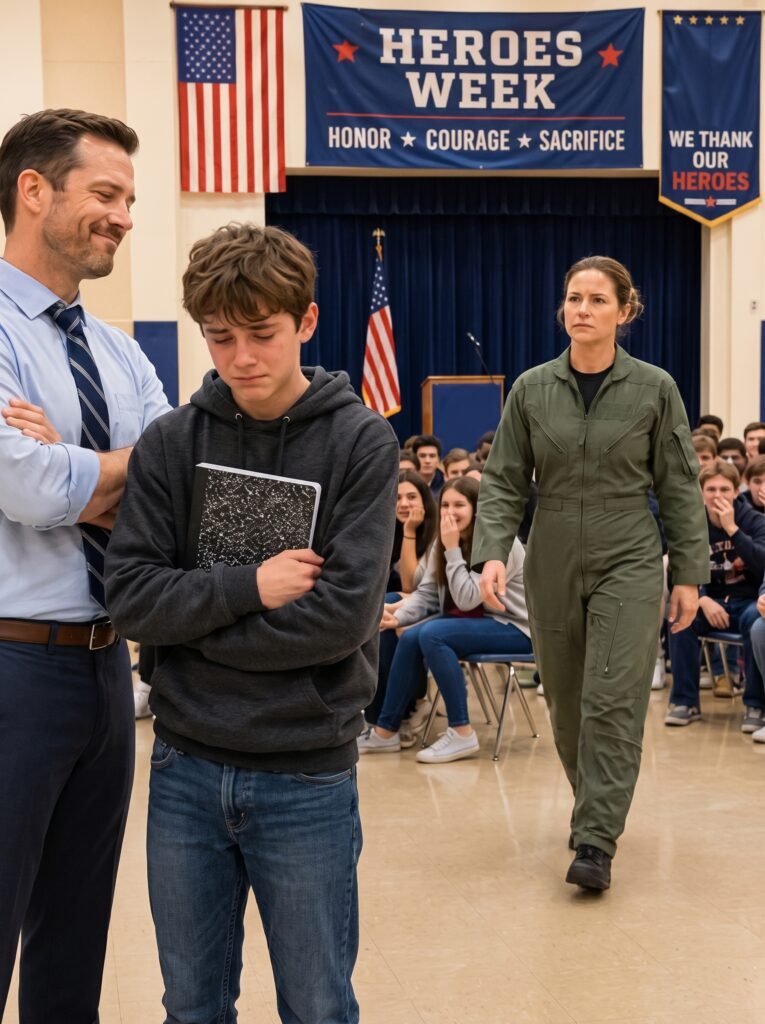
The lights dimmed, and the principal took the stage to introduce the surprise guest. “Today, we are honored to have someone very special with us,” she announced, her voice echoing in the spacious hall. “Please welcome former United States Air Force pilot, Sarah Jensen.”
A few whispers went around, confused and skeptical. But when Lucas’s mother walked in, flanked by a line of Navy SEALs in full uniform, a hush fell over the room. The disbelief that had once filled the air was replaced by awe.
Lucas watched as his mother took the stage, standing confidently before the entire school. She spoke about her experiences, the challenges she faced, and the dedication it took to serve her country. The students listened, spellbound, their earlier laughter forgotten.
Mr. Davies, sitting in the front row, no longer wore a smug smile. Instead, he watched Sarah Jensen with newfound respect. When she finished speaking, the applause was thunderous, echoing off the walls and filling the room with admiration.
As the assembly ended, Lucas felt a sense of pride swell within him. His mother had shown them the truth, and their actions had indeed spoken louder than words.