Hello, my name is Calvin Draper. I’m thirty-four years old, single, and working as a doctor at Tanova Healthcare Harton, in a small Tennessee town tucked into the Appalachian foothills. Out here, the highways curve like gray ribbons between green hills, old pickup trucks sit in gravel driveways, and porch flags hang still in the heavy Southern air.
Tuloma isn’t anything like New York or L.A. The streets are quiet after nine, the main drag has a diner with bottomless coffee, a hardware store that still smells like sawdust, and a couple of little coffee shops where retired teachers and off-duty nurses sit under framed photos of high school football teams, talking about everything and nothing as the sun slides down behind the hills.
I love this place, not just because it’s peaceful, or because a weathered American flag flutters outside the hospital entrance every morning I walk in. I love it because this is where I finally found what my life was supposed to be—and also where I realized just how badly the people I called “family” had failed the one person who loved me most.
Today, sunlight is pouring across the desk in my small apartment, catching the edge of my stethoscope and the stack of patient charts I brought home but haven’t touched. I’m scrolling my phone without really seeing anything when a Facebook notification pops up, bright and insistent.
“On this day, 16 years ago…”
The photo blooms onto my screen before I can stop it—me at eighteen, gangly and awkward in a hand-me-down suit, standing beside a woman with silver hair pulled back in a bun and flour still dusted on her apron sleeve. Grandma Hazel. Except she wasn’t my grandmother by blood. She was my neighbor, back when I was a scared, half-starved foster kid bounced through four homes in six years before landing, more by luck than design, in a rental two doors down from her modest house in Tuloma.
I stare at the photo for a long moment, my coffee going cold beside my elbow, and think about how strange it is that memory works the way it does—dormant for months, then arriving all at once, sharp enough to cut.
Hazel found me sitting on my own front steps the week I moved in, sixteen years old, refusing to go inside a house that didn’t feel like anything yet. She didn’t ask what was wrong. She just sat down beside me on the concrete with two glasses of sweet tea and said, “Well, since we’re both out here, might as well be out here together.”
That was it. That was the whole beginning of everything.
Over the next two years, she fed me more meals than my foster family ever managed to remember, taught me to change a tire, sat with me through every college application, and cried—actually cried, right there at her kitchen table—the day my acceptance letter to the state university’s pre-med program arrived. She wasn’t my blood. She became something better. She became the first person who made staying feel like it might be worth it.
I lost touch with her for a few years during residency, the way you do when eighty-hour weeks eat every spare hour you have, and I’ve regretted it every year since. When I finally moved back to Tuloma to practice, one of the first things I did, before I even finished unpacking, was drive to her old street.
Her house was empty. A neighbor told me she’d moved in with her daughter’s family a few towns over, something about wanting to be closer to her grandchildren in her later years.
I never followed up. Life got busy the way it does, and I let another year slip by telling myself I’d reach out eventually, the same quiet lie everyone tells themselves about the people who matter most.
Then, three weeks ago, I was leaving the hospital after a double shift when I saw her—Hazel, older now, thinner, standing at a gas station pay phone two towns over from where I thought she still lived, looking utterly lost.
I almost didn’t recognize her. Almost drove right past.
But something in the set of her shoulders, the particular way she held herself even while clearly overwhelmed, snagged in my memory before my conscious mind even caught up.
I pulled over.
“Hazel?” I said, getting out of my car, my voice catching on the name like it belonged to someone else’s mouth. “Hazel Whitfield?”
She turned, and for a moment her eyes were unfocused, cataloguing me the way you do a stranger, before something shifted and her whole face opened up.
“Calvin,” she breathed, like she couldn’t quite believe it. “Calvin Draper. Look at you.”
I crossed the gas station lot and folded her into a hug that felt like closing a sixteen-year gap in three seconds flat. She smelled the same—lavender soap and something faintly like cinnamon—and I felt something in my chest crack open that I hadn’t realized was still sealed shut.
“What are you doing out here?” I asked, stepping back to look at her properly. She was thinner than I remembered, her cardigan hanging looser on her frame, and there was an exhaustion behind her eyes that hadn’t been there in the photograph from sixteen years ago. “Is everything alright?”
Her smile faltered, just slightly, before she caught it and steadied it back into place—the same practiced composure I’d learn later she’d worn at that airport counter three weeks earlier.
“Oh, just a small family mix-up,” she said. “Nothing to worry about.”
I didn’t believe her for a second. I’d spent enough years reading patients who insisted they were fine while their bodies told an entirely different story to recognize the same performance in an old woman standing alone at a gas station pay phone, two towns from home, with no ride and no obvious plan.
“Hazel,” I said gently, “let me drive you home. Wherever home is. And you can tell me about the mix-up on the way, or not. Either way, you’re not standing out here alone.”
She hesitated, pride visibly warring with exhaustion, before finally nodding and letting me lead her to my car.
The story came out slowly during that drive, and then more fully over the following days, once I’d installed her in my guest room and refused, gently but firmly, to let her go back to a house where she’d clearly been made to feel like an afterthought. The Europe trip. The sudden sweetness that had preceded it. The airport, and her son’s flat, unbothered voice telling her to just go home, as though she were a forgotten umbrella rather than the woman who’d raised him.
“They said it was a mistake with the tickets,” she told me on the second night, sitting at my kitchen table with a cup of tea going cold in her hands. “But I saw the booking confirmation on my own phone, Calvin. My name was never on it. Not once. They planned this.”
I felt something cold and furious settle into my chest, the same feeling I sometimes got in the ER when a patient came in with injuries that didn’t match the story their family was telling.
“Why would they do that?” I asked. “Why spend thirty thousand dollars of your money and then cut you out?”
She was quiet for a long moment. “I think,” she said slowly, “they wanted the money without wanting me. I’ve been paying for things for years, Calvin—groceries when Robert lost his job, private school for the grandchildren, that down payment on their house eight years ago. I never minded. I loved being able to help. But I think somewhere along the way, they stopped seeing me as their mother and started seeing me as a line item they could manage.”
I thought of my own family—the ones who’d handed me off from foster home to foster home like an inconvenient piece of furniture nobody quite wanted to keep. I thought of Hazel, the only person who’d ever sat down on cold concrete steps beside a scared, silent teenager and simply stayed.
“You’re staying here,” I said. “As long as you need. And when your family gets back from Europe, I’m going with you to the airport.”
She looked up at me, startled. “Calvin, you don’t need to get involved in family business.”
“You are my family business,” I said. “You made sure I had a family to speak of when nobody else bothered to. I’m not about to let anyone treat you like you don’t matter, especially not the people who owe you everything.”
Over the following weeks, I learned the full shape of what her family had done—not just the airport, but years of quiet financial dependence dressed up as gratitude, years of holidays where she cooked and cleaned and paid for everything while being seated, increasingly, at the edges of her own family’s photographs. The sudden warmth before the trip, I came to understand, hadn’t been affection at all. It had been strategic softening, designed to keep her compliant and grateful right up until the moment they no longer needed her checkbook attached to a physical seat on the plane.
“I keep asking myself what I did wrong,” she admitted one evening, sitting on my back porch as the sun set over the hills. “Was I too much? Too demanding? I never thought I asked for anything unreasonable.”
“You didn’t do anything wrong,” I said firmly. “You loved people who decided, at some point, that loving you back was optional. That’s not a reflection of what you deserve. It’s a reflection of who they chose to become.”
She was quiet for a long moment, watching the sky turn orange over the ridge line. “You always did have a gift for saying the thing I needed to hear,” she said finally. “Even at sixteen, sitting on those front steps. I used to wonder what happened to that boy who couldn’t look anyone in the eye.”
“He became a doctor,” I said. “In no small part because a woman who owed him nothing decided he was worth showing up for.”
She reached over and squeezed my hand, the same gesture I remembered from a hundred kitchen table conversations sixteen years earlier, and I felt the plan solidifying in my chest—not vengeance, exactly, but something firmer. A reckoning. A reminder, delivered plainly and without apology, that the people who’d left her standing at that airport counter had badly, badly misjudged exactly how alone she actually was.
The morning her family’s flight was due to land, I put on the shirt Hazel had ironed for me the night before—unnecessary, since I owned an iron myself, but she’d insisted, the same fussing care she used to show over my college interview clothes sixteen years earlier, and I let her have it because I understood, watching her hands move over the fabric, that it was less about the shirt and more about needing something to do with her hands that wasn’t waiting.
“You don’t have to come with me,” she said for the third time that morning, sitting in my passenger seat, her hands folded tightly in her lap.
“I know,” I said. “I’m coming anyway.”
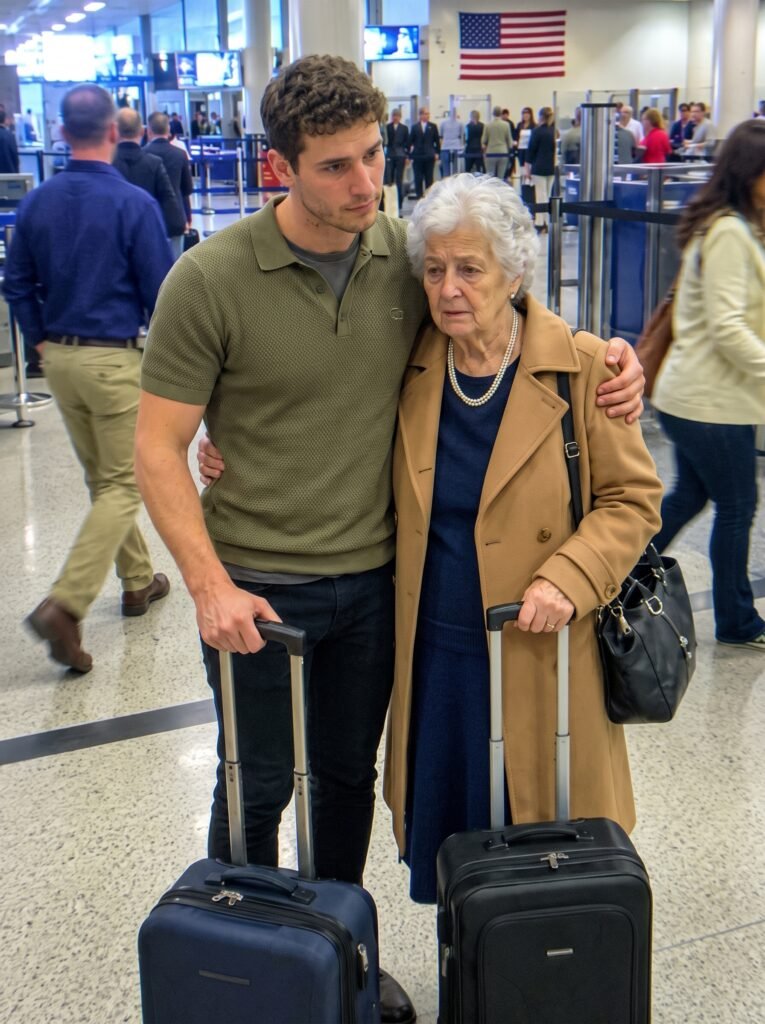
We arrived at arrivals twenty minutes before the flight was due, and I watched her scan the crowd—balloons, cardboard signs, a little girl squealing as she launched herself into her father’s arms near the sliding doors—with an expression I recognized from every difficult conversation I’d ever had with a patient’s family in a hospital hallway. Bracing. Preparing for a blow she already suspected was coming.
“Whatever happens,” I said quietly, “you’re not standing here alone this time.”
When her family finally emerged—her son first, then her daughter-in-law, then her sister trailing behind with an extra bag slung over one shoulder—they were mid-laugh, animated, still carrying the loose, sun-warmed energy of people who’d just spent three weeks somewhere beautiful without once thinking about the woman they’d left behind.
Then they saw her.
I watched every ounce of that laughter drain out of her son’s face in real time. His mouth opened, then closed. Beside him, his wife’s hand tightened reflexively on her suitcase handle, and Hazel’s sister actually stopped walking, as if her legs had simply forgotten how to move forward.
Their eyes moved from Hazel to me—my pressed shirt, my hospital lanyard still clipped at my waist from the shift I’d come straight from, the steady, unhurried way I stood beside her rather than behind her.
“Mom,” her son finally managed. “You look—we didn’t expect—”
“You didn’t expect me to still be standing,” Hazel said, her voice steady in a way that made me proud in some deep, unfamiliar place. “I understand that. You planned quite carefully for me not to be.”
“It was a mix-up with the ticket, Mom, I told you—”
“Robert,” Hazel said, cutting him off with a gentleness that somehow landed harder than anger would have, “I saw the booking confirmation. My name was never on that reservation. Not once. I’d like you to stop pretending otherwise, in front of your family and in front of mine.”
His eyes flicked to me, uncertain, clearly trying to place who exactly I was and why I was standing beside his mother with the calm, immovable presence of someone who had no intention of letting this conversation end the way he hoped it might.
“This is Calvin,” Hazel said. “You may not remember him. He lived two doors down from me, years ago, back when I still had my own house. He’s a doctor now. And for the past three weeks, while you were in Europe on money I paid for, he was the one who made sure I had somewhere warm to sleep and someone who actually wanted to hear about my day.”
I watched something crumble in Robert’s expression—not quite guilt yet, but the first crack of understanding that whatever quiet family arrangement he’d assumed would simply absorb this cruelty without consequence had just collided with an outside witness who had no reason to protect him.
“Mom, can we talk about this privately—”
“No,” Hazel said, and the single word landed with more finality than I’d heard from her in three weeks of gentle, careful conversations at my kitchen table. “I spent thirty thousand dollars so my family could see Europe together. I spent it gladly, the way I’ve spent on this family for years, because I believed that money bought closeness. I understand now it only ever bought convenience. I’m not interested in a private conversation where you explain this away quietly so nobody else has to know what you did. I’d like everyone standing here to understand exactly what happened, the same way everyone at that airport counter understood, and said nothing.”
Her daughter-in-law’s face had gone pale. Her sister was staring at the floor, the same posture I imagined she’d worn at the check-in counter three weeks earlier, complicit in her silence even if she hadn’t orchestrated the cruelty herself.
“I’d like my thirty thousand dollars back,” Hazel continued, her voice never rising, never cracking. “Not because I need it desperately, though I could certainly use it more wisely than funding a trip I wasn’t welcome on. I want it back because I think you need to understand that love isn’t a subscription service you can cancel once you’ve collected enough payments. I’m done being your family’s checkbook, Robert. I’d still like to be your mother. But you’re going to have to earn that back, the same way anyone earns anything that actually matters.”
The reckoning that followed wasn’t loud. There was no scene, no shouting match echoing through the arrivals terminal—just a quiet, devastating clarity that seemed to land harder on Robert and his wife than any argument could have. They drove Hazel home that evening, the four of us sitting in strained, careful silence, and by the end of the following week, an actual conversation had started—stilted, uncomfortable, full of long pauses where nobody quite knew how to bridge sixteen years of quiet dependence dressed up as devotion.
I don’t know if that family fully repaired itself. Some betrayals leave a mark too deep for total restoration, and I think Hazel understood that better than any of us, having lived on the receiving end of both extremes—cruelty from blood, and unconditional loyalty from a boy who owed her nothing except everything.
What I do know is that Hazel never went back to living dependent on anyone’s convenience again. She moved into a small house near mine, close enough that I could check on her without either of us calling it anything more dramatic than “stopping by.” I fixed her leaky faucet on weekends. She fed me dinner more nights than I’d like to admit I actually needed, the same steady, stubborn kindness she’d shown a scared sixteen-year-old on a set of cold concrete steps.
Six months later, at her seventy-second birthday, surrounded by a small gathering of neighbors and the handful of family members who’d genuinely shown up to make amends rather than simply save face, she stood to give a short toast, her eyes finding mine across the room.
“I used to think family was about blood,” she said. “I’ve learned, the hard way, that it’s about who actually shows up. I’ve been lucky enough, at my age, to learn that lesson twice—once through heartbreak, and once through grace.”
She raised her glass toward me, and I raised mine back, thinking of that gas station parking lot, of sixteen years compressed into a single moment of recognition, of a debt I could never fully repay to the one person who’d decided, long before I deserved it, that I was worth showing up for.
Some family you’re born into. Some you choose, again and again, every single day you decide to stay.
THE END.