It was a quiet autumn morning in Cedar Falls, Michigan, when veteran 911 dispatcher Dorothy Webb received a call that immediately felt unusual. She had barely reached for her coffee when her headset activated, but after she gave the standard greeting, nobody answered.
“911, what’s your emergency?”
Dorothy waited and heard only the faint breathing of a child on the other end. She softened her voice and asked again whether the caller could tell her what was wrong.
“My legs hurt. I can’t close them.”
The frightened voice instantly put Dorothy on alert, but she knew that sounding alarmed could make the child panic. She calmly asked for her name and age.
“Sadie. I’m six.”
Dorothy began tracing the call while keeping Sadie talking. When she asked whether another adult was home, the little girl explained that her mother was at work and had instructed her not to open the door for anyone.
“You’re doing great, Sadie. Can you tell me what your house looks like?”
“It’s white… but the paint is peeling. There’s a broken mailbox.”
That description, combined with the call location, gave emergency services enough information. Dorothy immediately dispatched an ambulance while continuing to reassure Sadie, listening to cartoons playing somewhere in the background and the child occasionally trying not to cry.
“Help is coming. Just stay with me.”
Several minutes later, sirens became audible through the phone.
“Do you hear them?”
“Yes… will they make it stop hurting?”
“They will, sweetheart. They’re almost there.”
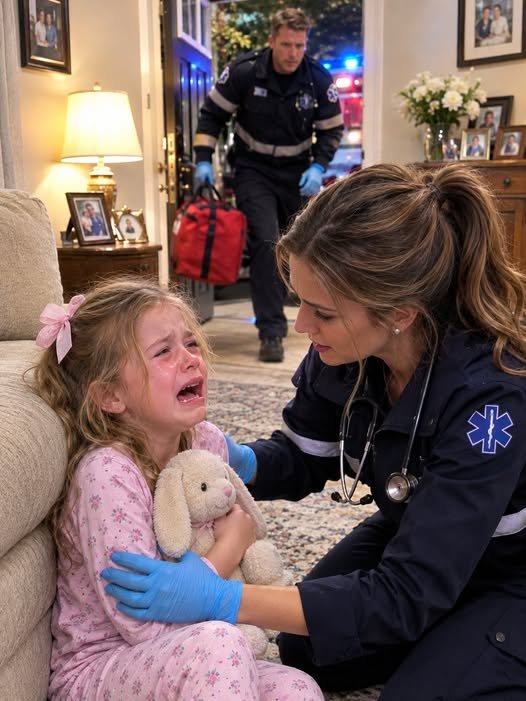
Paramedics Gideon Frost and Rhonda Pike soon reached the weathered white house, but the front door was locked. After they called to Sadie from outside, her weak voice directed them toward a spare key hidden beneath a flowerpot.
Inside, Gideon immediately noticed the stale air and an unusual chemical smell. They followed Sadie’s voice to a small bedroom, where they found the six-year-old lying beside her bed with her knees bent awkwardly, terrified to move because every attempt sent pain through her hips.
Rhonda crouched beside her instead of reaching for her immediately.
“Sadie, my name is Rhonda. I’m going to help you, but I need you to tell me if anything hurts when I touch it.”
Sadie nodded.
There was no obvious wound explaining the severity of her pain. That bothered Gideon more than something visible would have. He checked the room while Rhonda examined Sadie as gently as possible. The chemical smell appeared to be coming from a strong cleaning product that had spilled near the laundry area, but Sadie’s breathing and vital signs didn’t match a serious inhalation exposure.
Whatever was wrong with her legs, Gideon realized, probably had another cause.
They stabilized Sadie and carried her outside. As the stretcher rolled toward the ambulance, she clutched Rhonda’s sleeve.
“Don’t call him.”
Rhonda stopped.
“Call who, sweetheart?”
Sadie immediately looked away.
“I want my mom.”
Rhonda didn’t push. She simply told Gideon what Sadie had said, and he quietly passed the comment to the emergency department before they arrived.
At the hospital, the first examination raised more questions than answers. Sadie had no fever high enough to explain the pain, and routine blood work didn’t immediately reveal a clear cause. Because she could barely move her hips without crying, the attending physician ordered imaging.
Sadie’s mother arrived before the results came back.
She rushed through the doors still wearing her work uniform, breathless and shaking.
“I left her for less than two hours,” she told the nurse. “She was asleep when I left. She knows how to call me. I don’t understand.”
The doctor asked who normally watched Sadie while her mother worked longer shifts.
Her mother hesitated.
“My boyfriend, Wesley. But he’s out of town today.”
Across the room, Sadie heard the name.
Her entire expression changed.
She stopped answering questions.
That was when the radiologist called the attending physician into the hallway.
The doctor returned several minutes later carrying the images on a tablet. He didn’t sit beside Sadie first. He asked her mother to step into a consultation room.
“I need you to look at something,” he said.
On the scans were injuries around Sadie’s hips and upper legs that did not all appear to have happened at the same time. One was recent. Others showed signs of healing.
Her mother stared at the screen.
“That’s impossible.”
The doctor remained calm.
“Has Sadie had any serious falls recently?”
“No.”
“Any sports injuries?”
PART 2
“She’s six,” her mother said. “She doesn’t play sports. She watches cartoons and colors.”
The doctor, Raymond Hale, set the tablet down but kept his eyes on her face.
“Then I have to ask about the explanations you’ve been given for her pain. Has she complained before?”
Her mother hesitated. “She had a fall in the bathtub. That was a few weeks ago.”
“Who told you that?”
“Wesley. He said she slipped getting out.”
“Did Sadie tell you herself?”
The question seemed to land somewhere she hadn’t expected. She opened her mouth, closed it, and looked down at her hands.
“I don’t think I asked her,” she said quietly.
Dr. Hale didn’t fill the silence. After a moment he said, “I’m going to bring in people whose job is to help families in this situation. A hospital social worker, and someone from child protective services. That is standard when a child has injuries that don’t match a single event. It is not an accusation against you.”
“Is it against Wesley?”
“The medical findings will be reviewed by people trained to do that. My job is to document what I see and make sure Sadie is safe while they do.”
He called for a social worker named Lorraine Beck and notified the police, as the law required. Meanwhile, back at the dispatch center, I finished writing up the call.
Dorothy Webb had logged the time, 8:07, and Sadie’s exact words, the way she’d learned to do twenty years earlier. My legs hurt. I can’t close them. Don’t call him. She kept the child’s words separate from every adult’s explanation. If this went further, the first account on record would be Sadie’s own.
That afternoon, Detective Ana Ortiz came to the hospital and asked Dorothy to bring a copy of the recording. They sat in a small conference room. Ortiz played it once, all the way through, and said nothing at the end except, “She told you where the key was before anyone asked.”
“She was trying to help us help her,” Dorothy said.
“That’s what a lot of these kids do.”
Meanwhile, Rhonda Pike sat beside Sadie’s bed with both hands on her knees. Sadie twisted the cuff of her uniform between two fingers. She hadn’t let go of it since the ambulance.
“Do you want me to stay?” Rhonda asked.
Sadie nodded.
“Then I’ll stay.”
A trained child forensic interviewer was scheduled for the next morning, in a quiet room designed for this purpose, so that Sadie would have to tell her story only once, to someone who knew how to listen. Until then, nobody was to question her. Lorraine made that rule clear to everyone, from the nurses to the detective.
“She isn’t a witness tonight,” Lorraine said. “She’s a six-year-old who needs a blanket and a snack.”
Sadie’s mother stayed in the room, but she barely spoke. When the social worker asked her about Wesley, she answered in short sentences. He’d moved in the previous winter. He helped with rent. He picked Sadie up from school on her long shifts. She’d thought he was good with her.
“Where did he say he was going this week?” Detective Ortiz asked.
“A work trip. Chicago.”
“Do you have a number for his employer?”
She took out her phone to look, and stopped. A small notification glowed on the screen. A message from Wesley, sent at 8:14 that morning, seven minutes after Sadie’s call.
Everything okay at the house? Don’t forget what we talked about.
Her mother stared at it. “I didn’t tell him anything was wrong.”
Detective Ortiz asked her not to reply and not to delete anything. Then she asked a question that made her mother go pale.
“Did he know Sadie was home alone this morning?”
“He knew my schedule,” her mother whispered. “He always knows my schedule.”
PART 3
The next morning, Sadie sat in a small room with soft chairs, a box of crayons, and a woman named Dr. Yolanda Reyes, who spoke slowly and never raised her voice. Behind a one-way mirror, the detective, the social worker, and a prosecutor watched. Sadie’s mother was not in the room. She sat in the hallway with Rhonda, holding a cup of coffee she never drank.
I won’t repeat what Sadie said. It belongs to her, and to the people whose job is to protect it. I will say that she spoke for a long time, and that Dr. Reyes didn’t interrupt her once. And I will say that when the interview ended, Detective Ortiz walked into the hallway, took a breath, and said to Sadie’s mother, “She told us everything we needed to know. She was very brave.”
Her mother put the coffee down and covered her face.
“I should have asked her,” she said. “I should have asked her first.”
“Yes,” Lorraine said gently. “And now you will.”
The medical findings were reviewed by a team of specialists, who agreed with what Dr. Hale had seen on the first scan: injuries at different stages of healing, inconsistent with the explanations given at the time. The recorded 911 call, the paramedics’ observations, the message sent at 8:14, and the interview were all added to the file. Wesley’s phone, his messages, and his claimed trip to Chicago were examined under a court order. The trip, investigators found, had never happened. His car had been parked two blocks from the white house all morning.
He was arrested that afternoon.
I wasn’t there, and I’m glad. Detective Ortiz told me later that he hadn’t resisted. He had asked for a lawyer, then asked whether Sadie’s mother had been “told the whole story.” Ortiz said she told him the story had already been told, by the one person he’d spent a year teaching not to tell it.
The case took many months. There were hearings, motions, and delays, all of which were handled by the people trained to handle them. Sadie did not have to testify in open court. Her interview and the evidence carried the weight, and when the case concluded, Wesley was convicted and sentenced to a long term in prison. The judge said that what had protected Sadie in the end was the plain fact that a child had asked for help, and that adults had listened.
Her mother lost her job that winter, for missing shifts. She lost the apartment, too, because Wesley’s rent contributions had stopped. For a few weeks, she and Sadie lived in a county-supported family shelter. Lorraine fought for every form, every referral, every signature. A local church provided furniture. A hospital volunteer found her a daycare spot and a new job at a medical billing office, where the supervisor didn’t ask for explanations and let her take Thursdays for Sadie’s therapy.
Her mother started therapy too. In the first session, she told the counselor, “I believed him because he always sounded so sure.” The counselor said, “Certainty isn’t evidence.” She wrote it on the inside cover of her notebook.
Sadie healed in the slow way children do, not in a straight line. There were good weeks and terrible nights. She slept with the hallway light on. She flinched at certain voices. But she also learned to color in her own room again, and to ask for juice, and to say no to things she didn’t want. Her counselor taught her a game where she got to be the boss of the toys. Sadie, naturally, was strict.
One morning in the spring, I got a message from the hospital liaison. Sadie and her mother wanted to visit the dispatch center, if I was willing.
I was more than willing. I cleaned my desk twice.
They arrived on a Saturday. Sadie wore a yellow raincoat, though it wasn’t raining, and held her mother’s hand. She looked smaller than I remembered and also somehow taller.
“Are you the lady on the phone?” she asked.
“I am.”
“You had a nice voice.”
“So did you.”
She considered this. “I told you about the mailbox.”
“You did. And the flowerpot. You were very good at details.”
“Mom says details are important.”
“She’s right.”
I showed her the headset and let her put it on. She tapped the microphone and said “Hello?” in a very small, serious voice. Then she pressed it to her ear, listening, as if she thought someone might answer.
“What do you do when somebody doesn’t say anything?” she asked.
“I wait,” I said. “I keep the line open. Sometimes people need time before they can say it.”
Sadie nodded slowly.
“You waited.”
“I did.”
She took the headset off and held it out to me with both hands, the way you hand back something precious.
“Thank you for waiting,” she said.
I don’t think I answered. I think I nodded and looked at the clock, which is what I do when my eyes aren’t behaving.
Her mother stood by the door with a plain white envelope. She gave it to me before they left.
Inside was a drawing. A white house with peeling paint. A broken mailbox. A blue flowerpot. A bright yellow sun. And two figures in front, a woman and a little girl, holding hands. At the bottom, in careful, wobbly letters:
Mom stayed. Dorothy waited.
I put it in the file drawer under my desk, beside my folded dispatch checklist, the old one with the softened creases and the time written in my handwriting: 8:07 a.m. Child’s original words preserved.
Rhonda Pike came by the following week. She’d been promoted to supervisor. She sat on the edge of my desk with a coffee that cost $2.25 and complained about it, because some traditions are sacred.
“Think about it,” she said. “She was six. She didn’t have a plan. She just called.”
“She had a plan,” I said. “She remembered what her mom told her. And she called anyway.”
“She didn’t open the door.”
“No. She told us where the key was instead.”
Rhonda laughed softly. Then she stopped.
“Do you ever think about the ones who don’t call?”
“Every day,” I said. “That’s why I keep the line open.”
On the anniversary of that morning, a quiet Tuesday in late September, I glanced at the clock at 8:07. I thought of a small voice saying my legs hurt and a house with a broken mailbox. I thought of Gideon crouching to lift a flowerpot, and Rhonda sitting on a bedroom floor with her sleeve twisted in a child’s fist. I thought of Dr. Hale, who had asked the question nobody had asked before, and Detective Ortiz, who had played a recording once and said nothing.
And I thought of an ordinary phone setting, an ordinary message, an ordinary adult explanation that would have gone on being accepted if one small girl hadn’t picked up a phone.
My headset lit up.
“911, what’s your emergency?”
A pause. A faint breath.
I picked up my pen, and I waited.