“If you were going to show up like this, you could have at least given me a heads-up,” the woman said, eyeing Edward’s wheelchair as if she had just spotted a stain on the tablecloth.
She said it loud enough for the couple at the next table to stop arguing about their wine.
Edward was thirty-two, ran a consulting firm worth a fortune, and had spent fifteen minutes rehearsing how to greet Stella without sounding nervous. Now, all he wanted was a way out of the restaurant without having to wheel past every single table.
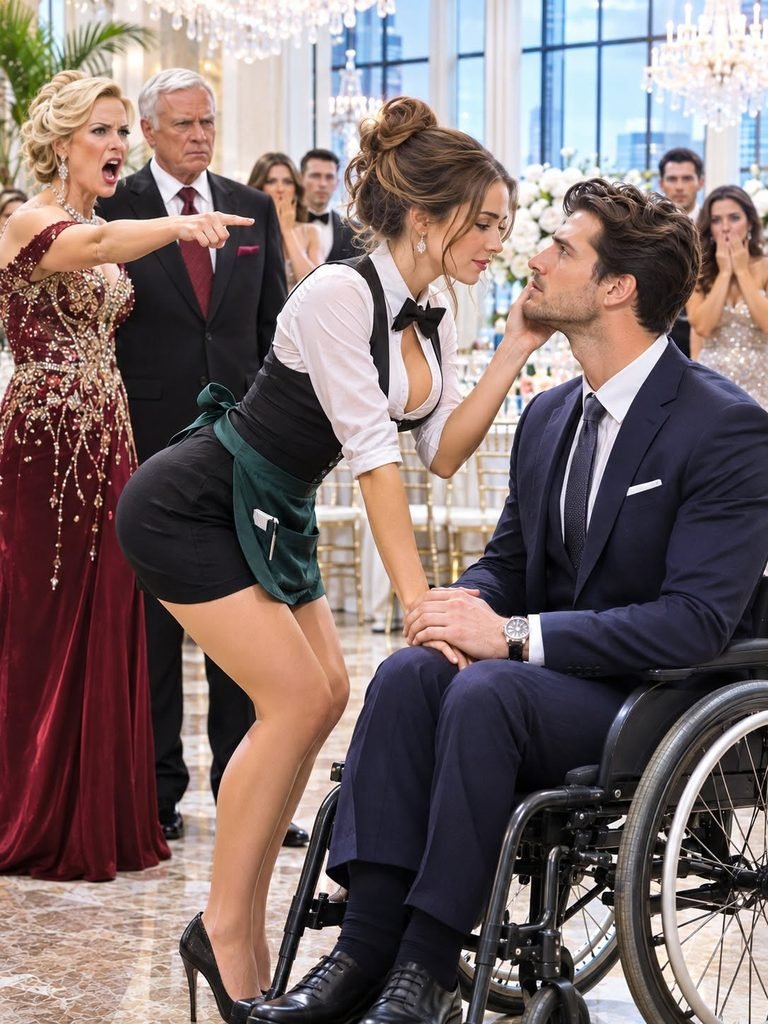
Rose, his mother, had set up the blind date. She had assured him Stella knew about the accident. Maybe Rose had assumed, like so many people did, that after three years, things would have somehow sorted themselves out by now.
“If you don’t feel like having dinner, you’re free to leave,” he said.
“It’s not that. It’s just that I like to travel, go out, hit the beach. I’m looking for someone who can live a normal life. What do they expect from me, to spend my summer pushing you around?”
Edward had just gotten back from San Diego, where he had gone swimming in the ocean and eaten better than on any of his business trips. He could have told her that. What closed his throat wasn’t the question itself, but the sheer exhaustion of pretending it had been asked in good faith.
A waitress set a basket of bread down on the table.
“Will the lady be dining tonight, or should I grab your coat?”
Stella looked up. The waitress had a smudge of marinara sauce on her apron and a crooked name tag that read Lydia.
“This is a private conversation.”
“Well, they can hear it all the way at the bar. If you don’t want to have dinner with him, don’t. Just stop explaining to the whole dining room why you think he’s worth less than you are.”
“Do you know who I am?”
“I know which hook your coat is hanging on.”
Stella walked out without putting it on.
Nobody clapped. The man who had stopped arguing about the wine slowly lowered the butter knife he had been holding mid-air. Gradually, the hum of conversation returned to the room.
Lydia leaned toward Edward. “Do you want me to leave you alone, or should I tell you which dish on the menu I wouldn’t order even with someone else’s money?”
Despite everything, Edward laughed.
He ordered the braised short ribs. Lydia brought him a fresh basket of bread, and by the end of the night, the manager authorized the kitchen to comp his meal for the trouble.
Edward left a hundred-dollar bill tucked under his saucer.
She caught up with him in the parking lot before he could reach his car, holding the bill out.
“If you want to thank me, come back tomorrow and order a coffee. Coffees actually count toward my register.”
He came back. He drank the coffee and worked up the nerve to ask her out for iced lattes and pastries at a bakery down the street after her shift ended.
Lydia was twenty-six, had a four-year-old son named Toby, and was halfway through her physical therapy degree. She told him all of this while tearing pieces off a warm croissant.
Edward talked about his job without mentioning what the company was worth. She didn’t ask. She was far more interested in why he kept insisting he had just happened to be passing by the restaurant by coincidence.
On Monday, Lydia arrived for the lunch shift still laughing about the excuse he had come up with.
Tony, the manager, called her into the back office.
Stella was sitting behind the desk, her forgotten coat draped over her lap and a termination notice lying on the blotter in front of her.
PART 2
Tony didn’t ask Lydia to sit down. He told her Stella was the daughter of one of the restaurant’s silent partners and had threatened to take her complaint straight to her father if management didn’t take action.
“She says you insulted her in front of other guests.”
“You were standing right behind the bar. What did you hear?”
Tony looked down at his shoes. Lydia had spent three years covering shifts for him every time someone called out sick. In that moment, she understood exactly how little those three years weighed against a single phone call from an investor.
“I hope this teaches you a lesson,” Stella said.
“Oh, it definitely will. I’m just not sure which one of us is learning it.”
Standing at the bus stop, Lydia did the math in her head, calculating how many weeks she had before her bank account hit zero after rent. Then she deleted the text message she had started typing to Edward. She didn’t want him thinking that because she had stood up for him, it was now his job to rescue her.
He was the one who called her. He had made a lunch reservation, and Tony, seeing him roll in, had ended up spilling the whole story.
Lydia agreed to let him stop by her apartment in Queens.
When she opened the door, Toby peeked out from beneath her arm, holding a crayon drawing of a dragon that didn’t know how to fly.
“Do you want to see it? My mom says it’s because of the wings, but she forgot to ask the dragon.”
Edward examined the drawing with all the gravity it deserved. Toby eventually explained that the dragon could fly—it just only knew how to land on top of apartment roofs.
Once the boy wandered back into the living room, Edward pulled out his phone to show Lydia a job posting his firm had been trying to fill for weeks.
“I need someone who can manage my calendar and knows how to talk to angry callers without flinching.”
“Depends. Am I allowed to offer them their coat?”
She said it as a joke. Then she read the salary figure and went quiet.
She insisted on interviewing with someone else at the company, getting her hours in writing, and having guaranteed flexibility to pick Toby up from daycare on the days her neighbor, Kathy, couldn’t make it.
She interviewed on Thursday. By Monday, she was at her desk.
In the lobby that morning, she spotted Edward on the cover of a business magazine profiling the wealthiest young executives in the country. Just forty-eight hours earlier, she had watched him color with Toby until his shirt cuffs were stained with washable marker.
It turned out that juggling executive meetings wasn’t all that different from squeezing walk-ins into a packed Friday night dining room. When a key investor moved up a make-or-break pitch by forty-eight hours, Lydia overhauled the entire schedule and put together a briefing packet Edward used to close a five-million-dollar contract.
Over at Kathy’s apartment, Toby knew his mom had had a good day because she showed up with glazed donuts and ate the first one before he could even open the box.
It was around that time that Lydia found out Edward had quit physical therapy. He admitted he had grown tired of leaving every session thinking only about the things he still couldn’t do.
She offered to go with him for a fresh evaluation. She had completed enough coursework to know it wasn’t her place to treat him, but also enough to ask him what he wanted to get back that had nothing to do with standing up.
Edward didn’t take long to answer. He wanted to be able to cook a full Sunday breakfast—flipping pancakes and all—without nerve pain forcing him to quit halfway through.
Another Friday, Lydia went back into his office to grab her keys. She found him sitting quietly with a photograph in his hands. In it, a young guy was grinning broadly with a bicycle helmet strapped on backward.
“That’s David, my brother,” Edward said.
Lydia was about to ask where he lived. Then she realized Edward was crying.
“He was twenty-two. He was in the passenger seat with me. And I was looking down at my phone.”
PART 3
Lydia sat down beside him.
Edward got the rest of it out in halting pieces. It had been raining. A call came in from the office, and a name flashed across his screen that, for years, he had considered too important to let go to voicemail. David had been right in the middle of telling him something about his first real job out of college.
Edward glanced down at the phone. When he looked back up at the highway, there wasn’t enough time left to correct the wheel.
The last memory he had of his brother was David going silent mid-sentence.
“I don’t even know what he was trying to tell me.”
That was what hurt the worst on Fridays. They had made plans to grab dinner that night, and David had asked him to keep the radio off because he had big news.
Ever since then, whenever Rose called to ask if he was coming over for Sunday dinner, Edward invented an excuse. He couldn’t bear watching his mother set the table for fewer people.
Lydia didn’t tell him it wasn’t his fault, and she didn’t tell him to stop thinking about it. She simply waited until he lifted his head.
“You can’t undo what happened. But your mother has already lost one son. What if every time she calls, it’s just because she misses the other one?”
He didn’t answer. When he picked up the photograph again, he turned it over and saw the date written in Rose’s neat handwriting. It was from a family camping trip upstate where David had insisted on wearing his bike helmet even while eating a PB&J sandwich.
It had been a very long time since Edward remembered anything about his brother that wasn’t tied to that stretch of highway. That afternoon, before tucking the photo back into his drawer, he told Lydia the entire story—from the squashed sandwiches to the patch of poison ivy that had sent both of them home covered in calamine lotion.
Before she left for the day, Edward confessed that he had been engaged right before the crash. His fiancée had handed the ring back the week he was discharged from the hospital. She told him she still loved him, but couldn’t picture herself in the life waiting for them.
Lydia recognized the posture Edward took as he told her—that subtle shrinking inward, as if trying to make the exit easier for the other person. Toby’s father had pulled the front door of their apartment shut with that exact same gentleness the day he found out she was pregnant. For months afterward, she had mistaken that politeness for kindness.
On Sunday, Edward showed up at his mother’s brownstone carrying a warm apple pie from a bakery in Brooklyn.
Rose set out two plates.
Edward asked her why she had hidden the wheelchair from Stella.
Rose opened her mouth to deny it, then stopped and began smoothing out the edge of the tablecloth.
“I told her you’d been in an accident. I was afraid she’d say no before she ever got the chance to meet you.”
“And she ended up saying it to my face in front of half a restaurant.”
Rose’s eyes filled with tears. She didn’t try to justify it a second time. She apologized and asked if he wanted her to sit with him or if he preferred to eat alone.
It was the first time in years she had asked him a question and genuinely waited for his answer.
Edward slid her plate closer. They ate slowly. When they finished, he pulled out the photograph and admitted that part of him was still waiting for her to finally say she hadn’t forgiven him.
Rose rested a fingertip against David’s crooked bike helmet.
“There are days I’m angry with you. There are also days I’m angry with him for not being here. And when you don’t answer my calls, all I want is to hear your voice—not keep score.”
Edward stayed until dark. As he was leaving, Rose asked him to bring Lydia and Toby along the following Sunday. She was curious to meet the woman who, judging by three remarkably brief phone calls, her son was clearly falling for. Mostly, though, she wanted to meet the four-year-old boy who had mailed her a crayon dragon drawn on the back of an old utility bill.
Meanwhile, Edward restarted physical therapy with a licensed specialist. Lydia went with him to the first couple of appointments, and after that, she began waiting outside in the lobby with her own textbooks balanced across her knees. She had been setting aside part of her paycheck to re-enroll for the fall semester.
Sometimes, rolling out of the clinic, Edward would find her muttering quietly at an anatomy diagram that refused to make sense. She would snap her binder shut and ask how his session went. Eventually, he started telling her about both the good days and the days he left in a foul mood.
One afternoon, he managed to repeat a small, voluntary movement with his left foot. The physical therapist jotted it down to monitor over the coming weeks, careful not to promise how far it might go.
The first thing Edward did upon leaving the exam room was look for Lydia. He wanted to tell her with all the calm composure in the world. He didn’t even make it to the end of his sentence. Lydia dropped her binder straight onto the linoleum floor, and the two of them stood there laughing without bothering to bend down and pick it up.
Their first kiss happened in the office elevator, following an unexpected stretch of silence. Lydia was the one who leaned in.
When the doors slid open at the lobby, they stepped apart, and she stood staring down at the loose class notes they had just gathered off the floor.
“I don’t want to walk into your office on Monday wondering if I still have a job.”
“Because you kissed me?”
“Because one day I might decide I don’t want to kiss you again.”
Edward started to say he would never do something like that. Then he caught himself—remembering that back at the restaurant, Lydia had also been told she was indispensable right up until the day she wasn’t.
He asked her what would give her peace of mind. She didn’t have an immediate answer. By the end of the week, they arranged for her role to report directly to the Chief Operating Officer, who had already asked for Lydia’s help on two major rollouts. Lydia insisted on sitting down with the COO herself before taking anything for granted. And Edward, who was dying to ask if he could kiss her again, walked her out to her car and kept the question to himself.
Saturday night brought a charity gala at a conservatory overlooking the Hudson River. Edward had invited her before the elevator kiss. Lydia still wasn’t sure she was going until Toby wandered into her bedroom and found her barefoot, trying on a red wrap dress that had been hanging untouched in the back of her closet for years.
“Can’t you wear that one?” the boy asked.
“I can. I just don’t know if I want to go.”
Toby sat down on the edge of the mattress holding a single sock. “The day I tried the big swimming pool, I didn’t want to go either. Then I didn’t want to get out.”
He looked so pleased with his own wisdom that it took him a full minute to notice the sock in his hand belonged to his mother.
Lydia put on the red dress. She dropped Toby off with Kathy and walked out the door before she could talk herself into another excuse.
At the gala, a man in a tuxedo handed her an empty champagne flute, assuming she was part of the catering staff. Lydia took it purely out of muscle memory. When the man glanced back and realized his mistake, she calmly gestured toward a nearby cocktail table.
“Leave the next one over there. Tonight, I’m here for dinner.”
Edward overheard the whole exchange and had to hide his grin behind his linen napkin.
Later, once the staff began clearing the dinner tables, he held out his hand to her. Lydia worried about stepping on his feet or getting tangled up when he turned. He asked her to step in a little closer, and soon enough, they found their rhythm.
Lydia recognized the song playing over the speakers. Kathy always put it on while baking chocolate chip cookies with Toby, and she always jumped the gun right before the chorus. She whispered that into Edward’s ear. By the time the chorus actually hit, both of them had jumped the gun too.
“I’m in love with you,” Lydia said, never stopping their slow sway. “And it really annoys me that Toby figured it out before I did.”
Edward let out a genuine laugh. They had only known each other six weeks. He knew it was way too early for the question sitting right on the tip of his tongue.
Even so, he ended up asking it anyway on the quiet edge of the dance floor, with no microphone and no crowd watching.
“Would you marry me someday?”
Lydia leaned back just enough to get a clear look at his face.
“Someday, yes. But first, I need you to survive a Sunday barbecue with Kathy and your mother both arguing over how to season the ribs.”
On a cocktail napkin, Rose—who had spotted the embrace from across the room—jotted down the date. When Lydia caught her at it, she asked Rose to write “no venues booked yet” underneath. Rose complied, slipping the napkin into her evening clutch with the innocent expression of a woman who already had four places picked out.
A few weeks later, Tony called Lydia. Following the formal labor complaint she had filed, the restaurant’s ownership group had reviewed the security footage and interviewed other servers on duty that night. Tony offered her job back.
She turned him down. She did, however, agree to stop by to pick up her severance settlement.
Tony met her at a dining table out front rather than hiding in the back office. He admitted he had heard every word Stella said from behind the bar.
“I know,” Lydia replied. “You looked away right when she asked who was going to push his chair.”
Tony stood there looking as though he didn’t know what to do with his hands.
Lydia ordered a cup of coffee. She drank it at the table right beside the front window—the exact spot where she had met Edward. When she got up to leave, she left exact change on the saucer. What surprised her most was that she wasn’t in any hurry to walk out the door.
Six months after that first dinner, Edward took several supported steps during a physical therapy session. Almost that exact same week, Lydia went back to college classes.
Toby wanted to know which milestone they were supposed to celebrate. They ended up celebrating both, even though the batch of pancakes Edward had managed to flip entirely on his own stuck hopelessly to the skillet. Toby ate every bite, including the mangled pieces they had to scrape out with a spatula.
On Toby’s fifth birthday, Edward promised he would make it back in time for breakfast. The boy pressed his nose against the living room window from the moment the sun came up. When he finally spotted Edward coming down the sidewalk, he sprinted to tell Lydia, who had spent the last twenty minutes pretending she wasn’t watching the street too.
They got married three months later at a sunlit orchard farmhouse upstate in the Hudson Valley. Edward walked the final stretch down the aisle to Lydia using a cane. Toby, entrusted with the wedding rings, stepped in so close to make sure he didn’t drop them that he ended up standing squarely on the hem of his mother’s dress.
Rose laughed out loud. Tucked inside her handbag was the cocktail napkin from the gala, and pinned to her lapel was a small silver tie bar that had once belonged to David.
When the dancing started, Edward switched back to his chair. His legs were tired, and he wanted to stay out on the floor until the band packed up. Lydia walked over to him just like she had that night overlooking the Hudson.
Toby, who had been weaving between the reception tables, trotted up holding his crayon drawing of the dragon. He had added three bright yellow windows to the rooftop where the dragon always landed.
“I figured out why he always comes down here,” Toby said, setting the paper gently across Edward’s lap. “It’s his house.”
As the song faded out, the guests drifted out toward the patio for sparklers. Edward lingered for a quiet moment, looking down at the three lit windows. Then he asked Toby to show him which room the dragon slept in.
The boy asked if he could climb up onto his lap. Edward made room for him, and Toby pointed to a corner of the paper roof and launched into a sprawling, intricate story.
Edward set his phone face down on the table—and this time, he listened all the way to the end.