Without raising my voice, I pulled out the $390 I had worked so hard to save. Then the owner walked over, noticed something in my hands, and his expression changed completely…
I worked until 2 a.m. for six weeks to save $425 for my 8-year-old daughter’s dream dress. But when we walked into a luxury boutique in Manhattan, the saleswoman looked at our worn-out clothes and snapped, “People like you don’t belong in this store. Get out before I call security!”
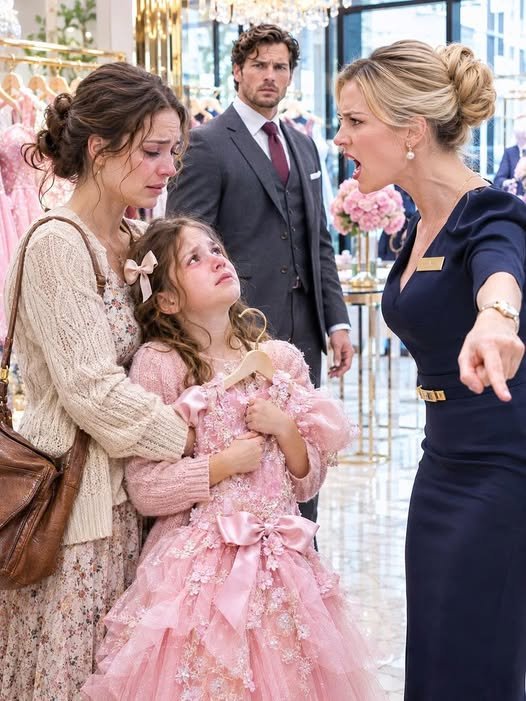
My daughter burst into tears, clutching the pink dress she had dreamed about for months.
I opened my old purse with shaking hands.
“I have the money,” I said quietly. “We’re here to buy a dress, not beg for one.”
What I didn’t know was that the millionaire who owned the boutique was standing at the top of the staircase, watching everything.
And when he saw what I pulled from my purse, he came straight toward us.
But that was only the beginning of a story that would change our lives forever.
PART 1: THE DRESS THAT COST ME SIX WEEKS OF SLEEP
My name is Emily Carter. I was 35 years old, a single mother, and a seamstress living in a small apartment in Queens, New York.
My husband had walked out when our daughter, Lily, was only two.
He left behind unpaid bills, an empty closet, and a little girl who kept asking when Daddy was coming home.
Eventually, she stopped asking.
I worked from home, fixing broken zippers, shortening pants, and altering wedding dresses. My old sewing machine sat beside our living room window.
It wasn’t much, but it kept us going.
We didn’t have expensive furniture or fancy vacations. Still, I made sure Lily had warm meals, clean clothes, and a bedtime story every night.
Then one afternoon, she came home from school unusually quiet.
“Sweetheart, what’s wrong?” I asked.
She stared at her shoes.
“Madison said my dress looks like it was made from old curtains.”
My heart sank.
I had made that little floral dress myself using leftover fabric from a customer’s order.
“Did someone else say something?”
Lily nodded.
“Some girls laughed.”
I sat beside her.
“But you told me you loved that dress.”
“I do, Mommy,” she whispered. “I really do.”
Then she looked up at me with tears in her eyes.
“But just once, I wish I could have a dress from a real store. One with a pretty tag and a fancy shopping bag. Like the other girls.”
I hugged her tightly.
She wasn’t asking because she was spoiled.
She just wanted to fit in.
Two days later, her school announced its annual fall dance recital.
Lily had been chosen for the opening performance.
She was so excited that she practiced her steps in our tiny kitchen every evening.
That weekend, we went into Manhattan to deliver a dress I had altered for a customer.
On our way back to the subway, Lily suddenly stopped in front of a beautiful boutique on Madison Avenue.
The sign above the door read:
MAISON ALBA.
In the window stood a child-sized mannequin wearing a breathtaking dusty-pink dress.
It had a soft tulle skirt, tiny embroidered flowers, and a satin ribbon tied around the waist.
Lily pressed her hands against the glass.
“Mommy,” she whispered, “that’s the most beautiful dress I’ve ever seen.”
I looked at the price tag.
$425.
My stomach tightened.
That was almost an entire month’s earnings after paying for basic supplies.
But when I saw the way my daughter looked at that dress, I made a decision.
I would buy it.
Somehow.
That night, after Lily fell asleep, I opened the small metal box where I kept our savings.
There was only $63 inside.
I counted it twice, hoping I had missed something.
I hadn’t.
So I started working harder.
For six weeks, I accepted almost every sewing job that came my way.
I repaired coats, altered bridesmaid dresses, and fixed torn evening gowns.
Some nights, I worked until 2 a.m.
By 6:30, I was awake again, making Lily’s breakfast and packing her school lunch.
Our elderly neighbor, Mrs. Parker, noticed the dark circles beneath my eyes.
“Emily, honey, you’re going to make yourself sick.”
I smiled tiredly.
“I just want to give my little girl something special.”
One morning, while cleaning Lily’s backpack, I found a small envelope filled with coins and crumpled dollar bills.
There was a note written in her crooked handwriting.
For Mommy. To help buy my princess dress.
I sat on the edge of her bed and cried.
When I asked where the money came from, she looked embarrassed.
“I saved some of my lunch money.”
I pulled her into my arms.
“Oh, baby. You don’t have to do that.”
“But you work so hard, Mommy. I wanted to help.”
That was the moment I promised myself I would never let my daughter feel ashamed of where we came from.
Finally, on the Saturday before her recital, I counted the money again.
Four hundred and twenty-five dollars.
Every last dollar.
I placed the bills inside a white envelope and tucked it into my purse.
“We’re going shopping,” I told Lily.
Her eyes lit up.
“For the pink dress?”
“For the pink dress.”
She screamed with excitement and threw her arms around me.
We took the subway into Manhattan.
Lily wore the floral dress I had made for her.
“Why did you choose that one?” I asked.
She looked down.
“Because after today, maybe I won’t have to be embarrassed wearing it anymore.”
Her words broke my heart.
But I smiled and squeezed her hand.
When we entered Maison Alba, everything looked expensive.
Crystal chandeliers hung above polished marble floors. Soft music played in the background. Beautiful dresses were displayed behind glass.
A saleswoman in a fitted black suit approached us.
Her name tag read PATRICIA.
She looked at my worn shoes, faded cardigan, and old handbag.
Then she looked at Lily.
“Can I help you?”
Her voice was cold.
“Yes,” I said politely. “We’d like to try the pink dress in the window.”
Patricia raised an eyebrow.
“Are you aware of the price?”
“Yes.”
“It’s four hundred and twenty-five dollars.”
“I know.”
She stared at us for another moment.
“Please wait here.”
We waited.
And waited.
A wealthy-looking woman entered the boutique ten minutes later.
Patricia immediately rushed to greet her.
“Welcome back, Mrs. Whitmore! It’s wonderful to see you!”
She offered the woman sparkling water and showed her several dresses.
Lily tugged on my sleeve.
“Mommy, did she forget about us?”
“I don’t think so, sweetheart.”
After nearly twenty minutes, Patricia finally returned.
“Fine. Which dress?”
I pointed toward the window.
She reluctantly brought it over.
Lily’s face lit up.
“Oh, Mommy!”
She held the dress against herself and turned toward the mirror.
For a moment, I saw the happiest little girl in the world.
Then Patricia snatched the dress from her hands.
“Be careful! This isn’t a toy!”
Lily jumped.
“I’m sorry,” she whispered.
Patricia gave a sharp laugh.
“Look, there are plenty of cheaper stores downtown. This boutique is for customers who can actually afford our clothes.”
I felt my face grow hot.
“We can afford this dress.”
“Of course,” Patricia replied sarcastically.
Then she pointed toward the door.
“People like you don’t belong here. Please leave before I have to call security.”
Lily began crying.
“Mommy, I didn’t mean to touch it wrong!”
I knelt beside her.
“You didn’t do anything wrong, baby.”
Then I stood, opened my purse, and pulled out the white envelope.
“I worked six weeks for this money,” I said, my voice shaking. “We came here to buy a dress. Not to be humiliated.”
Patricia rolled her eyes.
And that was when a deep male voice came from behind us.
“Why is there a little girl crying in my store?”
Everyone turned.
A tall, handsome man in a navy suit was standing at the bottom of the grand staircase.
Patricia’s face went pale.
“Mr. Bennett!”
The man looked at Lily’s tear-stained cheeks.
Then he looked at the envelope in my hands.
And his expression changed.
PART 2: THE MILLIONAIRE WHO SAW MORE THAN MONEY
The man’s name was Alexander Bennett.
He was 43, a divorced millionaire, and the owner of Maison Alba, one of New York’s most exclusive fashion boutiques.
He walked toward us slowly.
“Patricia,” he said, “I asked you a question.”
She swallowed.
“Sir, these customers were handling a delicate dress, and I was simply explaining—”
“She said we’re too poor to shop here!” Lily cried.
The entire boutique fell silent.
Alexander turned toward Patricia.
“Did you say that?”
“It was a misunderstanding.”
“No,” he replied firmly. “A misunderstanding is giving someone the wrong size. Judging a mother and her child by their clothes is something else entirely.”
He turned to me.
“Ma’am, I sincerely apologize.”
I held the envelope tightly.
“I don’t want charity, Mr. Bennett.”
“I wasn’t offering charity.”
He glanced at Lily.
“I was offering respect. Something you should have received the moment you walked through that door.”
He called over an older woman named Margaret, the head seamstress.
“Please help this young lady try on her dress. And make sure she has the same wonderful experience as every other customer.”
Margaret smiled warmly at Lily.
“Come on, sweetheart. Let’s see how beautiful this dress looks on you.”
A few minutes later, Lily stepped out of the fitting room.
The pink tulle floated around her knees.
She looked like a princess.
“Mommy?”
I covered my mouth.
“Oh, Lily.”
She spun around, laughing.
For the first time that afternoon, the tears on her cheeks were tears of happiness.
I knelt to straighten the skirt.
That’s when I noticed something.
A small section of the inner seam had come loose.
“Excuse me,” I said to Margaret. “There’s a little problem with the stitching.”
Margaret examined it.
“Oh, you’re right. We can send it to our workshop, but it might take a few days.”
Lily’s smile disappeared.
“But my recital is Monday.”
I looked at the seam.
“Actually, I can fix it.”
Margaret seemed surprised.
“You can?”
I reached into my purse and pulled out my small sewing kit.
I never went anywhere without it.
Within a few minutes, I repaired the seam using tiny invisible stitches.
Margaret watched my hands closely.
When I finished, she turned the fabric over and examined it.
“My goodness,” she whispered. “I can barely tell where the damage was.”
I smiled.
“My grandmother taught me when I was little.”
“Did you study fashion design?”
“A little. I took classes at a community college, but I had to stop when my daughter was born.”
Alexander had been standing nearby.
He stepped closer.
“Do you work professionally?”
“I’m a seamstress. Mostly alterations and repairs.”
Margaret looked at him.
“Alexander, you should see this stitching.”
He examined the repaired seam.
Then he looked at me.
“That’s impressive.”
Lily beamed.
“My mommy can fix anything!”
I laughed softly.
“Not everything, sweetheart.”
But Alexander was still studying the dress.
For a moment, he seemed deep in thought.
I paid the full $425, carefully folded the receipt, and took Lily home.
I thought that was the end of our encounter.
I was wrong.
Three days later, my phone rang.
“Is this Emily Carter?”
“Speaking.”
“This is Alexander Bennett from Maison Alba.”
My heart skipped.
“Is something wrong with the dress?”
“Not at all. Actually, I have a business proposal.”
He explained that his workshop was behind schedule preparing eighteen pieces for an upcoming fashion presentation.
One expensive silk gown had been damaged during shipping.
Margaret believed I could repair it.
“Would you be interested in taking a look?”
I hesitated.
Then I asked the question that mattered.
“Will I be paid fairly for the work?”
Alexander laughed.
“Absolutely.”
I visited the boutique the next morning.
The damaged gown was worth more than three months of my rent.
I examined the fabric, explained how I would repair it, and quoted my price.
Alexander accepted without arguing.
Forty-eight hours later, I delivered the finished gown.
The repair was nearly invisible.
The head designer, Isabella, examined it for several minutes.
Then she looked at Alexander.
“Where did you find this woman?”
He smiled.
“She walked into our store with her daughter.”
That single job led to another.
Then another.
Within a month, I was receiving regular orders from Maison Alba.
For the first time in years, I paid my bills without counting every dollar twice.
Lily noticed the difference.
“Mommy, you smile more now.”
I kissed her forehead.
“That’s because things are getting better, sweetheart.”
But not everyone was happy about my success.
Patricia still worked at the boutique.
And her aunt, Beatrice, was the store manager.
Neither of them had forgotten what happened the day Alexander defended us.
One evening, Patricia entered Beatrice’s office.
“She’s here again,” she complained.
“Who?”
“That seamstress. Emily.”
Beatrice frowned.
“Alexander seems quite impressed with her.”
“She’s taking work away from people who’ve been here for years.”
Beatrice slowly closed the folder on her desk.
“Then perhaps it’s time he stopped being so impressed.”
A few weeks later, Maison Alba announced a design competition.
The winning designer would create the centerpiece of the boutique’s Christmas window display.
The prize included a paid design contract and the possibility of launching a small collection.
Margaret encouraged me to enter.
“Emily, you’re not just good at fixing dresses. You understand how to create them.”
I wasn’t sure.
“I’ve never designed for a luxury store.”
“So what? Talent doesn’t need permission.”
That night, I told Lily about the competition.
Her eyes grew wide.
“Can we make matching dresses? One for a mommy and one for her little girl?”
I smiled.
“That’s a beautiful idea.”
She grabbed her colored pencils.
“And we can put little flowers on them!”
Then she added something that made me laugh.
“And a secret pocket!”
“A secret pocket?”
“Yes! Every girl needs somewhere to hide her treasures.”
For fifteen days, I worked on the designs.
I used delicate fabric, hand-embroidered flowers, and carefully matched details between the two dresses.
I spent nearly all the money I had saved from my new orders on materials.
But when I finished, I knew I had created something special.
I called the collection Roots.
Because no matter how far a person goes, they should never forget where they came from.
Margaret loved the dresses.
“Emily, these are extraordinary.”
I delivered them to the boutique two days before the judging.
Beatrice signed the delivery paperwork.
“Good luck,” she said with a smile that never reached her eyes.
The following morning, Margaret called me.
Her voice was shaking.
“Emily, you need to come here.”
“What’s wrong?”
There was a long silence.
Then she said the words that made my stomach drop.
“Your dresses are gone.”
When I arrived, the rack where my designs had been hanging was empty.
Beatrice stood nearby, pretending to look concerned.
“I’m terribly sorry, Emily.”
“Where are they?”
“We don’t know.”
“But I delivered them yesterday!”
“Unfortunately, we have no record of receiving them.”
I stared at her.
“You signed the paperwork.”
She folded her arms.
“Do you have a copy?”
I froze.
The original was in her office.
And she knew it.
“Without the dresses,” Beatrice continued, “you can’t compete.”
I felt the room spinning.
I had spent fifteen days working on those designs.
I had invested everything I could afford.
And now they were gone.
Beatrice leaned closer.
“Perhaps this kind of competition simply isn’t for someone with your background.”
I looked at her.
And suddenly, I understood.
This wasn’t an accident.
Someone wanted me to fail.
PART 3: THE NIGHT WE REFUSED TO GIVE UP
I left Maison Alba without crying.
I walked through Manhattan for nearly twenty minutes, holding my purse against my chest.
When I finally reached the subway station, my legs felt weak.
I sat on a bench and stared at the floor.
It wasn’t just the missing dresses.
It was the humiliation.
The money.
The sleepless nights.
And the terrible thought that maybe Beatrice was right.
Maybe I didn’t belong in that world.
By the time I got home, Lily was sitting at the kitchen table doing homework.
Mrs. Parker was making dinner.
“Mommy!” Lily called. “Did they love our dresses?”
I tried to smile.
But I couldn’t.
“They disappeared, sweetheart.”
Lily blinked.
“Our dresses?”
I nodded.
“Someone took them.”
She put down her pencil.
“But you made them. They have to find them.”
“I hope they do.”
Then she looked at the sketches still taped to our wall.
Two dresses.
Tiny flowers.
A hidden pocket.
“Then make them again,” she said.
I shook my head.
“Oh, baby. We don’t have enough fabric. And the judging is tomorrow morning.”
Lily looked at me seriously.
“But you always tell me broken things can be fixed.”
I stared at her.
For a moment, I couldn’t speak.
Mrs. Parker quietly put down her spoon.
“Emily, give me Margaret’s phone number.”
“Why?”
“Because sometimes strong women forget they’re allowed to ask for help.”
Margaret answered immediately.
When Mrs. Parker explained what happened, she was furious.
“I knew something was wrong,” Margaret said. “Those dresses didn’t just walk away.”
Then she made a decision.
“I have leftover fabric at the workshop. And I know two women who would be happy to help.”
At seven that evening, Margaret arrived at our apartment with two fellow seamstresses, Teresa and Nora.
They carried bags of fabric, thread, patterns, and portable sewing machines.
I stared at them.
“I can’t afford to pay all of you.”
Teresa waved her hand.
“Then pay us when you win.”
Nora smiled.
“Now stop talking and show us the designs.”
That night, our little apartment became a sewing workshop.
I cut and assembled the main pieces.
Margaret checked measurements.
Teresa worked on the linings.
Nora prepared the sleeves and finishing details.
Mrs. Parker organized fabric while Lily sorted thread by color.
At midnight, Lily fell asleep on the couch.
I covered her with a blanket.
In her hand was a tiny ribbon with the Maison Alba name on it.
Margaret had given it to her during one of our visits.
My daughter held it like a treasure.
I kissed her forehead.
“I won’t let anyone take this dream away from us.”
At 3:15 a.m., I finished the final embroidered flower.
At 5:40, I closed the hidden pocket.
By seven, both dresses were complete.
I hadn’t slept for a single minute.
But when I hung them beside the window, I felt something I hadn’t felt in years.
Pride.
Not because they might make me money.
But because they were mine.
At 9:50 a.m., I walked into Maison Alba carrying two garment bags.
The judging would begin at ten.
Alexander was standing with Isabella, Margaret, and several executives.
Beatrice was there too.
The moment she saw me, her face changed.
“I thought you had withdrawn,” she said.
I looked directly at her.
“No. I’m here to present my work.”
I unzipped the garment bags.
The room went silent.
I placed both dresses on the mannequins.
The mother’s dress had an elegant flowing skirt and a delicate ribbon at the waist.
The child’s dress carried the same design details, but with a playful softness of its own.
Both featured a tiny five-petal flower embroidered near the neckline.
Isabella stepped forward.
She examined the stitching, the lining, and the proportions.
Then she discovered the hidden pocket.
“What’s this?”
I smiled.
“My daughter’s idea.”
“Why a hidden pocket?”
“She says every little girl needs somewhere to keep her secrets.”
Isabella smiled.
“That’s wonderful.”
Beatrice quickly interrupted.
“Unfortunately, the child’s dress doesn’t fit the display mannequin. The size was changed last week.”
Isabella looked up.
“How do you know that, Beatrice?”
“Because you told me.”
“Yes,” Isabella replied slowly. “And I gave you a written notice to send Emily.”
Beatrice hesitated.
“I sent it.”
Margaret crossed her arms.
“Just like you sent her the updated fabric specifications?”
The room became painfully quiet.
Isabella walked toward the reception desk.
A few minutes later, she returned holding a folded paper.
“This is the original notice,” she said. “It was underneath Beatrice’s keyboard.”
Alexander took the paper.
His expression hardened.
“Beatrice, we’ll discuss this later.”
Then he turned back to the judges.
“Let’s continue.”
They examined every entry.
Some dresses were made from far more expensive materials than mine.
Others had elaborate details that must have taken weeks to create.
But when Isabella finished her evaluation, she placed her folder on the table.
“The winning design is Emily Carter’s Roots Collection.”
For a moment, I thought I had heard wrong.
“Mine?”
She nodded.
“Yours.”
Margaret let out a delighted laugh.
Teresa and Nora, who had come to watch, began clapping.
I covered my mouth.
Isabella continued.
“Other designers created beautiful clothes. You created something people can feel. A story about mothers, daughters, and the love that connects them.”
I began to cry.
For the first time in my life, someone wasn’t just paying me to repair another person’s work.
They were recognizing something I had created.
Alexander approached me.
“Congratulations, Emily.”
“Thank you.”
He lowered his voice.
“And I promise you, we’re going to find out what happened to your original dresses.”
He kept that promise.
Over the next several days, Margaret reviewed the boutique’s inventory records.
She had worked for the company for almost thirty years and knew every procedure.
Eventually, she found something unusual.
A package had been transferred to another Maison Alba location in New Jersey on the exact day I delivered my designs.
The transfer had been authorized by Patricia.
Alexander ordered the package returned.
When it arrived, Margaret opened it in front of him.
Inside were my two original dresses.
Perfectly folded.
Still attached to a handwritten label.
Emily Carter — Christmas Window Competition.
Nothing had been damaged.
Nothing had been lost.
The dresses had been deliberately hidden.
Alexander called Patricia and Beatrice into his office.
He placed the transfer documents, the missing notice, and my contract records on his desk.
“I want an explanation.”
Patricia went pale.
“It was an administrative mistake.”
Alexander looked at her.
“Was it also a mistake when Emily’s contract sat unsigned for twelve days? Or when her deadlines were changed without notifying her?”
Beatrice snapped.
“Alexander, you’re making a huge issue out of a seamstress!”
He stared at her.
“That’s exactly the problem.”
“What?”
“You still believe someone’s job determines how much respect they deserve.”
Patricia turned toward Beatrice.
“Aunt Beatrice, say something!”
Alexander’s eyes narrowed.
“Aunt?”
For years, Beatrice had hidden the fact that Patricia was her niece while supervising her performance reviews.
The internal investigation uncovered the missing paperwork, altered deadlines, and unauthorized transfer of my designs.
Patricia was dismissed after the investigation.
Beatrice lost her position for abusing her authority and violating company policies.
When Alexander told me what happened, I didn’t celebrate.
“I never wanted anyone to lose their job.”
He shook his head.
“They didn’t lose their jobs because of you, Emily. They lost them because of their own decisions.”
Then he sighed.
“And I have to take responsibility too. I let this happen in a company with my name on it.”
I looked at him.
“Then make sure another mother never has to go through what Lily and I went through.”
He nodded.
“I will.”
And this time, he meant it.
PART 4: MY NAME ON THE WINDOW
Alexander made changes throughout his stores.
He introduced new customer-service standards, reviewed management practices, and gave the workshop more authority over its own work.
But the biggest change in my life came when Isabella invited me into her office.
“Emily, we want to produce a small collection based on your designs.”
I stared at her.
“A real collection?”
“Yes. Your original work, sold under your name.”
I almost couldn’t believe it.
But I had learned something from my years of struggling.
An opportunity was only valuable if the terms were fair.
So I asked questions.
How much would I be paid?
Who would own the designs?
Could I continue taking my own customers?
Would I still have time to pick Lily up from school?
Alexander listened to every question.
Finally, he smiled.
“You’re quite the negotiator.”
I smiled back.
“I’m a mother who’s learned the price of trusting the wrong people.”
I took the contract home.
Mrs. Parker read it with me, and I paid a small-business attorney to review the details.
The next afternoon, I returned with Lily.
“I’ll accept,” I told Alexander, “but I have conditions.”
He leaned back.
“I’m listening.”
“I want fair payment for every design. I want to remain independent. And I won’t agree to a schedule that keeps me from being there for my daughter.”
He nodded.
“Reasonable.”
“And one more thing.”
“Yes?”
“I want my name on the clothes. Not just the store’s.”
Isabella smiled.
“Emily, that was already part of the plan.”
Lily, who had been sitting quietly in a large leather chair, suddenly raised her hand.
“Can my name be on them too?”
Everyone laughed.
Isabella handed her a sheet of paper.
“How about junior design assistant?”
Lily wrote her name in large, uneven letters.
And just like that, my little girl became part of the collection.
Over the next few weeks, I rented a small workshop above a bakery in Queens.
It wasn’t fancy.
The walls were plain white, the floors were old, and the windows faced an alley.
But it had enough room for a cutting table, three sewing machines, and shelves of fabric.
Mrs. Parker came with me the day I received the keys.
“Look at what you’ve done, sweetheart.”
I stood in the empty room.
“I’m still scared.”
She squeezed my hand.
“Then be scared and keep going.”
I laughed through my tears.
And that’s exactly what I did.
Alexander began visiting the workshop to discuss orders.
At first, he always arrived with a briefcase and a strict schedule.
Then he started staying for coffee.
He learned that Lily liked drawing dresses while doing her homework.
He learned that Mrs. Parker loved lemon cookies.
And he learned that I always kept a spare chair at the table for anyone who needed one.
One afternoon, he looked around our little workshop and smiled.
“You know something, Emily? My house is ten times bigger than this place.”
I laughed.
“Congratulations.”
“But it hasn’t felt this much like a home in years.”
I looked at him.
For the first time, I saw something beyond the expensive suit and the successful businessman.
I saw a lonely man.
Alexander had been divorced for years.
He had spent so much time building his company that he had forgotten how to build a life outside it.
Our friendship grew slowly.
We talked about work, childhood, family, and the mistakes we’d made.
One evening, he asked me to dinner.
I smiled.
“You’ll have to ask Lily for permission.”
He laughed.
“Is she in charge?”
“More than you know.”
Lily appeared in the doorway.
“You can take Mommy to dinner,” she announced. “But bring her home early. We have a dress to finish tomorrow.”
Alexander laughed so hard that he had to sit down.
We started dating.
Slowly.
Carefully.
I didn’t need a man to rescue me.
I had already learned how to stand on my own.
But it felt wonderful to have someone who respected that.
Then December arrived.
And with it came the moment I would remember for the rest of my life.
Lily’s school organized a trip to see the Christmas window displays in Manhattan.
That morning, I accompanied her to meet her classmates.
We walked down Madison Avenue, past the same stores where we had once felt invisible.
Then we reached Maison Alba.
Lily suddenly stopped.
“Mommy.”
I looked down.
“What is it, sweetheart?”
She pointed toward the window.
Two mannequins stood beneath soft golden lights.
One wore an elegant woman’s dress.
The other wore a beautiful child’s dress with embroidered five-petal flowers.
Lily stepped closer.
Her eyes widened.
“Mommy… that’s my flower.”
I smiled.
She pointed again.
“And that’s my secret pocket!”
Then she noticed a small gold plaque beneath the display.
She read the words slowly.
ROOTS COLLECTION
Original Designs by Emily Carter
Lily stared at the plaque.
Then she read it again.
“Mommy, that’s your name!”
I knelt beside her.
“Yes, baby.”
“YOUR NAME IS ON THE WINDOW!”
She began jumping up and down.
People passing by turned to look.
An older woman carrying shopping bags stopped nearby.
“Do you like the dresses, sweetheart?” she asked.
Lily grinned.
“My mommy made them!”
The woman smiled.
“Well, your mommy is very talented.”
Lily wrapped her arms around my neck.
“Mommy, remember when I wanted a dress from a real store?”
I nodded.
“Of course.”
She looked back at the window.
“Now the store wants dresses made by you.”
I couldn’t hold back my tears.
In that moment, I understood something.
My greatest achievement wasn’t signing a contract with a famous boutique.
It wasn’t earning more money.
It wasn’t even seeing my name displayed in gold letters.
It was watching my daughter become proud of the very hands she had once wished could buy her something better.
We entered the boutique together.
A new saleswoman greeted us warmly.
“Good morning! Welcome to Maison Alba.”
Lily pointed toward the window.
“My mommy designed those dresses.”
The young woman looked at me.
“Oh! You must be Ms. Carter. Margaret has told us so much about you.”
Lily stood a little taller.
A few minutes later, another woman entered the store.
She wore a cleaning uniform and held the hand of a little girl.
The woman stopped near the door.
“Excuse me,” she said nervously. “We just wanted to look. We’re not buying anything.”
The saleswoman smiled.
“You’re welcome to look as long as you’d like.”
The little girl’s face lit up.
From the staircase, Alexander watched the exchange.
Margaret stood beside him.
“Well,” she said quietly, “this place finally feels different.”
Alexander nodded.
“It’s becoming the store it should have been all along.”
PART 5: THE DRESS THAT CAME FULL CIRCLE
Four months passed.
My little workshop had grown.
I now had three sewing machines and two employees from our neighborhood.
Both women earned fair wages and had flexible schedules for their families.
Maison Alba continued ordering new designs.
But I never stopped accepting alterations from the customers who had supported me when I had nothing but an old machine.
One afternoon, the baker downstairs came into my workshop with his granddaughter.
She was seven years old and needed a dress for her school recital.
He looked embarrassed.
“Emily, I know your work is worth a lot more now. I don’t have much money, but I was hoping you might have something simple.”
I looked at the little girl.
She reminded me so much of Lily.
“What’s your favorite color?” I asked.
“Pink,” she whispered.
I smiled.
“Wait here.”
I called Lily into the back room.
A few minutes later, we returned carrying a beautiful shopping bag.
Inside was the dusty-pink tulle dress.
The same dress I had worked six weeks to buy.
The same dress Patricia had once snatched from my daughter’s hands.
The same dress Lily had worn at her first big recital.
Lily held it up.
“This was my favorite dress,” she told the little girl. “I wore it when I danced at school.”
The girl gasped.
“It’s beautiful.”
Lily smiled.
“Now I want you to have it.”
The grandfather reached for his wallet.
“How much do I owe you?”
I shook my head.
“Nothing.”
“But—”
“That dress has already been paid for.”
He looked at me with tears in his eyes.
“I don’t know what to say.”
I smiled.
“Just let her enjoy it.”
The little girl tried on the dress.
When she spun around, the pink tulle opened like a flower.
Lily clapped.
And I realized that a dress that had once represented everything we couldn’t afford had become something much more beautiful.
A gift.
A memory.
A reminder that kindness could travel from one family to another.
A few weeks later, Lily’s school held Career Day.
Parents were invited to explain their jobs to the students.
When it was Lily’s turn, she walked to the front of the classroom with me.
She wore one of the dresses from our Roots Collection.
The little embroidered flower rested near her shoulder.
The secret pocket was hidden inside the skirt.
Madison, the girl who had once mocked Lily’s homemade clothes, sat in the front row.
Lily took a deep breath.
“My mommy is a seamstress,” she began.
“She fixes clothes, makes dresses, and designs things that people buy in fancy stores.”
She turned toward me.
“I used to think a dress was better if it came from an expensive store.”
My throat tightened.
“But now I know something.”
She looked at her classmates.
“The most important thing isn’t the price tag. It’s the person who made it and how much love they put into it.”
I covered my mouth.
Lily continued.
“My mommy worked really late every night so I could have everything I needed. Some people laughed at the clothes she made, but she never stopped sewing.”
The teacher began clapping.
Then the entire classroom joined in.
I stood there crying.
Not because I was sad.
But because my little girl finally understood what I had been trying to teach her all along.
After the presentation, Madison approached us.
She looked nervous.
“Lily?”
“Yeah?”
“Do you think your mom could make me a dress sometime?”
Lily hesitated.
I knew she remembered the cruel things Madison had said.
But then she smiled.
“Sure. You can come to our workshop.”
Madison looked down.
“I’m sorry about what I said about your flower dress.”
Lily studied her for a moment.
“My mom made that dress,” she said. “And it was beautiful.”
Madison nodded.
“Yeah. It was.”
That afternoon, when we returned home, I found Lily sitting beside my old sewing machine.
She was holding her favorite doll.
“Mommy, can you make her a dress like mine?”
I smiled.
“Of course.”
I pulled up a chair and took out my measuring tape.
As I measured the tiny doll, Lily watched carefully.
Then she asked a question that made my heart ache.
“Mommy, when I’m older, will you teach me to sew like you?”
I looked at her.
“Sweetheart, I’ll teach you everything I know.”
She gently touched the old machine.
“Then promise you’ll never sell this.”
I laughed.
“Why?”
She looked at me as if the answer were obvious.
“Because this is the machine you used to make dresses for me.”
She paused.
“And then you made dresses that everyone wanted.”
I pulled her into my arms.
Sunlight streamed through the window, falling across the spools of thread, scraps of fabric, and the old sewing machine that had carried us through our hardest years.
That machine had heard me cry when I couldn’t pay the bills.
It had kept running when my hands were tired.
It had helped me raise my daughter when no one else was there.
And now, it was helping me build a future I once thought was impossible.
A year earlier, I had believed that buying Lily an expensive dress would finally make her feel important.
But I had been wrong.
The most valuable thing I ever gave my daughter wasn’t a $425 dress.
It was the courage to be proud of who we were.
And the lesson that no one, no matter how wealthy or powerful, has the right to make another person feel small.
THE END.