The first thing Emily Mercer remembered after the crash was the smell of gasoline and lilies.
Not blood.
Not smoke.
Lilies.
Her bouquet had been crushed somewhere near her feet, the white petals mashed into the floorboard like wet tissue.
Rain blew through the missing windshield in cold sheets and hit her face, her arms, the torn lace at her shoulder.
Somewhere beneath the twisted metal, a turn signal kept clicking with a calm little rhythm that felt almost insulting.
Click.
Click.
Click.
As if the car were still asking to merge.
As if her life had not just broken open in the middle of a wet road outside Mount Pleasant.
Beside her, Nathan Mercer sat completely still.
Emily turned her head because she could not move anything else without pain ripping through her body.
His tuxedo collar was bent.
His wedding ring was still bright on his hand.
His face was turned slightly toward her, as if he had been about to say something and had been stopped halfway through the sentence.
“Nathan,” she whispered.
He did not answer.
Thirty minutes earlier, he had been laughing so hard outside the reception hall that one of his groomsmen told him he looked drunk on happiness.
He was not drunk.
He had barely finished half a glass of champagne because he wanted to drive.
Their friends had stood under the awning with sparklers, shouting through the rain as Emily and Nathan ran toward the car.
Her veil was pinned crooked in her hair.
Her mother had cried through the sendoff.
Nathan had opened the passenger door for her, bowed like an idiot, and said, “Mrs. Mercer, your getaway car awaits.”
She had laughed because the name still felt borrowed.
Emily Mercer.
It sounded like a woman who had already figured out what kind of curtains to buy and how to argue about dishwasher loading without taking it personally.
It sounded like a life.
They pulled away from the reception hall in Charleston with rain streaking the windows and sparklers glowing behind them like tiny fading stars.
Nathan reached across the center console and took her hand.
“You okay?” he asked.
“My feet hurt,” she said.
“That’s marriage.”
“That is not marriage.”
“It starts with sore feet. Then comes shared insurance. Then one of us pretends not to see the Amazon boxes.”
She squeezed his hand.
Outside the car, the summer storm had turned the roads slick and black.
Charleston lights blurred in the rear window, gold and red and soft around the edges.
For a few minutes, everything was normal enough to be sacred.
Then headlights appeared behind them.
Nathan noticed first.
Emily saw his eyes lift to the rearview mirror once.
Then again.
The smile left his face so quickly that she felt her own mouth go still.
“What?” she asked.
He did not answer.
His hands shifted on the wheel.
The vehicle behind them came closer.
Too close.
Its high beams flooded the back window and turned the inside of the car white.
“Maybe somebody from the party?” Emily said.
Nathan’s jaw tightened.
“Nathan.”
“Hold on,” he said.
That was all.
Not a scream.
Not a panic.
Just two words, low and hard, and suddenly Emily understood that her husband had seen something she had not.
The road outside Mount Pleasant narrowed where dark pines crowded the shoulder and black water ditches ran along both sides.
Rain hit the windshield fast enough that the wipers could barely keep up.
Nathan sped up.
So did the truck.
The first hit was hard enough to throw Emily forward against the seat belt.
Nathan cursed and fought the wheel.
“What is he doing?” Emily cried.
The second impact came before Nathan could answer.
The car spun sideways.
The third hit crushed the driver’s side like paper.
Emily heard metal scream.
She heard herself gasp.
She heard Nathan say her name.
“Emily—”
Then everything became glass, thunder, and silence.
She woke up three days later in a hospital room.
Tubes ran into her arms.
Stitches pulled along her ribs.
Her left wrist was wrapped.
Her mother slept in a chair beside the bed with an untouched paper coffee cup in one hand, the cardboard gone soft from being held too long.
The TV on the wall was muted.
Rain tapped the window like a finger that would not stop asking to come in.
Emily did not understand at first why her whole body felt like it had been built wrong.
Then she turned her head and saw the flowers.
Not wedding flowers.
Hospital flowers.
White lilies in a glass vase on the windowsill.
The smell hit her before the memory did.
She tried to sit up and made a sound so small it woke her mother instantly.
“Emily,” her mother said, already standing. “Baby, don’t move.”
“Nathan,” Emily said.
Her mother froze.
That was the moment Emily knew.
People think bad news arrives when someone says the words.
It does not.
It arrives in the pause before them.
Her mother started crying before she spoke.
Nathan was dead.
Instant, they told her.
No pain, they told her.
People repeat sentences like that because they want mercy to sound official.
Emily listened because there was nothing else to do.
A doctor explained her injuries.
A nurse adjusted the line in her arm.
A hospital intake form listed her as stable.
The police report called the crash a hit-and-run.
The local news called them newlyweds, because that word made the tragedy easier to understand from a distance.
Newlyweds killed in crash.
Bride survives.
Driver flees.
Three lines on a screen, simple enough for strangers to feel sad over breakfast and then keep scrolling.
But grief does not care what the paperwork says.
For seven days, Emily floated between morphine and a pain that made every ceiling tile feel personal.
Nurses changed her bandages.
Her mother answered reporters in the hallway.
Nathan’s parents stood outside her door with their hands folded in front of them like they were waiting for church to start and did not know the service had already ended.
Nathan’s mother, Diane Mercer, came in only once during those first days.
She stood at the foot of the bed in a dark dress, her hair pinned back neatly, her face pale and controlled.
“I’m sorry,” Diane said.
Emily was too drugged to know what to do with those words.
Diane looked at Emily’s bandaged hands.
Then at the ring.
Then she looked away.
Nathan’s father, Paul, stayed longer.
He cried quietly beside the window and told Emily that Nathan had loved her more than anything.
Diane did not cry in front of Emily.
At the time, Emily thought that was shock.
Later, she would understand that not every dry eye is strength.
Some are calculation.
Nathan and Emily had been together for four years.
They met at a neighborhood fundraiser where Emily was helping her mother carry paper plates and Nathan had been drafted into moving folding chairs.
He asked her where the trash bags were.
She told him he had walked past them twice.
He grinned and said, “Then I guess I needed a better reason to come back this way.”
It should have been cheesy.
It was cheesy.
It worked anyway.
Nathan was not dramatic with love.
He showed up.
He brought soup when Emily had the flu and left it on the porch because she did not want him to catch it.
He changed her tire in a grocery store parking lot without making her feel helpless.
He drove forty minutes back to her apartment before a work trip because she had left her grandmother’s necklace on the bathroom counter.
He learned her coffee order and her mother’s birthday and which side of the couch she preferred.
Emily trusted him with small things first.
Then she trusted him with everything.
That is how love usually enters a life.
Not with fireworks.
With receipts, spare keys, remembered coffee orders, and someone standing in the cold because your car will not start.
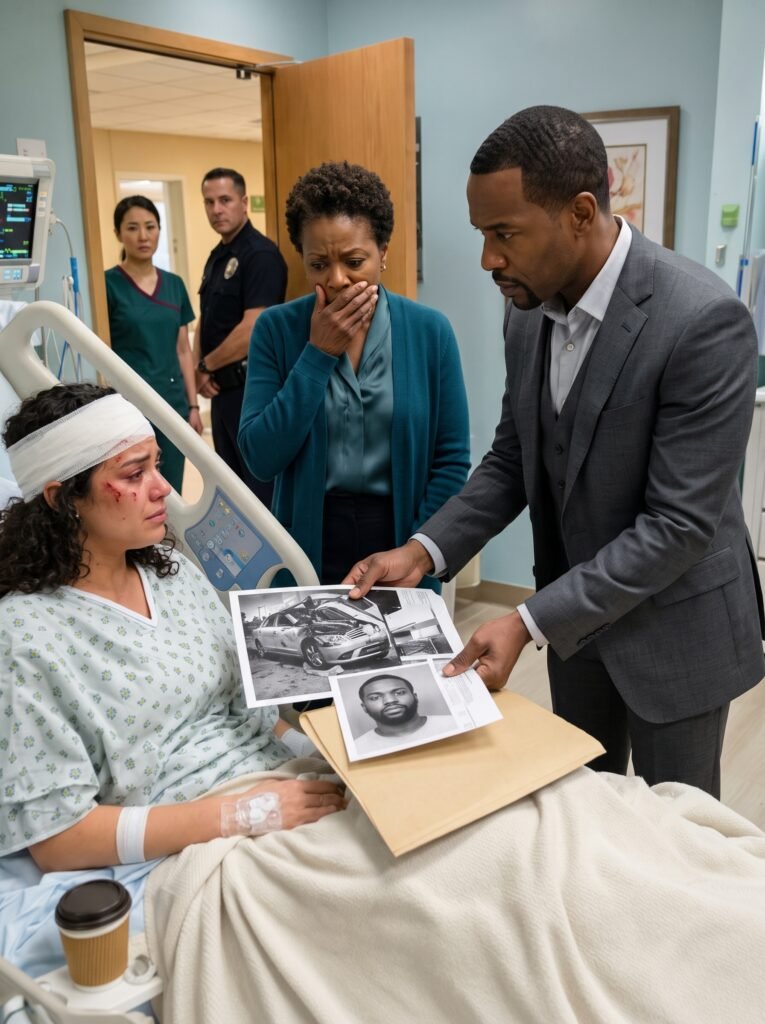
On the eighth day, at 9:18 a.m., Detective Rachel Ward came into Emily’s hospital room carrying a folder pressed flat against her chest.
Emily remembered the exact time because the wall clock was above the detective’s shoulder, and because grief sometimes sharpens the wrong details.
Detective Ward was in her forties, with tired eyes and a navy blazer that looked like it had spent too many hours in hospital chairs.
She was careful with Emily.
Not soft.
Careful.
“Emily,” she said, “we found the driver.”
At first, Emily felt nothing.
Then her hands started shaking so hard the blanket moved.
Her mother sat up in the chair.
“Who?” Emily asked.
“Cole Whitaker,” Detective Ward said. “Forty-two. Former commercial driver. No steady employment for the last year.”
“Was he drunk?”
Detective Ward paused.
“No.”
“High?”
“No.”
Emily stared at her.
The machines beside the bed kept making their small, steady sounds.
“Then why did he do it?”
Detective Ward looked toward the closed door.
Then she lowered her voice.
“He refused to talk at first. But this morning, he asked for a deal.”
Something cold opened behind Emily’s ribs.
“A deal for what?”
“For telling us who hired him.”
The room tilted.
Hired him.
Not an accident.
Not bad weather.
Not one reckless stranger on a wet road.
Paperwork had names.
Phones had timestamps.
Money left trails.
And suddenly Nathan’s death had edges sharp enough to hold.
Detective Ward opened the folder and placed a photograph on the blanket.
Cole Whitaker stared up at Emily with hollow eyes and a bruised cheek.
The booking timestamp was printed across the bottom edge.
7:42 A.M.
Emily looked at the face of the man who had driven a truck into her marriage and felt nothing as clean as hatred.
Hatred would have required energy.
She had only shock.
“He confessed?” her mother asked.
“He confessed to being behind the wheel,” Detective Ward said. “He also gave us enough to verify that someone contacted him before the crash. We have phone records. We have surveillance stills from the reception venue. We are still building the file.”
Building the file.
Emily almost laughed.
Her husband was in a funeral home, and somewhere adults were building a file.
Detective Ward reached back into the folder.
Emily’s mother sat straighter.
The detective placed a second photograph beside the first.
The air left Emily’s lungs before she even understood why.
It showed a woman standing outside the wedding venue, half-hidden near the valet stand, watching Nathan and Emily walk toward the car.
Her dress was dark.
Her hands were clasped in front of her.
Behind her, one small American flag hung beside the reception hall entrance, wet from the storm.
The photograph was grainy.
But the face was clear enough.
Clear enough that Emily’s mother stopped breathing.
Clear enough that Detective Ward touched the edge of the picture and said, very quietly, “Emily, I need you to look at her face before I say the name.”
Emily did look.
She looked until the woman in the photograph stopped being only a shape in the rain.
She looked until the posture became familiar.
The straight spine.
The tight mouth.
The hands folded like she was waiting for a hymn to begin.
“No,” Emily whispered.
Her mother gripped the bed rail.
Detective Ward slid one more paper from the folder.
It was a phone record, printed and highlighted.
The call was marked at 10:46 p.m.
Twenty-two minutes before the crash.
The number on the left belonged to Cole Whitaker.
The number on the right had been traced through subscriber records that morning.
Detective Ward turned the page toward Emily.
The name was Diane Mercer.
Nathan’s mother.
For a moment, Emily could not connect the words in her mind.
Diane Mercer had chosen the flowers for the rehearsal dinner.
Diane Mercer had corrected the seating chart twice.
Diane Mercer had kissed Nathan on the cheek before the ceremony and told him he looked handsome.
Diane Mercer had stood in a church hallway six months earlier and said, “I suppose if Nathan is happy, we all have to adjust.”
At the time, Emily had pretended not to hear the insult tucked inside the sentence.
Women like Diane knew how to make cruelty sound like manners.
They did not shout.
They adjusted a bracelet, lowered their voice, and left the knife where only you could feel it.
“Why?” Emily asked.
The word came out broken.
Detective Ward did not pretend to have a full answer.
“We are still investigating motive,” she said. “But Cole Whitaker says he was paid to scare Nathan. To force the car off the road. He claims he was told Nathan would be alone.”
Emily closed her eyes.
That detail was almost worse.
Not because it made Diane innocent.
Because it made her careless.
Nathan was her son.
Emily was his wife.
One dead.
One broken.
And someone had treated both outcomes like acceptable risk.
“Where is she?” Emily’s mother asked.
Detective Ward looked at her folder again.
“At home, as far as we know. We have officers preparing to speak with her. I came here first because you needed to know before this started moving.”
“Moving,” Emily repeated.
“Yes.”
The detective’s voice stayed low.
“Once we make contact, things may happen quickly. There may be calls. Statements. Family pressure. I need you not to answer anything from the Mercers without telling me.”
Emily thought of Paul’s shaking shoulders beside the window.
She thought of Diane standing at the foot of the bed, staring at Emily’s wedding ring.
She thought of Nathan’s face turned toward her in the ruined car.
“Does Paul know?” Emily asked.
Detective Ward did not answer fast enough.
That was an answer by itself.
Emily’s mother sat down slowly, as if her knees had forgotten what they were for.
“Emily,” she said. “Baby.”
But Emily was looking at the phone record.
One highlighted call.
Fifty-eight seconds.
That was all the time it took to turn a wedding night into a crime scene.
By noon, the hospital hallway outside Emily’s room had changed.
It was still the same hallway.
Same waxed floor.
Same nurses moving with clipboards.
Same vending machine humming by the waiting area.
But the air felt different.
Detective Ward had stationed an officer near the elevator.
Emily’s mother had stopped answering unknown numbers.
The hospital intake desk had been told not to release updates without permission.
At 12:17 p.m., Paul Mercer called Emily’s mother.
She let it go to voicemail.
At 12:19 p.m., Diane called.
Emily watched the phone vibrate on the tray table until it went still.
At 12:23 p.m., a text came through from Diane’s number.
Please call me before you listen to anyone.
Emily read it once.
Then again.
Before you listen to anyone.
Not, Are you okay?
Not, I love my son.
Not, I swear I did not do this.
Before you listen to anyone.
Control always announces itself as concern when it is running out of room.
Emily handed the phone to Detective Ward.
The detective photographed the screen, logged the time, and asked Emily not to respond.
At 1:04 p.m., Detective Ward returned with an update.
Diane had agreed to come in for questioning.
Voluntarily, at first.
Paul had driven her.
Emily pictured the two of them in their family SUV, Diane in the passenger seat with her purse in her lap, Paul gripping the wheel, both of them saying whatever people say when a life cannot be repaired by conversation.
At 1:31 p.m., Detective Ward received another call in the hallway.
Emily could not hear the words, only the detective’s tone.
It changed.
Not louder.
Flatter.
When she came back in, her face had hardened.
“Emily,” she said, “Diane has asked for an attorney.”
Emily nodded.
She did not know what else to do.
“Paul made a statement,” Detective Ward added.
Emily looked up.
“What kind of statement?”
The detective hesitated.
“He says he did not know about the call to Cole Whitaker. But he did know Diane had been trying to stop the marriage.”
Emily’s mother made a sharp sound.
“Stop it how?”
Detective Ward opened another page.
There were printed emails.
Messages.
One bank withdrawal.
“She believed Nathan had changed his will,” the detective said.
Emily stared.
“He did not have money like that.”
“Not money,” Detective Ward said. “A life insurance policy through work. And the house he bought before you met. He updated beneficiary paperwork two weeks before the wedding.”
Emily remembered that errand.
Nathan had come home with takeout and a manila envelope.
He had kissed the top of her head and said, “Boring grown-up stuff is done. We are officially responsible people.”
She had laughed.
She had not asked what forms he meant.
Trust lives in small omissions too.
You do not ask because you believe you will have years to learn the boring details.
“He made me beneficiary?” Emily asked.
Detective Ward’s expression softened by one degree.
“Yes.”
Emily turned her face toward the window.
Rain blurred the glass.
Nathan had loved her in paperwork too.
That hurt in a place morphine could not reach.
Diane’s version, when it finally came through her attorney, was polished.
She said she had been worried about Nathan.
She said she believed Emily was rushing him.
She said Cole Whitaker had been hired only to frighten him into returning home, to make him think clearly before making permanent decisions.
She said she never meant for anyone to die.
People who set fires always claim they only wanted warmth once the house is gone.
Cole Whitaker’s version was uglier and simpler.
He had been paid cash.
He had been given the reception venue address.
He had been told Nathan would leave around 10:30.
He had been told to make it look like road rage.
He had been told not to get caught.
He had not been told Emily would be in the car, or so he said.
Emily did not care whether that part was true.
Nathan had been in the car.
That was enough.
The funeral happened under a gray sky that looked too much like the crash.
Emily attended in a wheelchair because standing for more than a minute made her ribs burn.
Her mother stayed behind her with both hands on the handles.
Paul Mercer looked twenty years older.
Diane was not there.
Her attorney had advised against it.
Or maybe the county had.
Emily did not ask.
At the service, Nathan’s best man talked about his terrible dancing.
A cousin told a story about Nathan fixing a broken porch step without being asked.
Emily held her wedding ring so tightly that the edge pressed into her palm.
When it was her turn, she did not give a long speech.
She could not.
She said only, “Nathan made ordinary things feel safe. That was his gift.”
Then she sat down before her body gave out.
Paul approached her afterward.
For a moment, Emily’s mother moved as if she might block him.
Emily shook her head.
Paul stopped a few feet away.
His eyes were raw.
“I didn’t know,” he said.
Emily looked at him.
She wanted to believe him.
She also knew wanting something does not make it clean.
“Did you know she hated me that much?” Emily asked.
Paul’s face broke.
“I knew she thought you were taking him away. I thought it was mother nonsense. I thought she would calm down after the wedding.”
Emily almost closed her eyes.
After the wedding.
People always postpone hard truths until after something.
After the holidays.
After the baby.
After the wedding.
Sometimes after is too late.
The case moved slowly after that, because real consequences rarely arrive with the speed grief demands.
There were hearings.
Continuances.
Statements.
Evidence logs.
Phone records.
Surveillance stills.
A cash withdrawal that Diane could not explain without making herself look worse.
Cole Whitaker accepted a deal first.
He testified that Diane had contacted him through an old acquaintance, paid him in cash, and described Nathan’s car.
He admitted following them from the reception hall.
He admitted ramming the car.
He admitted leaving the scene.
When asked why he did not call for help, he looked at the table and said, “I panicked.”
Emily sat in the courtroom with her mother’s hand over hers and thought about the turn signal clicking in the rain.
Panic had a sound.
So did cowardice.
They were not the same.
Diane’s attorney tried to make her small.
A grieving mother.
An anxious woman.
A parent who made a terrible mistake while trying to protect her son.
But Detective Ward’s file had grown thick by then.
There were printed messages where Diane called Emily temporary.
There was an email to Paul saying Nathan needed to be reminded where his loyalty belonged.
There was the beneficiary paperwork Nathan had filed two weeks before the wedding.
There was the 10:46 p.m. call.
There was the surveillance photo of Diane outside the venue, half-hidden near the valet stand, watching her son walk toward the car with his bride.
That photo changed the room every time it appeared on the screen.
Not because it was the worst evidence.
Because it showed choice.
Diane had been there.
She had watched them leave.
She had known Emily was in the passenger seat.
When the prosecutor asked about that, Diane’s face moved for the first time.
Her lawyer objected.
The judge overruled.
The prosecutor asked again.
“Mrs. Mercer, when you saw Emily get into the car with Nathan, did you call Cole Whitaker and tell him to stop?”
Diane looked at the table.
She did not answer at first.
Then she said, “There wasn’t time.”
Emily felt her mother inhale beside her.
There is always time to stop harm if you are still more attached to the person than the plan.
Diane had chosen the plan.
The trial did not bring Nathan back.
Nothing did.
Not the guilty verdict.
Not the sentence.
Not Cole Whitaker’s apology letter, which Emily never opened.
Not Diane’s final statement, where she cried and said she had lost her son too.
Emily did not dispute that.
Diane had lost him.
But Nathan had lost everything.
There are losses you suffer, and there are losses you cause.
They do not belong in the same sentence.
Months later, after physical therapy had taught Emily how to walk without flinching, she went back to the road outside Mount Pleasant.
Her mother drove.
They did not bring flowers.
Emily did not want lilies anywhere near that place.
They parked on the shoulder in daylight.
The ditch was lower than she remembered.
The pines looked ordinary.
Cars passed with their tires whispering over damp pavement.
For a long time, Emily stood there with one hand on the door of her mother’s SUV and the other pressed over her ribs.
She thought she would feel Nathan in the road.
She did not.
She felt him in other places.
In the spare key still on her ring.
In the grocery store parking lot where he once changed her tire.
In the coffee order he knew by heart.
In the house paperwork that had quietly named her as someone he trusted with his future.
Nathan was not in the violence that took him.
He was in the ordinary things he had made safe.
That was what Diane had never understood.
Love is not possession.
Love is not control.
Love is not keeping someone close by making the world outside your grip dangerous.
Love is receipts, spare keys, remembered coffee orders, and someone standing in the cold because your car will not start.
Emily stayed by the road until the sky cleared.
Then she got back in the car.
Her mother looked over at her.
“Home?” she asked.
Emily watched the wet pavement shine under the weak sun.
For the first time since the wedding night, the word did not feel impossible.
“Home,” she said.
And when they drove away, no headlights followed.