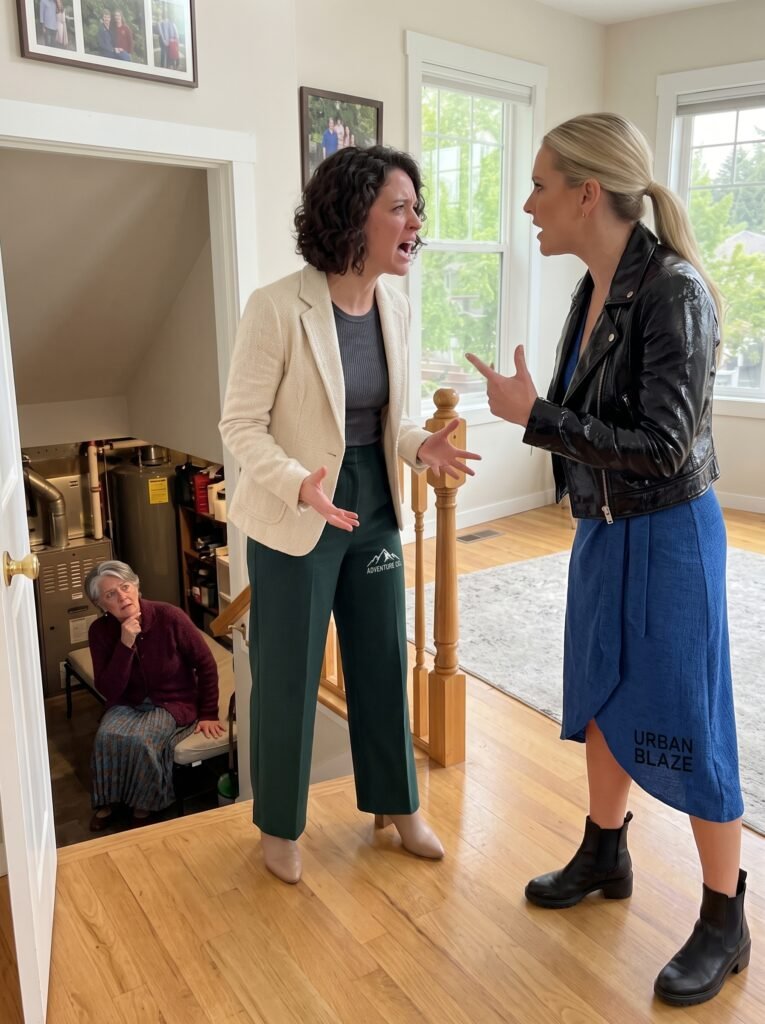
“After six years abroad, I came home to surprise Mom in the house I bought for her. My sister answered the door wearing Mom’s jewelry and casually told me Mom now slept in the basement because the upstairs rooms were rented out. I smiled and said, “You just made this very easy.” By 9 p.m., two men were at the door.
After six years working in Singapore, I landed in Seattle with one suitcase, a carry-on, and the stupid grin of a daughter who thought she was about to give her mother the surprise of her life.
I rang the bell.
My younger sister, Vanessa, opened the door wearing Mom’s pearl earrings and the gold bracelet Dad gave her on their twenty-fifth anniversary.
“Oh,” she said. “You’re back.”
Not hello. Not welcome home.
I looked past her. Three unfamiliar cars sat in the driveway. A man in gym clothes walked across the upstairs hallway carrying a towel.
“Where’s Mom?”
Vanessa folded her arms. “Basement.”
I thought I had misheard.
“What?”
“She sleeps downstairs now. The upstairs rooms are for people who pay.”
The basement door was beside the kitchen. I went down without taking off my shoes.
Mom was asleep on a narrow cot near the furnace, wrapped in a winter coat even though it was June. There was no proper bedroom, just storage shelves, detergent boxes, and an old lamp. Her prescription bottles sat on a folding chair.
Her face looked thinner than it had on our video calls. The camera had always been angled close, never showing the room. I suddenly understood why Vanessa had insisted Mom was “too tired” whenever I asked her to walk around the house with the phone.
When she woke and saw me, she started crying before she said my name.
Vanessa came down behind me. “Don’t make this dramatic. She agreed.”
Mom stared at the floor.
I asked, “Agreed to what?”
Vanessa sighed. “I manage the property. She needs supervision. The renters cover expenses.”
“The mortgage is paid from my account.”
“Utilities aren’t free.”
I looked around again. No smoke detector near the cot. No window large enough for emergency escape. A space heater plugged into an overloaded extension cord.
Then I noticed a stack of envelopes on a shelf, all addressed to me, unopened and hidden behind paint cans.
My smile came back.
Not because anything was funny.
Because Vanessa had finally made one mistake big enough to prove everything.
“You just made this very easy,” I said.
At 7:12 p.m., I photographed every room. At 7:35, I called the attorney who handled the purchase. At 8:10, I sent him the deed, bank records, and pictures.
At exactly 9:00, two men knocked on the front door.
Vanessa opened it.
One held a badge.
The other held a red notice from the city.
The man with the badge was a detective from Adult Protective Services. The one beside him, holding the red notice, was a code enforcement officer from the city.
Vanessa’s face went through three expressions in under five seconds: confusion, denial, and finally, when she saw me standing behind them with my phone still in hand, something close to panic.
“There’s been a report of elder neglect at this address,” the detective said, glancing past her into the house. “And unpermitted rental units operating without inspection or occupancy certificates.”
“This is a mistake,” Vanessa said quickly. “My mother lives here comfortably. My sister is exaggerating—”
“I have photographs,” I said, stepping forward. “Timestamped an hour ago. My mother sleeping on a cot next to a furnace, no smoke detector, an overloaded extension cord feeding a space heater in June, and prescription bottles left unsecured on a folding chair. I also have six months of unopened mail addressed to me, hidden behind paint cans, which I believe includes bank statements and property notices my sister intercepted.”
The code enforcement officer was already walking past her toward the stairs, radio in hand, calling for a second inspector.
“You can’t just come in here—” Vanessa started.
“Ma’am,” the detective said evenly, “this is your sister’s registered property. She has legal ownership and she’s invited us in. You don’t have standing to refuse entry.”
I watched something in Vanessa collapse behind her eyes, the same look she used to get as a kid when she got caught rearranging the truth to fit whatever story kept her out of trouble, except this time there was no parent left to smooth it over for her.
Upstairs, the man in gym clothes I’d seen earlier was already gathering his things, along with two other tenants who emerged from rooms I didn’t even know had been converted into rentals. None of them, it turned out, had signed anything resembling a proper lease. All three had been paying Vanessa in cash, off the books, for rooms in a house she didn’t own.
While the officers worked, I went back down to the basement and sat beside my mother’s cot. She hadn’t moved from where she sat crying quietly, her hands wrapped around the same wool coat she’d been sleeping under.
“I didn’t want to tell you,” she said. “You were so far away. I didn’t want you to worry.”
“Mom, this isn’t something you protect me from,” I said, taking her cold hands in mine. “This is something I should have caught sooner. I trusted the calls. I trusted her.”
“She said it was temporary,” Mom whispered. “Just until she got back on her feet. Then it became the rule instead of the exception, and I didn’t know how to tell you without it sounding like I was choosing sides.”
“There are no sides,” I said. “There’s you, and there’s everyone who was supposed to take care of you and didn’t.”
Upstairs, I could hear Vanessa’s voice rising, first pleading, then sharp, as the code enforcement officer explained that operating unpermitted rentals in a residential property came with fines that would land squarely on whoever had been collecting the rent, not on the deed holder three states away, if she wasn’t a registered occupant.
“Ma’am, according to the property records, you’re not listed as a resident here at all,” I heard him say. “You’ll need to explain that to your sister’s attorney.”
I looked down at the stack of unopened envelopes I’d carried down with me from the shelf, still sealed, my name on every one of them, and felt something settle in my chest that wasn’t quite anger anymore. It was clarity.
“Mom,” I said gently, “I’m going to open these. All of them. I need you to tell me everything you know, starting from the day I left for Singapore.”
She nodded, wiping her face, and for the first time since I’d walked through that door, she looked less like a woman hiding in a basement and more like someone finally ready to stop protecting the person who’d put her there.
I opened the envelopes at the kitchen table while the officers finished their inspection downstairs, my mother sitting beside me wrapped in a blanket someone from Adult Protective Services had given her, finally somewhere warmer than a cot by a furnace.
The first envelope was a bank statement, six months old, showing a secondary account I hadn’t set up. My name was on it, but so was Vanessa’s, added as a joint holder with a signature that looked like mine but wasn’t quite right if you looked closely enough, the loop on the “y” too tight, the slant leaning the wrong direction.
“Mom,” I said slowly, “did you know about this account?”
She shook her head. “She told me it was for household expenses. I never saw the statements.”
The second envelope was worse. A notice from the mortgage company, addressed to me, warning that a payment had been returned for insufficient funds two months earlier, an automatic transfer Vanessa had apparently rerouted from the account I funded into the joint one she controlled, skimming a portion before letting the rest go through late.
By the fourth envelope, I stopped being surprised and started taking pictures of each page before setting it aside for the attorney.
Rental deposits, three of them, each for a thousand dollars, deposited into the joint account under Vanessa’s control. Cash payment logs, handwritten, tracking six months of rent collected from tenants who believed they were renting legally. A receipt for a leased car, financed using the house as informal collateral in a private loan agreement Vanessa had signed with a family friend, using my mother’s name without her knowledge.
“She told the loan broker Mom co-owned the house,” I said quietly, reading the document twice to make sure I understood it correctly. “She used Mom’s identity to secure a private loan for a car.”
My mother’s hand went to her mouth. “I never signed anything like that.”
“I know,” I said. “The signature doesn’t match yours either.”
The detective came upstairs just as I finished laying out the last of it, and when I explained what we’d found, forged signatures, diverted mortgage payments, unauthorized loans taken out in my mother’s name, his expression shifted from procedural to something more serious.
“This isn’t just neglect anymore,” he said. “This is looking like fraud and identity misuse. You’ll want to file a formal report, and I’d recommend contacting your bank immediately to freeze that joint account before anything else moves through it.”
I called the bank that night, sitting at the kitchen table with my mother finally warm beside me, and had the account frozen within the hour, along with a fraud alert placed on both our names.
Vanessa, meanwhile, sat on the porch steps outside under the watch of the second officer, no longer arguing, no longer performing outrage, just staring at the driveway where the three renters’ cars had already begun pulling away, along with any income she’d built off a house that was never hers to manage.
When I finally stepped outside to speak to her, she looked up at me with an expression I hadn’t seen since we were kids, not defiance, but the beginning of real fear.
“I was going to pay it back,” she said. “Once I got the rentals stable.”
“You forged Mom’s signature on a car loan,” I said. “You didn’t forget to mention a detail. You built an entire structure on lying to both of us.”
“She let me,” Vanessa said, gesturing weakly toward the house. “She never said no.”
“She’s seventy-one years old and sleeping next to a furnace,” I said. “She didn’t let you do anything. She trusted you, the same way I did from six thousand miles away, and you used both of our trust as a business model.”
I didn’t wait for her response. I walked back inside, sat down beside my mother, and began making a list, not of grievances, but of what came next: a locksmith for the morning, a proper bedroom upstairs cleared out that same week, a fraud attorney already documenting everything for a formal case, and a plane ticket I would not be using anytime soon, because for the first time in six years, home wasn’t something I was visiting.
The formal charges took three weeks to process, but the changes at home started that very first night.
I had the locksmith out by 8 a.m., new locks on every door, including the basement, which I’d already begun clearing out myself before the sun came up, hauling detergent boxes and paint cans to the garage, tearing the cot away from the wall by the furnace and burning the overloaded extension cord in the trash where it belonged.
By that afternoon, movers I’d hired arrived to bring my mother’s things out of storage, the real bed she hadn’t slept in for months, her dresser, the small collection of photographs Vanessa had apparently boxed up “to make room” for paying tenants. I set her up in the largest room upstairs, the one with the window that actually opened, the one with morning light instead of a single hanging bulb.
She stood in the doorway for a long time before she finally stepped inside.
“This is really mine?” she asked, like she needed to hear it confirmed out loud.
“It always was,” I said. “You just weren’t allowed to remember that for a while.”
The fraud attorney moved quickly once the bank’s records came back. The forged signature on the car loan matched a pattern the handwriting analyst had seen before, distinct enough that Vanessa couldn’t argue her way around it once it was laid beside an authentic sample of my mother’s signature from an old medical form. The joint account, the diverted mortgage payments, the unlicensed rental income, all of it built a case that moved well beyond a family dispute and into criminal territory.
Vanessa was charged with identity theft, forgery, and fraud. She tried, through her own attorney, to frame it as “helping manage” a struggling household, but the unopened envelopes hidden behind paint cans told a different story, one where she’d deliberately kept both my mother and me in the dark for as long as she could keep collecting.
She didn’t go to prison. A plea agreement gave her probation, mandatory restitution, and a permanent record that would follow her through every background check for the rest of her life. But the house, the money, and any illusion of control she’d built over the past year were gone the moment those two men knocked on the door at 9 p.m.
My mother didn’t attend the final hearing. She said she’d already lived through enough of that story in the basement and didn’t need to watch the ending in a courtroom too.
Instead, on the day the case closed, I took her to the little Italian place she used to love before I left for Singapore, the one Vanessa always claimed was “too expensive to bother with anymore.” We sat by the window, and for the first time in longer than either of us wanted to admit, she laughed, really laughed, the way she used to before her voice on our video calls started sounding careful and small.
“I keep waiting for something to feel too good to be true,” she admitted over dessert.
“It’s not,” I said. “It’s just what should have been happening the whole time.”
I didn’t go back to Singapore. I transferred my role to the Seattle office, close enough to make sure no one would ever again mistake distance for permission to treat my mother as an inconvenience to be managed instead of a person to be cared for.