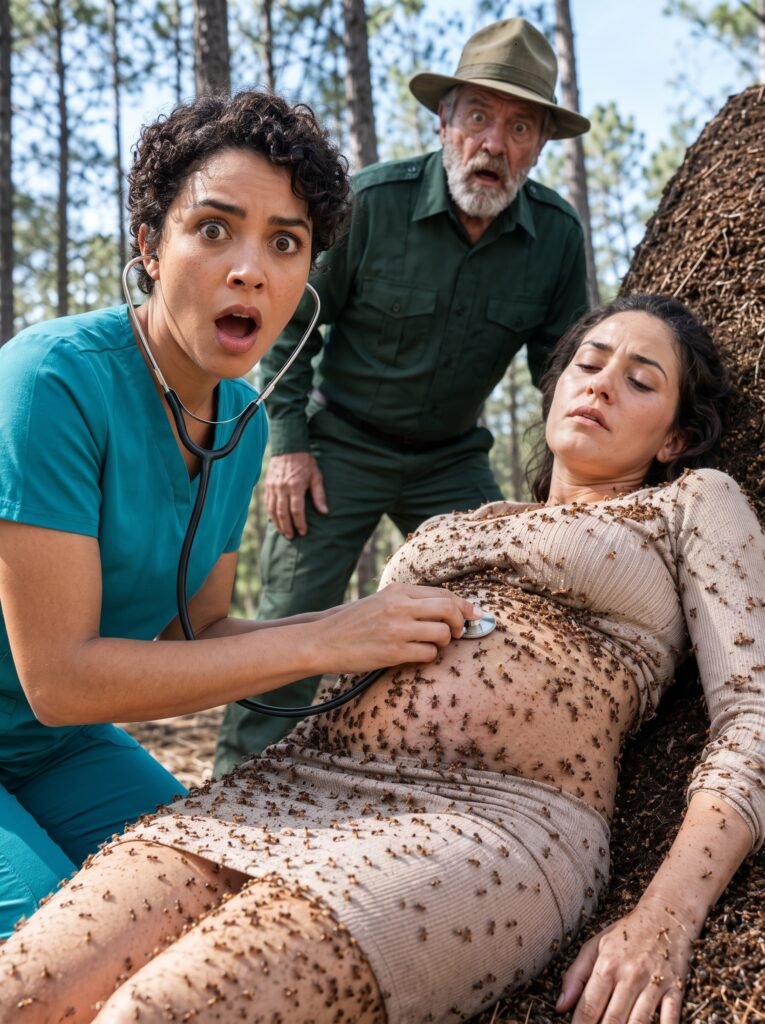
Mariana’s eyes were unfocused at first, fluttering against the gray morning light filtering through the pines, her lips moving without sound.
“Don’t move,” Lucía said gently, kneeling beside her, one hand still resting near the warm curve of her abdomen. “You’re safe now. We’re going to get you help.”
Ernesto was already on the radio, calling for an emergency evacuation team and a helicopter transport to the regional hospital in Guadalajara, his voice tight with urgency but steady from two decades of practice.
“She’s hypothermic,” Lucía told him, checking Mariana’s pulse at her wrist, faint but present. “Core temperature’s dangerously low. But the fetal heartbeat is strong. I don’t understand how, after two nights out here, but it’s strong.”
Mariana’s mouth finally formed a word.
“Cold,” she whispered. “So cold.”
“I know,” Lucía said. “We’re going to warm you up right now.”
She stripped off her own jacket and laid it over Mariana’s exposed leg, careful not to disturb the strange, dense layer of pine needles and bark fragments the ants had built along her abdomen, something she still couldn’t fully explain but didn’t dare interfere with until paramedics could assess it properly.
Ernesto crouched on Mariana’s other side. “Can you tell us what happened? How long have you been down here?”
“Two nights,” Mariana breathed. “I fell. I couldn’t… I couldn’t climb back up.”
“Your husband,” Ernesto said carefully. “He said you two argued.”
Something shifted in Mariana’s expression, exhaustion giving way, just barely, to something sharper.
“He told me to handle it alone,” she said. “I didn’t think he meant it like this.”
Lucía exchanged a look with her husband. Twenty-two years of mountain rescues had taught Ernesto to recognize when a story didn’t add up, and a husband who waited nearly two full days to report his pregnant wife missing, after telling her to leave and “handle it alone,” was already sitting heavy and wrong in his gut.
The sound of rotor blades finally broke through the trees above them, and within minutes a rescue harness was being lowered through a gap in the canopy. As the paramedics carefully lifted Mariana, still wrapped in blankets, still cradling the small mound of her belly with one protective hand, Ernesto looked back at the anthill one last time.
The ants had already begun dispersing, retreating from the space where Mariana had lain for nearly forty-eight hours, as if their strange, instinctual work — building an insulating barrier of dry organic material, layer after layer, exactly where her body needed it most — had simply run its course.
He didn’t have an explanation for what he’d seen. He wasn’t sure science would ever fully give him one. But he knew, watching the helicopter lift Mariana toward the hospital that would keep her and her baby alive, that he would never forget it.
Back at the ranger station an hour later, his phone buzzed. A text from the local police liaison, forwarding a message Adrián had sent the night before, one he claimed proved he wasn’t at fault.
Ernesto opened it and read the words that would end up mattering far more than Adrián ever expected them to:
“You said you could handle it alone.”
Sent eighteen hours after Mariana had gone missing. Not a search request. Not a call for help.
A justification.
The hospital in Guadalajara moved fast once the helicopter landed, a full obstetric team waiting at the emergency entrance, warming blankets and IV fluids ready before Mariana had even been wheeled through the doors.
Lucía rode along in the transport, unwilling to leave her side, and stayed in the hallway outside the maternal-fetal monitoring unit for the next six hours, watching through the glass as doctors worked to stabilize both mother and baby.
By early evening, the obstetrician came out to update her, since Mariana had listed no other emergency contact who’d actually shown up.
“She’s severely dehydrated and hypothermic, but stable,” the doctor said. “The baby’s heart rate is strong and consistent. Given what she survived out there, this is honestly remarkable. Whatever kept her body temperature regulated in that specific area probably made the difference between a stable fetus and a very different outcome.”
“The ants,” Lucía said quietly.
The doctor gave her a measured look, clearly still processing the report Ernesto had radioed in. “I’ve read about behavior like that in isolated cases, insects responding to heat gradients from the body, but I’ve never seen anything documented quite like what you’re describing. We’ll be studying it, honestly, once she’s stable enough to talk it through.”
When Mariana was finally lucid enough for visitors, Lucía sat beside her bed, watching her hand rest instinctively over the blanket covering her stomach, the same protective motion she must have made a hundred times crawling through the dark, injured and alone.
“Has anyone called Adrián?” Mariana asked, her voice still hoarse.
Lucía hesitated. “The police have. He knows you were found.”
“Did he ask about the baby?”
The question hung there long enough that Mariana already had her answer before Lucía said anything.
“He asked whether you were going to press charges for the delayed report,” Lucía said gently. “Mariana, I have to tell you something. The investigators found a text message he sent before you were rescued. It wasn’t a message asking anyone for help.”
She showed her the message on her phone, the one Ernesto had forwarded that morning.
“You said you could handle it alone.”
Mariana stared at it for a long moment, then closed her eyes, not in shock, but in something closer to confirmation, like a piece of a puzzle she’d already suspected sliding quietly into place.
“He didn’t report me missing because he was worried,” she said. “He reported me because someone else must have asked him where I was.”
“A neighbor,” Lucía confirmed. “She called your mother when you didn’t answer for two days. Your mother’s the one who called the police. Adrián only made an official report after officers showed up at his door asking questions.”
Mariana’s hand tightened over her stomach.
“I want to see the case file,” she said. “Everything. The timeline, the messages, all of it.”
“Are you sure? You need to rest—”
“I’ve spent two nights on a mountainside because a man decided my pregnancy was inconvenient to his life,” Mariana said, her voice steadier now than it had been since they found her. “I’m not going to spend whatever comes next protecting him from the consequences of that.”
Lucía nodded and reached for her phone to call the lead investigator.
Three days later, once Mariana was strong enough to give a formal statement, the detective assigned to the case sat beside her hospital bed with a folder thick enough that it clearly held more than a simple missing-persons timeline.
“Before we start,” the detective said, “I need to tell you something. Cell tower data shows your husband’s phone pinged near the trailhead the morning you disappeared. Not the night you argued. The morning after.”
Mariana went very still.
“He knew where I was,” she said slowly. “He knew, and he didn’t tell anyone.”
The detective nodded. “We’re going to need you to walk us through everything, starting with the argument. Because right now, this isn’t looking like a delayed report anymore.”
Mariana sat up straighter in the hospital bed, ignoring the ache still radiating through her ribs and knees, and told the detective everything, starting with the fight two nights before she disappeared.
“He said if I wanted the baby, I could handle it alone,” she said. “I packed a bag and left to clear my head. I was going to hike to the waterfall, sit for a while, and come back once I calmed down. I never planned to be gone more than a few hours.”
“And the fall?”
“The trail was wet. I slipped near the ridge and hit my head on a rock. After that, I don’t remember much, just crawling, trying to find somewhere out of the wind.”
The detective made notes, then set his pen down. “Here’s what doesn’t add up on his side. Cell tower data puts his phone near the trailhead parking lot the next morning, eleven hours before he ever called anyone for help. We pulled traffic camera footage from the gas station down the road. His truck is on it, timestamped the same morning.”
Mariana’s jaw tightened. “He went looking for me himself.”
“It appears that way. And when he couldn’t find you quickly, instead of calling search and rescue, he went home.” The detective flipped a page. “We found messages between him and a coworker from that same day. He wrote, quote, ‘She’ll come back when she cools off. Not dealing with this today.'”
Lucía, standing by the window, felt her stomach turn.
“He knew I could be hurt out there,” Mariana said quietly. “And he decided it was easier to wait.”
“Given the timeline, and the fact that he had direct knowledge of your last known location and chose not to report it for nearly thirty-six hours afterward,” the detective said, “the district attorney’s office is reviewing this for potential criminal negligence charges. That’s separate from anything civil you may choose to pursue.”
Mariana was quiet for a long moment, staring at the small monitor beside her bed, the steady rhythm of her baby’s heartbeat filling the silence.
“I want to press charges,” she finally said. “Not out of anger. Because if I don’t, the next time he decides someone is inconvenient, there won’t be an anthill there to save them.”
The case moved through the following months alongside Mariana’s recovery. Adrián was charged with criminal negligence for the delayed report, and though his lawyer argued it wasn’t a legal obligation to search before calling authorities, the timeline, the messages, and the testimony from Mariana’s neighbor and mother painted too clear a picture for the charges to be dismissed. He accepted a plea deal that included mandatory community service, a formal restraining order at Mariana’s request, and full financial responsibility for prenatal and postnatal care, regardless of custody arrangements decided later.
Mariana gave birth eight weeks later to a healthy baby girl, two weeks early but strong, the same steady heartbeat the doctors had first detected beneath a blanket of pine needles and ants on a cold mountainside.
She named her Esperanza.
Hope.
Ernesto and Lucía visited the hospital the day she was born, and when Lucía held the baby for the first time, she thought back to that strange, inexplicable layer of insulation built with such precision around Mariana’s abdomen, something science still hadn’t fully explained.
“Some people will say it was just instinct,” Ernesto said, watching his wife cradle the newborn. “Ants responding to heat, nothing more.”
“Maybe,” Lucía said. “But I’ve worked in that clinic for fifteen years, and I’ve never seen anything protect a mother and child so precisely, in the one place it mattered most, for two nights straight, without a single bite.”
Mariana, listening from the bed, reached for her daughter and held her close.
“I don’t need it explained,” she said softly. “I just know we’re both here. And that’s enough.”
Months later, Mariana moved closer to her mother, rebuilt her life around a job she loved and a daughter who filled it with more purpose than she’d ever known, and though the mountain never fully left her memory, she visited it once, a year after, standing quietly near the spot where she’d been found.
She didn’t leave flowers. She didn’t need to.
She simply whispered a thank-you to a mountain that had, in its own strange way, refused to let her daughter go.