While the emergency call was still being made from Lily Carter’s classroom, the phone in the principal’s office rang.
The principal had not yet seen Lily on the floor.
He had not heard the thin, nearly vanished breaths that had frightened a room full of second-graders.
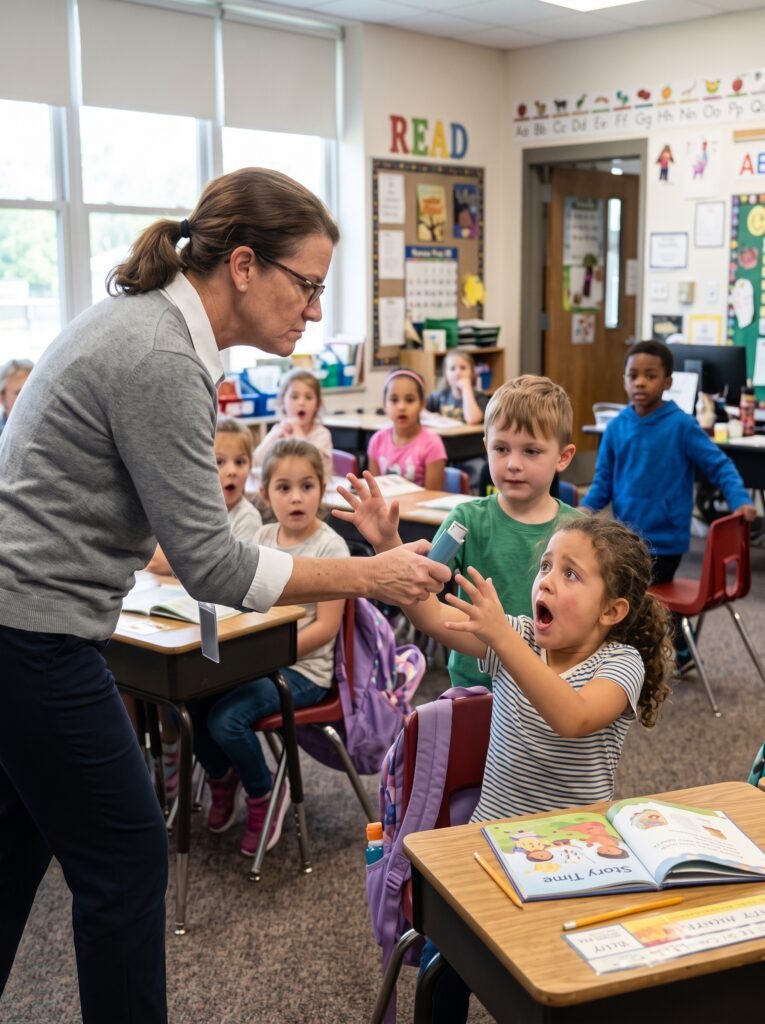
He had not seen the blue inhaler still in Mrs. Grayson’s hand after Lily had asked for it, reached for it, and then collapsed without being able to speak.
What he knew was only that the nurse had requested an ambulance and that something serious was happening down the hall.
Then he answered the phone.
Lily’s mother was on the other end.
She had received the school’s emergency notification moments earlier, but she was not calling simply to ask whether her daughter was okay.
Her first question was sharper.
“Did Lily have her inhaler?”
The principal hesitated.
He said the nurse was with her now.
That was not what Lily’s mother had asked.
“She carries it herself,” she said. “Her asthma plan says she can use it immediately when symptoms start. You have the signed copy. I have your acknowledgment that you received it.”
The principal looked toward the hallway.
Until that moment, he had been treating the situation as a medical emergency that had happened at school.
Now he understood there might be another question entirely.
Had the emergency become worse because an adult had blocked the treatment Lily was specifically allowed to use?
He told Lily’s mother that he was going to the classroom himself.
She was already on her way.
Down the hall, Rebecca Owens was kneeling beside Lily while another staff member relayed information to the 911 dispatcher.
The nurse had taken the rescue inhaler from Mrs. Grayson and was following the emergency instructions already on file.
Lily was conscious, but she was exhausted from fighting for each breath.
Her small hands no longer had the strength they had shown when she had braced herself against the desk.
Rebecca kept her voice steady and short.
She did not ask Lily to explain what happened.
She did not ask her to defend why she needed medication.
She focused on breathing and getting emergency help there as quickly as possible.
Ethan Morales remained near the doorway.
The adrenaline that had carried him through the hallway was beginning to drain out of him, and he suddenly seemed like what he was: a frightened 7-year-old who had broken a classroom rule because another child was in trouble.
When the principal arrived, he first saw Lily on the floor.
Then he saw Rebecca beside her.
Then he saw the inhaler.
His eyes shifted to Mrs. Grayson.
“What happened?”
Mrs. Grayson started with the part she could explain most easily.
Lily had complained that she could not breathe.
She had become upset.
The class had become distracted.
Mrs. Grayson said she believed Lily was panicking and needed to slow her breathing.
Rebecca looked up.
“Did she ask for this?” she said, holding the inhaler.
Mrs. Grayson paused before answering.
“Yes.”
“And did you take it from her?”
Another pause.
“I was trying to calm her down.”
The principal did not respond immediately.
The answer mattered because Lily’s emergency action plan was not written around whether a teacher believed her symptoms were serious enough.
It existed so that the adults responsible for her would not have to improvise during exactly this kind of moment.
The sound of approaching footsteps broke the exchange.
Emergency responders entered the room with equipment, and the children were moved away from the immediate area.
For the first time since Lily had raised her hand, the adults around her were working from the same assumption: her breathing difficulty was real, urgent, and not something she needed to prove.
Ethan was guided into the hallway with the rest of the class.
He looked back once.
Rebecca was still beside Lily.
The inhaler was no longer above anyone’s head.
It was where it should have been from the beginning: part of Lily’s care.
The principal asked another staff member to stay with the children while he followed the emergency response toward the front of the building.
He also asked for Lily’s health file.
That request changed the tone of what came next.
The file contained the action plan Lily’s mother had mentioned on the phone.
It carried the required medical information and the instruction that Lily could have access to her rescue inhaler when symptoms appeared.
There was no vague language telling staff to wait until she collapsed.
There was no instruction saying the medication should be withheld if an adult thought she was anxious.
There was no requirement that a 7-year-old persuade a teacher before she was allowed to follow her established plan.
And attached to the file was the school’s record that the plan had been received.
The principal read it twice.
Then he asked one question.
“Was Mrs. Grayson informed?”
Rebecca’s expression tightened.
The health information relevant to Lily’s classroom had been communicated at the beginning of the school year, she said.
That did not yet answer every question about what Mrs. Grayson remembered, what she understood, or what training she had retained.
But it made one thing harder to dismiss.
Lily’s asthma was not new information.
The school had known.
The teacher had known enough to recognize the inhaler as Lily’s.
And Lily herself had known exactly what she needed before she became unable to speak.
The ambulance left with Lily, and her mother arrived in time to go with her.
She did not stop to confront Mrs. Grayson in the hallway.
She did not yell at the principal.
She took one look at her daughter, climbed in beside her, and went where Lily needed her most.
The confrontation could wait.
Breathing could not.
At the hospital, Lily’s condition gradually stabilized with treatment and observation.
Her mother sat beside the bed with the blue inhaler on the small tray nearby.
For several hours, that ordinary piece of plastic carried a weight it had never carried before.
It was the thing Lily had asked for when she could still talk.
It was the thing an adult had taken away.
It was also the thing that now made her mother keep replaying one question.
How long had Lily been trying to tell people she was in trouble before someone finally listened?
Lily did not give a dramatic answer when her mother gently asked what happened.
She told it the way children often tell frightening things: in pieces.
She had been reading.
Her chest started feeling tight.
She heard the whistle when she breathed.
She raised her hand.
Mrs. Grayson did not believe she needed the inhaler.
Lily tried to get it back.
Then breathing got harder.
Then she could not make words anymore.
Then she remembered being on the floor.
Her mother held her hand through the whole account.
When Lily reached the part about Ethan leaving the classroom, she stopped.
“He ran even when she told him not to,” Lily whispered.
Her mother squeezed her fingers.
“He got help.”
Lily nodded.
That mattered to her.
Not because Ethan had done something grand, but because someone her own age had looked at her and believed what he was seeing.
Back at the school, the principal began building a timeline.
He spoke separately with Rebecca, Mrs. Grayson, the staff member who had placed the emergency call, and the adults responsible for supervising the children after they left the classroom.
He did not interview the second-graders as a group or turn the hallway into a spectacle.
The purpose was narrower.
He needed to establish what happened between Lily’s first request for help and the moment the nurse reached her.
The most difficult part of the timeline was also the simplest.
Lily had reported trouble breathing before she collapsed.
She had identified her rescue medication.
She had physically retrieved it.
Mrs. Grayson had taken possession of it.
Lily had asked for it again.
Her condition had visibly worsened.
A classmate had warned the teacher that Lily looked very sick.
The classmate had been ordered to sit down.
Lily had then lost the ability to speak and fallen.
Only after Ethan ran for help did the nurse enter the room.
Mrs. Grayson did not deny the basic sequence.
She disputed the meaning of her decisions.
She said she had thought Lily was becoming frightened and making her symptoms worse.
She said she had wanted her to sit, breathe slowly, and settle down.
She said she had not intended to deny necessary care.
The principal listened without interrupting.
Then he placed Lily’s written plan on the desk between them.
“This is why we have the plan,” he said.
Mrs. Grayson looked down at it.
For the first time, the issue was no longer whether she had meant to hurt Lily.
Intent could not erase the sequence.
A child had recognized her own symptoms, followed the instruction she had been given, and reached for the medication she was authorized to carry.
An adult had substituted personal judgment for that plan.
The school’s next decisions could not be based on protecting anyone from embarrassment.
They had to begin with Lily’s safety.
Mrs. Grayson was removed from Lily’s classroom while the school reviewed the incident.
The principal also ordered an immediate check of emergency health procedures for students with documented medical plans, including whether classroom staff understood that rescue medication had to remain accessible according to those plans.
It was not announced as a grand reform.
There was no assembly.
There were no speeches over the intercom.
Teachers were simply told that emergency instructions were not suggestions and that a child’s established plan could not depend on whether an adult found the symptoms convincing.
Rebecca pushed for one additional change.
She wanted every relevant staff member to know exactly what to do if a student became too distressed to speak for themselves.
That point stayed with the principal because Lily had done everything adults had asked of her right up until her body no longer let her keep explaining.
She raised her hand.
She named the problem.
She named the medication.
She tried to use it.
She tried again.
The failure had not been that Lily did not communicate clearly enough.
The failure was that her words were treated like something optional.
By that afternoon, Lily’s mother had asked the school for the incident timeline and copies of the records related to her daughter’s health plan.
She did not threaten anyone during the call.
She did not need to.
She asked concrete questions.
Who had access to the plan?
When had Mrs. Grayson received the information?
Why had Lily’s medication been removed from her hand?
How long passed before the nurse was called?
What would be different if Lily returned?
The last question was the one the principal could not answer with paperwork alone.
He could provide procedures.
He could provide supervision.
He could change Lily’s classroom assignment.
But he could not tell a 7-year-old that the room where she had collapsed would suddenly feel safe because adults had held a meeting.