That was his gift to me on my wedding night.
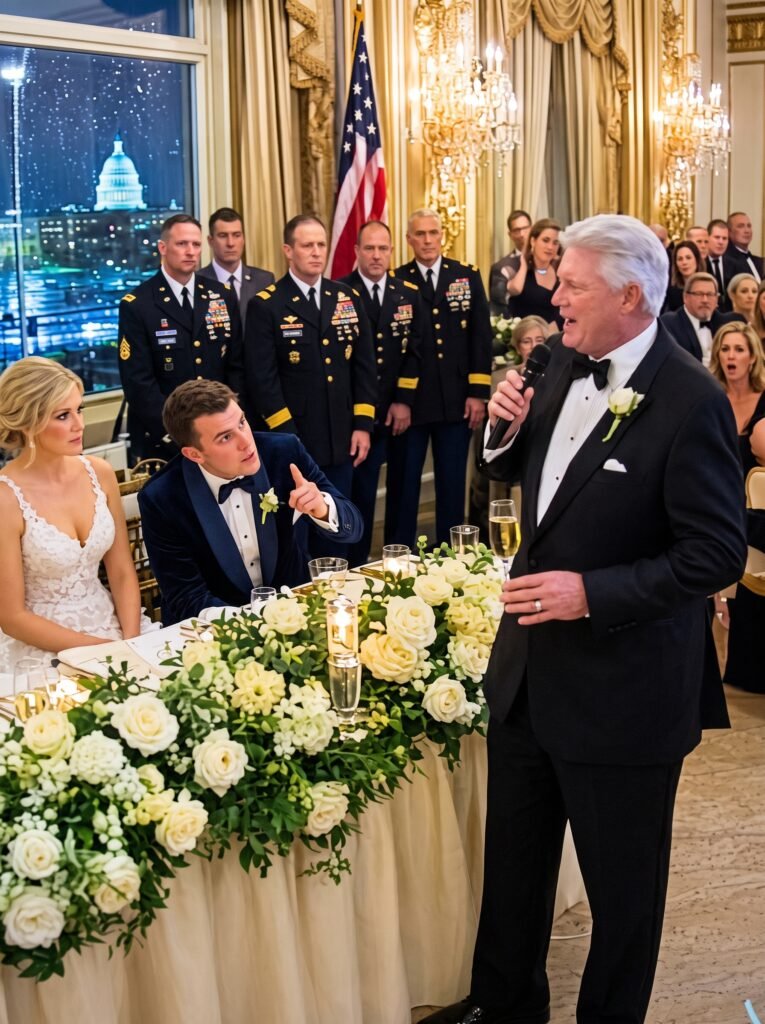
The Mayflower Ballroom had been dressed to look like a dream—soft gold lights dripping from crystal chandeliers, white roses climbing silver stands, candles trembling inside glass cylinders on every table. Outside, Washington, D.C. was wet from a spring rain, and through the tall windows the streets shone black and gold like polished shoes.
I should have been thinking about my husband’s hand around mine. I should have been thinking about the way Ethan had looked at me at the altar, like I was the only stable thing in a city built on performance. I should have been tasting the honeyed frosting from our cake or laughing at the flower girl who had fallen asleep under the head table with one shoe off.
Instead, I watched my father cross the ballroom with a microphone in his hand.
Senator William Abbott never walked into a room. He occupied it. Even at my wedding, people shifted toward him the way sunflowers turned toward light. Donors straightened their jackets. Reporters pretending not to be reporters lifted their phones. My father smiled with that practiced warmth that had made half the country trust him and half the Senate fear him.
“Ladies and gentlemen,” he said, tapping the microphone once. The sound cracked through the speakers.
Ethan’s thumb moved gently over my knuckles beneath the tablecloth. I looked at him. His face was calm, but there was something tight around his mouth.
“He’s going to behave,” I whispered. Ethan did not answer.
My father lifted his glass, his silver hair catching the chandelier light. “Tonight, we celebrate my daughter, Marceline Abbott.”
Applause rose around me. For one second, I let myself believe he might actually say something kind. He looked at me and smiled.
“My daughter has always been brilliant,” he said.
The room softened. My mother lowered her eyes. Ethan’s hand went still. My father paused, waiting for attention to gather.
“Brilliant,” he continued, “at typing other people’s words.”
The laughter came fast. It rolled across the ballroom, bright and easy, bouncing off crystal and marble. A man near the back slapped the table. Someone whistled. My cousin Beth covered her mouth like she was embarrassed for me, though she was still laughing.
I smiled because I had been trained to smile. That was how girls survived men like my father in rooms like this. Smile. Don’t embarrass the family. Don’t ruin the evening. Don’t make a scene when someone else cuts you open in public.
My father chuckled with them, delighted by his own cruelty. “She’s always been the quiet one,” he said. “Behind the scenes. Helpful. Careful. The kind of girl who keeps the coffee warm while real heroes do the hard work.”
More laughter. Not from everyone.
At the front table, Deputy Secretary Harold Vance did not laugh. Neither did the two foreign officials seated beside him. Neither did Mara Ellison from the National Security Committee, who had barely touched her dinner all night. Their silence felt louder than the laughter.
My father did not notice. He never noticed people who stopped clapping.
Ethan leaned closer. “Marcy.” I kept looking at my father.
For years, he had taken my silence as proof that I had nothing worth saying. He had mistaken restraint for weakness. He had built a whole family mythology around it, one where he was the giant and I was the useful little shadow holding his notes.
But shadows remember the shape of everything they stand behind.
As he raised his glass higher, the ballroom lights blurred slightly at the edges. Not from tears. From focus. Because beneath my plate, tucked under the linen napkin, my phone buzzed once.
I looked down.
Unknown Number: He’s going off-script. Be ready.
A cold line moved through my spine.
My father smiled wider into the microphone, and I suddenly understood that tonight’s humiliation was not going to be casual.
It was planned.
The buzz against my thigh was a low, rhythmic vibration that felt entirely separate from the clinking of Baccarat crystal and the soft jazz floating from the orchestra. I didn’t look down at my phone again. I didn’t need to. I knew the cadence of that specific secure line; it was the digital pulse of the West Wing after hours, the quiet grunt of a machine that never slept, even when the rest of Washington was drunk on expensive champagne.
My father, Senator William Abbott, was still holding the microphone. He looked magnificent in his bespoke tuxedo, his silver hair catching the light like a halo designed by a committee of image consultants. He paused, letting the laughter subside, his eyes scanning the crowd with the practiced intimacy of a seasoned predator. He knew exactly where the cameras were. He knew exactly which journalists from The Post and The Times were sitting at the rear tables, their notebooks hidden under their napkins.
“But seriously,” my father continued, his voice dropping into that warm, baritone register he used when he was about to deliver a lie that sounded like a confession. “Marceline has always known her place. In our family, we value public service. We value the front lines. And while my daughter has spent the last five years doing… administrative support, shall we say, in the lower basements of the Pentagon, we are still immensely proud that she found someone like Ethan to bring her out into the light.”
Another ripple of polite, slightly uncomfortable amusement drifted through the room.
Ethan’s hand didn’t tremble, but the muscle in his jaw bunched so tightly the skin went white. He was a Captain in the United States Army, a man who had survived two tours in the Helmand Province and a year in the gray zones of Eastern Europe. He knew what a real ambush looked like. He also knew that the worst kind of violence didn’t always involve gunpowder; sometimes, it just involved a microphone and a father who needed to remind the world that his daughter was nothing more than an footnote in his biography.
“He doesn’t know,” Ethan murmured, his voice so low it barely carried across our small table. His eyes were fixed on my father’s face, analyzing the micro-expressions that the donors missed. “Marcy, he’s set the stage for the announcement. He’s going to use the wedding toast to declare the committee’s veto on the defense appropriation bill.”
“I know,” I said. My voice was level, devoid of the heat that was currently rising in my chest.
For three years, I had been the Senior Director of the Strategic Intelligence Response Unit—a title so deliberately boring it practically begged people to skip over it on an organizational chart. To my father, I was a glorified secretary who cleared schedules and drafted memos for men with stars on their shoulders. He truly believed that my existence was a quiet, grey thing lived in his shadow. He didn’t know that the “administrative support” I provided involved managing the back-channel intelligence networks that kept his own sub-committee from accidentally starting a proxy war in the Black Sea.
He didn’t know because I had spent three years ensuring he didn’t. In Washington, the most dangerous weapon you can possess is the assumption that you are stupid.
“William,” my mother whispered from her seat beside him, her hand reaching out to touch his sleeve. Her face was a mask of elegant panic. She knew the mood of the room was shifting, even if he didn’t. She could see Deputy Secretary Vance staring into his water glass, his expression completely blank—the universal sign of a high-ranking official who was currently calculating the political fallout of a public disaster.
My father brushed her hand away with a quick, dismissive flick of his wrist. He wasn’t looking at her. He was looking at the table where the senior members of the Senate Armed Services Committee sat.
“We live in dangerous times,” my father said, his tone shifting effortlessly from patronizing patriarch to grim statesman. “And as Chairman, I have always believed that our nation’s secrets must be guarded by those with the steel to carry them. Not by bureaucrats who hide behind red tape and classification stamps. Tonight, as we celebrate this union, we must also look to the future of our security. And tomorrow morning, my committee will be taking a stand that will ensure—”
“Sir,” a voice cut through the air.
It wasn’t loud, but it had the distinct, unmistakable ring of military authority. The kind of voice that stopped men from walking into minefields.
Ethan had stood up.
The ballroom went completely still. The jazz band stumbled over a transition, the saxophone trailing off into an awkward, reedy squeak before stopping altogether. Hundreds of faces turned toward the head table. My father froze, the microphone hovered inches from his mouth, his smile stiffening into something hard and defensive.
“Captain Miller,” my father said, his voice dropping an octave. He tried to laugh it off, turning to the crowd. “It seems the groom is eager to get to the dancing.”
Ethan didn’t smile. He stood tall, his dress blues immaculate, the medals on his chest gleaming under the gold lights. He looked down at my father from the slight elevation of the dais, his expression entirely devoid of the deference my father spent his whole life demanding.
“Funny,” Ethan said, his voice carrying perfectly across the silent room without the aid of a microphone. “Every soldier in this room takes orders from her. You might want to check who actually writes the script before you try to change the ending, Senator.”
The silence that followed was heavy, almost physical. It was the sound of a room full of people who suddenly realized they were standing on a fault line just before the earth cracked open.
My father’s face went through three distinct transformations in the span of two seconds. First, the confusion of a man who had never been corrected in public; second, the sharp, ugly flash of anger that he usually reserved for closed-door committee hearings; and finally, the smooth, professional veneer of the politician regaining control.
“Ethan,” my father said, his voice dripping with condescending warmth. “I think the champagne has gone to your head, son. Marceline is a wonderful girl, but let’s not inflate the duties of a GS-12 staffer into a military command.”
A few people laughed—the desperate, nervous laughter of loyalists who knew their jobs depended on the Senator’s mood. But at the front table, Mara Ellison from the National Security Committee slowly stood up. She didn’t look at my father. She looked at me.
“Senator Abbott,” Mara said, her voice clear and entirely sober. “Perhaps you should look at your phone.”
My father frowned, his brow furrowing as he glanced toward his jacket pocket. He didn’t move to reach for it. To do so would be an admission that someone else was controlling the narrative. “Mara, this is a family celebration. If you have a question about the committee’s agenda for Monday—”
“It’s not about Monday, William,” Deputy Secretary Vance said, his voice cutting through the tension like a dull knife. He was looking at his own device, his face pale under the ballroom lights. “It’s about five minutes ago. The White House just issued an executive override on your committee’s veto. The Strategic Intelligence Response Unit has just authorized the immediate release of the unredacted Baltic reports.”
My father’s hand dropped slightly, the microphone catching the heavy fabric of his trousers with a dull thud. “That’s impossible. The SIRU director hasn’t even signed off on the transmission. We’ve been tracking the digital signature from the Pentagon all evening. The director is in a secure bunker in Virginia.”
I stood up then.
The movement was deliberate. I didn’t rush. I smoothed the skirt of my white silk gown, the fabric whispering against the parquet floor. I didn’t look at the guests, or the reporters, or my mother, whose eyes were wide with a sudden, terrible comprehension. I looked directly at my father.
From beneath my napkin, I drew out the small, black encrypted device that had been buzzing against my leg for the past hour. It wasn’t a standard government iPhone. It was a heavy, military-grade terminal with a dual-factor biometric scanner on the back.
I pressed my thumb against the glass. The screen flared green.
“The director isn’t in Virginia, Dad,” I said. My voice wasn’t loud, but in that silent room, it sounded like a gavel striking stone. “She’s sitting at the head table. And she’s currently missing her own wedding dinner because you couldn’t resist the urge to use my marriage as a press release.”
The room didn’t just go quiet; it seemed to lose oxygen.
My father looked from the device in my hand to my face, his mouth opening slightly before closing again. For thirty years, he had seen me as the quiet girl who brought him tea during his late-night study sessions, the daughter who took notes while he bellowed at his staff, the useful, invisible extension of his own ambition. He had never looked at me long enough to realize that while I was listening to him, I was also learning exactly how he operated.
“Marceline,” he whispered, the microphone still live, his voice carrying his sudden vulnerability to every corner of the Mayflower Ballroom. “What have you done?”
“I did what you taught me to do,” I said, stepping out from behind the table. “I took care of the details.”
The transition from a wedding to a command center happens remarkably fast when the people involved are trained for crisis.
Within ten minutes, the Mayflower Ballroom had cleared out, the guests escorted toward the lobby by the hotel staff with the quiet efficiency that only Washington venues can manage when a scandal breaks. The crystal chandeliers still burned gold, but the room felt vast, cold, and empty, like a theater after the curtain had fallen on a bad play.
Only a few remained: my father, my mother, Ethan, Deputy Secretary Vance, and Mara Ellison. The white roses on the tables looked drooping now, their silver stands casting long, distorted shadows across the carpet.
My father was sitting at Table 4, the microphone abandoned on the white linen next to a half-eaten plate of salmon. His silver hair was slightly disheveled, a single strand falling across his forehead—the first time in my life I had ever seen him look untidy.
“You lied to me,” he said. He didn’t look up as I approached. His voice was low, devoid of the theatrical power he had used on the podium. It was the voice of an old man who had just realized his house was built on sand. “For three years, you sat at my dinner table and let me believe you were a junior analyst. I recommended you for that position. I signed the security clearance variance myself.”
“No, Dad,” I said, standing opposite him with my hands folded in front of my dress. “You didn’t recommend me. You signed a pile of papers your chief of staff gave you because you didn’t look at the names. You saw the word ‘Abbott’ and assumed it was a favor for one of your donors’ children. You never asked what the acronym stood for.”
“Marceline,” my mother pleaded from the edge of the room, her voice trembling. “Your father was only trying to protect the family’s legacy. This… this position you have, it’s dangerous. It’s not what we wanted for you.”
“What you wanted was a trophy that didn’t talk back,” Ethan said, stepping up beside me. His hand found the small of my back, his presence a solid, unyielding weight that kept me grounded. “You wanted someone you could trot out during campaign season to show what a family man the Senator is, while she spent fifty hours a week cleaning up the intelligence messes your committee created.”
My father finally looked up, his eyes sharp, reflecting the light of the dying candles. The fear was gone now, replaced by the hard, calculating intelligence that had kept him in power through four administrations. “You think you’ve won something tonight, Marcy? You’ve destroyed my committee’s leverage. The Baltic reports will cause a run on the defense sector. The market will drop three hundred points by the opening bell tomorrow.”
“The market will adjust,” Vance interrupted, his tone dry as he looked at his tablet. “And your committee will be restructured, William. The President has already called a 6:00 AM meeting with the Joint Chiefs. They aren’t asking for your input this time.”
My father stood up, his tall frame still imposing, though the shoulders were slightly curved. He walked toward me until he was standing just inches away, the scent of his expensive cologne mixed with the stale smell of the champagne he hadn’t finished.
“You used my own event to execute a coup,” he said, his voice dropping into a harsh whisper. “On your wedding night. What kind of daughter does that?”
“The kind you raised,” I answered, looking him dead in the eye. I didn’t blink. I didn’t flinch. I had spent a lifetime watching him dismantle his political opponents with a smile, and I had learned that the only way to survive him was to be more precise than he was. “You wanted to make me small tonight, Dad. You wanted to use my marriage to tell the world that the Abbotts control the defense bill. But you forgot the first rule of intelligence.”
He didn’t ask. He just stared.
“Never assume the person holding the door is the one who belongs outside,” I whispered.
The rain had stopped by the time Ethan and I walked out of the Mayflower’s side entrance. The air was cool and clean, smelling of wet asphalt and spring earth. The black town cars that usually lined Connecticut Avenue were gone, replaced by two nondescript SUVs with dark windows and government plates.
My wedding dress was slightly damp at the hem from the puddles on the pavement, but I didn’t care. The heavy silk felt different now—less like a costume and more like armor that had served its purpose.
Ethan opened the door of the first SUV for me, his eyes searching my face in the dim light of the streetlamp. “Are you okay?” he asked.
“I’m tired,” I admitted, the adrenaline finally beginning to clear from my system, leaving a dull, heavy ache behind my eyes. “But I’m fine.”
He leaned down, pressing his forehead against mine for a brief, silent second. “You were brilliant,” he muttered. “And I don’t mean at typing other people’s words.”
I managed a small, genuine smile—the first real one of the entire evening. “We’re going to miss the honeymoon flight, aren’t we?”
“Probably,” he said, pulling back to look at the driver, who was waiting patiently with the engine idling. “The Pentagon doesn’t do vacation days during a structural reorganization.”
As I climbed into the back seat, my phone buzzed again. This time, it wasn’t an unknown number. It was the secure link from the Director of the Central Intelligence Agency.
CIA Director: The Baltic file transmission is complete. Secure lines established for the 6:00 AM brief. We need your opening statement, Director.
I looked out the window as the SUV pulled away from the curb. The lights of the Capitol building were visible in the distance, a pale white dome rising against the dark Washington sky, looking solid and permanent, even though everything inside it was constantly shifting.
Behind us, in the ballroom, my father was likely still trying to figure out how to spin the evening to the press. He would probably tell them it was a misunderstanding, or that he was proud of his daughter’s sudden advancement. He would try to survive, because that was what he did.
But the rules had changed.
I pulled the laptop from the secure compartment in the back of the seat, the screen illuminating the dark interior of the car with a cool, blue glow. My fingers hovered over the keys for a fraction of a second, the rhythm coming back to me instantly—the familiar, quiet language of power that didn’t need a microphone to be heard.
“Ethan,” I said, not looking up from the screen.
“Yes, ma’am?” he said, his voice warm with amusement from the front seat.
“Tell the driver to take the long way past the river,” I said, my fingers beginning to move across the keyboard. “I need to draft an order.”