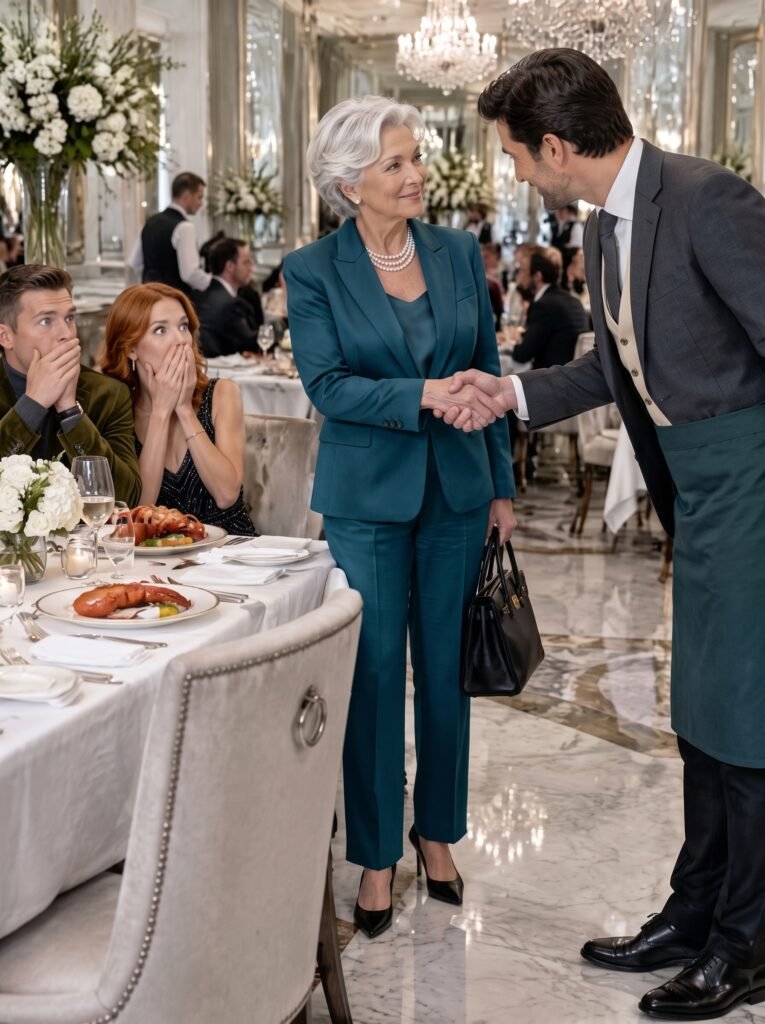
“That will be enough for her,” Vanessa told the waiter.
I looked at my son, Daniel. He was seated beside her beneath the restaurant’s crystal chandeliers, dressed in an expensive suit and staring at his plate as though he had not heard a word.
“Daniel?” I asked.
After a pause, he answered quietly.
“Just accept it, Mom. Remember your place.”
For a moment, I did not see the successful man sitting across from me. I saw the little boy whose hand I held during winter rain, the child I fed before I fed myself, and the student whose lunches, shoes, and college bills I found ways to pay.
I looked down at the water.
“Understood,” I said.
Vanessa seemed disappointed. She had expected tears, anger, or a loud reaction that would make it easy to call me difficult and blame me for ruining the night.
I gave her none of that.
My name is Margaret. I am sixty-five years old, and I raised Daniel alone after his father disappeared when Daniel was six. There was no explanation, no support, and no one else to take over when things became hard.
So I did everything.
I cleaned corporate offices before sunrise, worked lunch shifts in a school cafeteria, waited tables, and spent long hours in commercial kitchens. I carried trays, stood near ovens, and went home with aching feet, but Daniel had clean clothes, school supplies, and food on the table.
When college came, I found a way to help with that too.
I wanted my son to have choices I had never been given. He graduated, built a career, and eventually married Vanessa.
At first, I tried hard to love her because I believed that if she made Daniel happy, that was enough. I ignored the small comments about my clothes, my apartment, and the way she looked around my modest home as though it made her uncomfortable.
Then came the exclusions. Birthday dinners I learned about afterward, holidays I was not invited to, and family trips no one told me about until they had returned.
Daniel let it happen.
So when he called one evening and said they wanted to repair our relationship, I allowed myself to hope. I wore my nicest navy dress and accepted their invitation to one of the city’s most exclusive restaurants.
The table told me everything before anyone spoke. Vanessa sat between her parents, Daniel sat beside her, and my chair was placed far away from the group with an uncomfortable stretch of empty space between us.
The waiter approached, and Vanessa began ordering.
“Four lobster dinners,” she said. “Imported wine, appetizers, and desserts.”
I waited for her to include me.
She did not.
The water arrived soon afterward.
As the others ate, Vanessa’s parents discussed people who reached retirement without planning properly. They laughed about small apartments, working-class neighborhoods, and people who spent their lives “getting by” instead of building something worthwhile.
Then Vanessa looked at me.
“I think Margaret should attend fewer family events,” she said. “We have a certain image now.”
Daniel stayed silent.
Beside my chair was the strawberry cake I had brought for Vanessa’s four-year-old daughter, Chloe. I had bought it because I knew she loved strawberries.
Vanessa glanced at the box.
“What exactly do you think you can contribute?” I asked.
She leaned back in her chair.
“Love is nice, Margaret. But love does not provide status, opportunities, or useful connections.”
Something inside me became calm.
They had made their decision about who they believed I was.
And as the executive chef entered the dining room, I decided it was finally time for them to learn how wrong they were.
The dinner continued as if nothing unusual had happened. Lobster tails arrived beneath warm butter and herbs, wine was poured, desserts were ordered, and my untouched glass of water sat alone at the end of the table.
Vanessa’s parents kept talking about wealth and status. They joked about people who worked their entire lives without ever reaching “the right level,” while Daniel remained quiet beside his wife.
I listened without reacting.
When the bill arrived, it totaled seven hundred and eighty dollars. Four lobster dinners, imported wine, appetizers, desserts, and one glass of water for me.
No one apologized. No one even looked embarrassed.
Vanessa folded her napkin and reached for her purse, while Daniel prepared to leave. They assumed I would quietly follow them out, grateful that I had been allowed a seat at their table.
Instead, I stood.
“Excuse me,” I said.
But I turned toward the kitchen hallway.
I knew the sound of kitchen doors opening. I knew the rhythm of staff moving with trays, the sharp scent of heat and steam, and the quiet urgency that exists behind every elegant dining room.
I had spent years working in places like that.
As I walked away, I heard Vanessa whisper something to Daniel. Then footsteps followed behind me.
The kitchen doors opened, and the executive chef stepped out.
He stopped when he saw me.
Then he removed his chef’s hat and gave a respectful nod.
“Mrs. Margaret,” he said. “The management team is ready for you in the private office.”
Behind me, everything went quiet.
Vanessa had followed closely enough to hear him. Daniel was a few steps behind her, and her parents remained near the table with confused expressions.
“Why does he know you?” Vanessa asked.
I did not answer immediately. I lifted the glass of water I had carried from the table, took one slow sip, and placed it on a nearby tray.
Then I followed the chef toward the private office.
The general manager, Julian, greeted me warmly when I entered.
“I am sorry you had to experience that in our dining room,” he said.
“You do not need to apologize,” I replied. “You and your staff did nothing wrong.”
He glanced toward the door.
“Would you like us to ask them to leave?”
“No.”
I had no interest in creating a scene or returning humiliation with humiliation. What I wanted was much simpler: I wanted to stop pretending.
After Daniel left for college, I continued working in kitchens. But I also began saving and investing what I could. I understood restaurants, suppliers, customers, and the small details that made people return.
I started with one modest restaurant.
Then a second.
Then a third.
I reinvested nearly everything, learned contracts and property investments, made mistakes, corrected them, and eventually built a business I had never discussed with my son.
The restaurant where my family had just treated me as an embarrassment was one of mine.
I had never kept it secret to test anyone. I lived simply because I liked living simply, and I wanted Daniel to value me as his mother rather than as a source of money or influence.
But the dinner had answered a question I had quietly carried for years.
When I returned to the table, Vanessa’s smile was gone. Daniel stood so quickly his chair scraped against the floor.
“Mom,” he said. “I’m sorry.”
I looked at him.
He did not look heartbroken.
He looked afraid.
Vanessa was the first to speak after I returned to the table. Her expression had softened into the kind of concern people use when they are afraid they may have offended someone important.
“That was just a misunderstanding,” she said. “The dinner got awkward.”
Daniel moved closer.
“Mom, I’m sorry.”
I looked at him for a long moment. He was the person whose life I had built my own around for decades, and he had watched me receive nothing but water while everyone else ate a luxury meal.
“You knew,” I said.
His eyes dropped.
“Yes.”
“And you said nothing.”
“I did not know what to do.”
The answer hurt more than Vanessa’s remarks. She had never claimed to love me, but Daniel had.
I nodded slowly.
“I do.”
Vanessa stepped in quickly, insisting she was only joking. She said she never wanted to hurt me and that she had not expected things to become so serious.
But I had heard every word. I had watched her decide that my value depended on whether I could impress her parents, offer connections, or fit the image she wanted for her family.
“You do not get to decide what I am worth based on what you think I own,” I told her.
Then I picked up my purse.
Daniel reached for my hand.
“Mom, please. Give me another chance.”
I looked at him again, remembering every time he called when he needed something, every holiday he failed to include me in, and every moment he chose silence because defending me might make his wife uncomfortable.
“I gave you one tonight,” I said. “You just did not recognize it.”
There was no shouting. I did not demand an apology in front of strangers, ask the manager to embarrass them, or explain my finances to prove that I deserved a place at their table.
I simply walked away.
The restaurant’s staff treated me with the same quiet respect they always had. The chef thanked me for stopping by, the general manager offered to have someone bring the strawberry cake to my car, and I left through the private hallway instead of returning to the dining room.
Outside, I stood for a moment beneath the city lights and let myself breathe.
For years, I had lived modestly on purpose. I drove an ordinary car, wore simple clothes, and remained in a small apartment because I did not need a larger life to feel successful.
My investments had grown over time, and my restaurant group had become profitable enough to make me financially secure. But I had never told Daniel about the money because I did not want his love to depend on it.
That night, I learned the truth.
Vanessa and Daniel did not suddenly respect me because I was financially independent. They respected what they believed I could offer them.
And that was not the same thing.
When I arrived home, I placed Chloe’s unopened strawberry cake on the kitchen counter. I thought about the little girl who had nothing to do with the cruelty at dinner, and I hoped she would grow up learning that people mattered for more than the brands they wore or the connections they carried.
The next morning, Daniel called repeatedly.
I did not answer.
Then a message arrived from Vanessa.
We need to talk. There is something about Daniel you do not know.
I stared at the screen.
For the first time, I wondered whether the dinner had been more than an attempt to humiliate me.
Vanessa asked to meet me the next morning at a quiet café across town, nowhere near the house Daniel and I had once shared. I almost ignored her message, but something about its wording felt less like another excuse and more like fear.