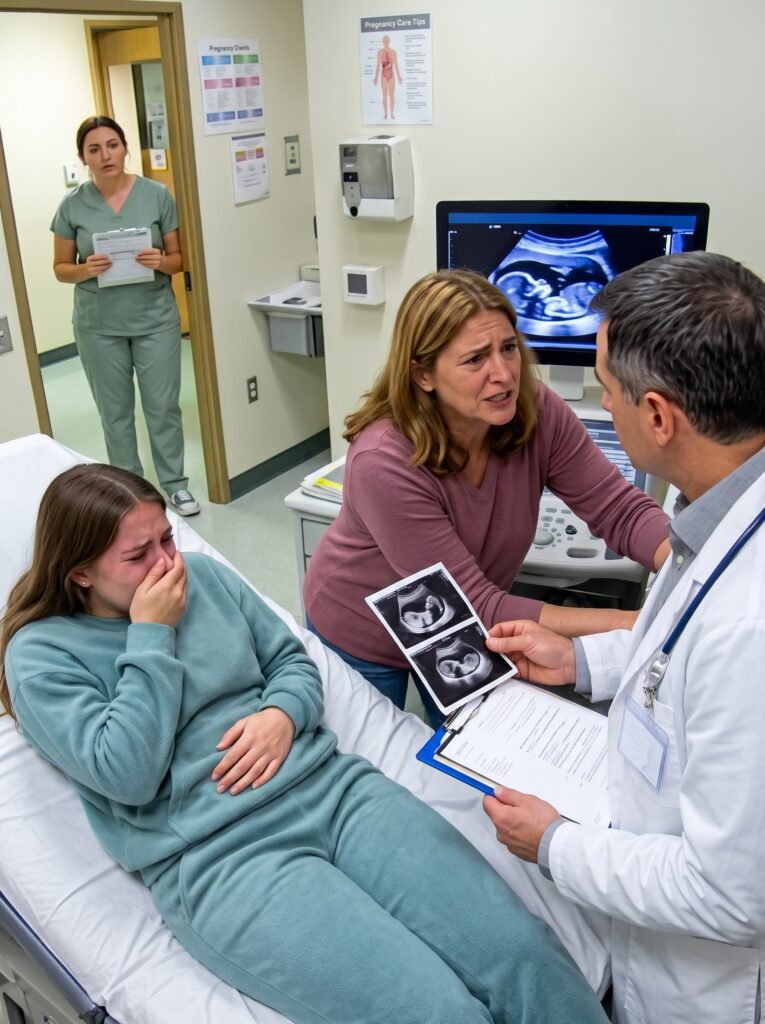
Dr. Lawson exhaled slowly. Then he reached toward the scan, turned it just enough for me to see the dark shape on the image, and said, very carefully, “It appears to be a large mass in her abdomen. We need to conduct further tests to understand exactly what we’re dealing with.”
My heart dropped. Words fell short as I looked at the image, unable to comprehend how something so alarming could be inside my daughter. Maya’s eyes flickered to mine, wide with fear.
“Is… is it cancer?” I barely managed to ask, my voice breaking.
Dr. Lawson shook his head slightly. “We can’t say for sure yet. It could be a tumor, but we need a biopsy to confirm its nature. I’m going to arrange for her to be admitted so we can perform more tests as soon as possible.”
Maya’s trembling hand reached for mine, and I held it tightly, trying to convey strength I didn’t feel. “We’re going to figure this out, sweetheart,” I assured her, though my own doubts swirled.
As the nurses prepared to transfer Maya to a hospital room, I stepped into the hallway to call Robert. My fingers hesitated over the screen before I pressed dial. The phone rang only twice before he answered.
“What’s happening?” His voice held an edge of accusation that grated on my nerves.
“They found something, Robert. A mass. They’re admitting her to run more tests,” I explained, trying to keep my voice steady.
There was silence on the other end, a pause so long I wondered if the call had dropped. Finally, he spoke, his voice softer, almost defeated. “I’ll come.”
I hung up, feeling a mix of relief and apprehension. Back inside the exam room, Maya looked small and fragile on the gurney. I stayed by her side as they wheeled her to a room upstairs.
The hospital room was sterile, the walls a dull shade of blue. Maya settled into the bed, and I pulled a chair close, sitting by her side as the slow hours ticked by. Nurses came and went, adjusting her IV, checking her vitals, each time with gentle reassurances.
As night fell, the room dimmed, shadows stretching across the floor. Maya drifted into a restless sleep, her hand still clutching mine. I watched her, my mind a whirl of ‘what ifs’ and unspoken fears. The uncertainty was a heavy weight, pressing down with every breath.
Robert arrived just after nine, his face drawn and weary. He lingered at the doorway, unsure of his place. Eventually, he moved to stand beside me, the tension between us a palpable thing.
“I’m sorry,” he said quietly, surprising me. “I should have listened.”
I nodded, not trusting myself to speak without anger slipping through. Together, we kept vigil by Maya’s side, united in our worry, if nothing else.
The next morning, Dr. Lawson returned with a team, ready to discuss the plan for more tests. A biopsy was scheduled for the afternoon. He explained the procedure, his words a blur of medical jargon and cautious optimism.
Maya nodded along, her strength surprising me. When Dr. Lawson asked if we had questions, she simply looked at him and asked, “Will it hurt?”
He smiled gently, shaking his head. “We’ll make sure you’re comfortable.”
The waiting was the hardest part. Hours dragged as we sat by her bed, exchanging tense glances with Robert, both of us lost in our thoughts.
Finally, the time came. I hugged Maya tightly before they wheeled her away, whispering promises of ice cream and movies, anything to distract her from the fear.
As Robert and I sat side by side in the waiting room, I realized that this was only the beginning of a long journey. Whatever the outcome, our lives had shifted, priorities reordered in the face of uncertainty.
The door opened, and Dr. Lawson stepped out, a clipboard in hand, ready to share the results that would determine our next steps.
Dr. Lawson’s expression gave nothing away, the careful neutrality of a man who’d delivered this particular walk down this particular hallway more times than he could count. I stood so fast my chair scraped against the linoleum, Robert rising beside me a half-second later, our earlier tension forgotten entirely in the face of something larger than either of us.
“The biopsy results came back faster than we expected,” Dr. Lawson said, gesturing for us to sit. We didn’t. “The mass is a Wilms tumor. It’s the most common form of kidney cancer in children, and I understand that word is frightening, but I want you to hear the rest of what I’m about to say before you let it be only frightening.”
My knees nearly gave out. Robert’s hand found my shoulder, steadying me without either of us acknowledging it.
“Wilms tumors have one of the highest cure rates of any pediatric cancer,” Dr. Lawson continued. “Caught at this stage, we’re looking at a survival rate above ninety percent with the right treatment protocol. Maya’s case appears to be localized to the one kidney, with no evidence yet of spread to the lymph nodes or other organs, though we’ll confirm that with additional imaging this week.”
“Ninety percent,” Robert repeated, like he was testing the number for weight, for truth, for something solid enough to hold onto.
“I don’t say that to minimize what’s ahead,” Dr. Lawson said gently. “There will be surgery. Likely chemotherapy afterward, depending on the final staging. It will be hard on her, and hard on both of you. But this is, genuinely, one of the more treatable cancers we see in children her age, and I want you to carry that with you through everything that comes next.”
I found myself crying without quite deciding to, the fear I’d been holding rigid for eighteen hours finally breaking loose, not into despair but into something closer to relief, sharp and disorienting.
“Can we see her?” I asked.
“She’s still coming out of sedation, but yes. She’ll want to see your faces first.”
Maya’s eyes fluttered open slowly when we entered, groggy, confused, searching the room until she found us standing on either side of her bed. “Did they figure out what it is?” she asked, her voice thick with the tail end of anesthesia.
“They did,” I said, taking her hand. “It’s called a Wilms tumor. It’s treatable, sweetheart. Dr. Lawson says most kids who have it get all the way better.”
She blinked slowly, processing this with the particular gravity of an eight-year-old trying to understand something enormous through a haze of medication. “So I’m not going to die?”
The question landed like a physical blow, simple and direct in the way only children manage, unfiltered by the careful hedging adults use to protect themselves from saying the hardest things aloud.
“No,” Robert said, before I could find my own voice, kneeling beside the bed so he was level with her. “No, baby. You are not going to die. It’s going to be a hard road. There’s going to be surgery, and probably medicine that makes you feel pretty rough for a while. But we are going to be right here, every single step, and you are going to come out the other side of this.”
Maya considered this with the same seriousness she’d shown Dr. Lawson the day before. “Will I still get the ice cream you promised?”
Despite everything, I laughed — a real laugh, startled out of me by the sheer, stubborn ordinariness of an eight-year-old negotiating dessert in the middle of a cancer diagnosis.
“You’ll get so much ice cream,” I promised, “you’ll be sick of it before this is over.”
“I doubt that,” she murmured, already drifting back toward sleep, her hand still loosely curled around mine.
Robert and I stood together in the hallway outside her room a while later, the sterile blue walls stretching around us in every direction, the weight of what lay ahead settling slowly into something we could both, finally, begin to carry instead of merely fear.
“I know things have been bad between us,” Robert said quietly, staring at the closed door instead of at me. “I know I haven’t shown up the way I should have, for a long time before any of this happened. But I need you to know I’m not going anywhere now. Whatever it takes — appointments, treatments, nights in this hospital — I’m here.”
I studied him for a long moment, remembering the accusatory edge in his voice on that first phone call, weighing it against the man kneeling at our daughter’s bedside promising ice cream and honesty in the same breath.
“I need that to actually be true,” I said. “Not just tonight, when everything’s still raw. In three months, when the routine gets exhausting and it would be easier to disappear back into work the way you always have.”
“I know,” he said. “I’m not asking you to trust me yet. I’m just telling you what I intend to do, and asking you to let me prove it instead of deciding in advance that I can’t.”
It wasn’t forgiveness. It wasn’t even close, not yet. But it was, I recognized, a starting point — the same kind of fragile, uncertain ground Maya herself would need to stand on in the weeks ahead, learning to trust a body that had betrayed her, learning to believe the people around her when they promised things would be okay.
I nodded, once, and together we walked back into her room to keep vigil through whatever came next.
Surgery was scheduled for the following Tuesday, giving us five days that stretched impossibly long and impossibly short all at once — long in the hours spent watching Maya nap fitfully against hospital pillows, short in how quickly the appointment calendar filled with pre-op consultations, anesthesia briefings, and a parade of specialists who each explained, in their own careful language, exactly what removing a kidney from an eight-year-old would actually involve.
Robert didn’t disappear. That was the thing I kept waiting for, some part of me still braced for the old pattern — the sudden work emergency, the quiet retreat into distance whenever things demanded too much of him emotionally. Instead, he showed up every single day, sometimes twice, learning the names of nurses, memorizing Maya’s medication schedule, sitting through consultations with a legal pad where he wrote down every question either of us thought to ask.
“You don’t have to prove anything to me by taking notes,” I told him quietly, on the third day, watching him underline something Dr. Lawson had said about post-surgical recovery timelines.
“I know,” he said, not looking up. “I’m not doing it for you. I’m doing it because I finally understand that showing up isn’t a single decision you make once. It’s a hundred small decisions, every single day, and I let too many of those days slip by unmade for too long.”
I didn’t have a response for that. I just reached over and squeezed his hand, and for the first time in longer than either of us could probably name, he squeezed back without either of us needing to explain what it meant.
The surgery took four hours. Robert and I sat in the same waiting room where we’d first heard the word “tumor,” this time gripping each other’s hands instead of sitting carefully apart, watching the clock with the particular, suspended terror that only parents in that specific chair truly understand.
Dr. Lawson emerged looking tired but unmistakably relieved. “The surgery went well,” he said, and I felt the air leave my lungs in a rush I hadn’t realized I’d been holding. “We removed the affected kidney along with the tumor. Her remaining kidney is healthy and fully functional — most people live entirely normal lives with just one, so that’s not a long-term concern. The margins looked clean, which is a very good sign, but we’ll confirm everything once pathology finishes examining the tissue.”
“Chemotherapy?” Robert asked.
“Likely, given the tumor’s size, but as a precaution rather than a sign of aggressive spread. We caught this early, and it shows.” Dr. Lawson allowed himself something close to a smile. “I think you should feel good about where things stand tonight.”
We were allowed to see her an hour later, small and pale against the white sheets, an IV taped to the back of one hand, a bandage across her abdomen where they’d removed the thing that had frightened all of us so completely. She opened her eyes slowly when I took her hand, and the first thing she said, groggy and slurred from anesthesia, made both Robert and me laugh through tears we could no longer hold back.
“Is it ice cream time yet?”
The chemotherapy that followed was, as Dr. Lawson had warned, hard — four months of treatment that took Maya’s energy and her appetite and, for a brief, terrifying stretch, most of her hair, though she wore the baldness with a stubborn eight-year-old bravado that put both her parents to shame, picking out increasingly ridiculous beanies and declaring each one “better than hair anyway.”
Robert kept his promise. Every single appointment, every rough night when the nausea medication wasn’t quite enough, every ordinary Tuesday that could have easily slipped past unmarked, he was there — not performing devotion for an audience, simply present, the way a father should have been all along.
Somewhere in those difficult months, something between us shifted too, quietly, without either of us announcing it. We weren’t rebuilding a marriage exactly — too much had happened before Maya’s diagnosis for that to be simple — but we were rebuilding something. A partnership. A shared commitment to showing up for the person who needed us most, and in doing so, slowly, cautiously, learning to show up for each other again too.
Maya rang the bell in the hospital’s survivor hallway on a bright Tuesday morning in early spring, exactly six months after that first terrifying scan, her hair growing back in soft dark tufts, her laugh — genuinely, fully hers again — echoing off the walls as the small crowd of nurses who’d cared for her through every rough week applauded.
“No evidence of disease,” Dr. Lawson told us afterward, the words I’d read about and hoped for and been almost afraid to fully believe in until I heard them spoken aloud. “We’ll continue monitoring for the next few years, standard protocol, but Maya, you did it. You beat it.”
She looked up at both of us, this small, fierce girl who’d asked whether the biopsy would hurt and then negotiated ice cream terms from a hospital bed hours after major surgery, and grinned the wide, unguarded grin I’d feared, in the darkest hours of that first sleepless night, I might never see again.
“Told you I wasn’t going to die,” she said.
Robert laughed, wet and unrestrained, pulling her carefully into a hug. I wrapped my arms around them both, feeling the particular, hard-won peace of a family that had walked through the worst thing imaginable and come out the other side not unscathed, but intact — closer, in some ways, than we’d been before any of it started.
Outside the hospital, the spring sun was warm against my face for the first time in months, and as we walked to the car together, Maya skipping ahead in her favorite beanie despite the fresh growth of hair beneath it, Robert reached over and took my hand.
“We made it,” he said quietly.
“We did,” I agreed. “All three of us.”
And for the first time since Dr. Lawson had turned that first scan toward us and spoken the word that changed everything, I let myself believe, fully and without reservation, that the hardest part really was behind us.
THE END