After nine years of marriage, I came out of my divorce with absolutely nothing. I let Grant keep the house, our savings, and even my diamond wedding ring. But before I walked away for good, there was one last thing I needed to do: give my mother-in-law, Harriet Hayes, one final bath.
Harriet had been almost entirely unable to move or speak since suffering a stroke three years ago. Ever since that day, I had taken care of her every morning, bathing her, changing her bedsheets, and ensuring she was comfortable.
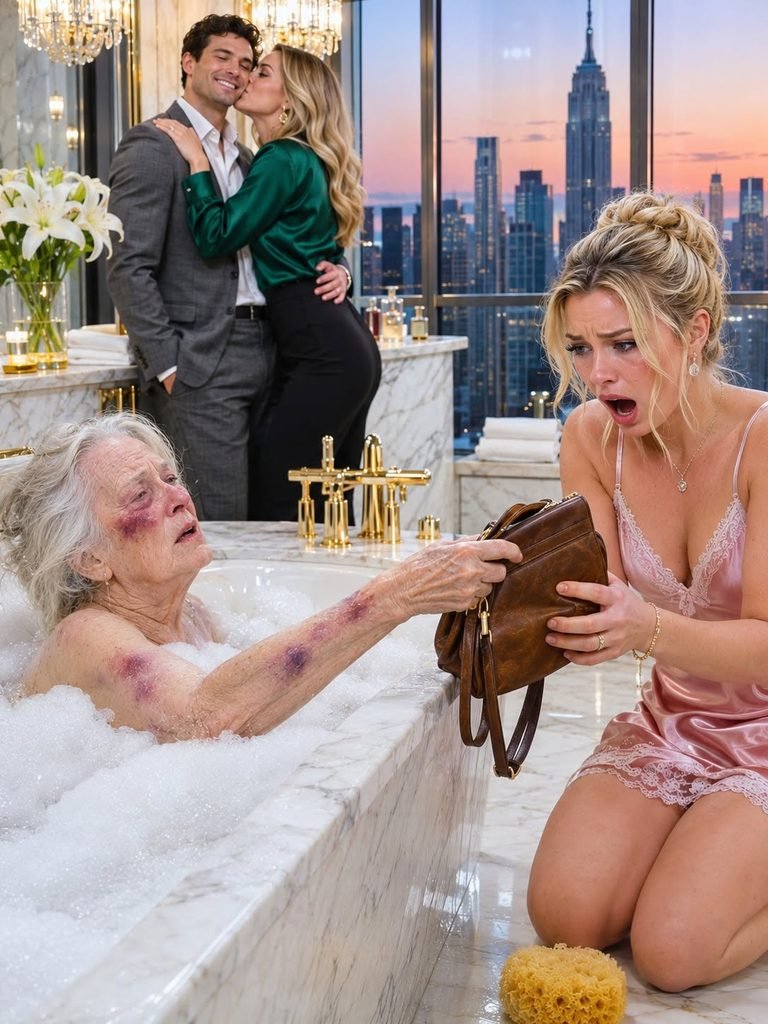
“Almost done, Harriet,” I whispered, squeezing the warm washcloth.
Standing in the doorway, Grant was busy scrolling through his phone. Next to him was Bianca Sterling, his former assistant, who was now his mistress.
“I seriously don’t get it,” Bianca said loudly. “She wasted three years playing nursemaid to a bedridden old woman. And for what? She’s leaving with a beat-up bag and nowhere to go in the freezing rain.”
Grant grunted without lifting his eyes from his phone.
I forced down the lump in my throat and carefully dried Harriet’s hands. Her sharp blue eyes remained fixed on me, following every movement as though she desperately wanted to communicate something.
“Goodbye, Harriet,” I whispered. “I have to go.”
I turned to leave.
Without warning, a hand suddenly wrapped around my wrist.
I went completely still.
Harriet’s hand was shaking as she struggled to keep hold of me. With great effort, she slowly placed an old leather purse into my hand. The leather was cracked, and its brass clasp had lost its shine.
“Keep… this,” she rasped. “Yours.”
“Thank you, Harriet. I promise I’ll take good care of it.”
Yet she refused to release my hand.
“Promise… me,” she choked out, struggling for breath. “Promise.”
“I promise, Harriet. Just calm down. You’re going to trigger another episode.”
She shook her head urgently and pulled my wrist closer to her. Her blue eyes were filled with desperation.
“Open… the purse. At… your parents’ house. Not… here. Not… in front… of him.”
I furrowed my brow, utterly bewildered.
“The purse in the cabinet? Harriet, I don’t—”
“Let… him… believe,” Harriet hissed, her gaze darting toward the bedroom door, her face twisting with disgust. “Let him think… you have… nothing.”
I stood there staring at her, my heart racing.
Why was she so determined to keep Grant from discovering what was hidden inside that old purse?
PART 2
By the time I pulled into my parents’ driveway in Dayton, the rain had turned to sleet. My coat was soaked through at the shoulders, and the old purse sat on the passenger seat, beads of water sliding down its cracked leather. I had driven the whole way with the radio off, turning Harriet’s broken words over and over in my head.
Mom opened the front door before I could knock. One look at my face, and she pulled me inside without asking a single question. Dad stood in the kitchen in his work boots, the smell of coffee and wet wool filling the small house.
They had kept my childhood bedroom exactly as I’d left it: the faded quilt, the lamp with the chipped shade. I set the purse on the dresser and stood there dripping onto the rug until Mom brought me a towel.
“Take all the time you need,” she said softly, and closed the door.
The brass clasp was stiff. It took me two tries before it gave way with a quiet click.
I had half expected cash, or maybe a piece of jewelry. Instead I found a small brass key tied to a faded red ribbon, a sealed manila envelope, and a black notebook with soft, worn corners.
I opened the notebook first. Harriet’s handwriting was shaky but still legible. Page after page of dates, dollar amounts, and account numbers. Notes ran down the margins: “G does not know.” “Keep this from G.” And near the bottom of the first page: “For Colleen, if she stays.”
She had written my name.
Inside the envelope were three documents. The first was a deed that moved the house, the same house I’d just signed away in the divorce, out of Grant’s reach and into a living trust. That had happened six months before Harriet’s stroke. The trust named me as sole beneficiary. The second was a notarized power of attorney giving me authority over every account in the notebook. The third was a letter, three pages long, in the same careful hand.
I read it twice, sitting on the edge of the bed.
Harriet had known about Bianca for more than a year. She had watched her son quietly shift money into accounts he believed no one could see. She had watched me carry her breakfast tray upstairs, then go back down and cook dinner for a husband who no longer looked at me. Once, she wrote, she had tried to confront Grant. He had patted her hand and told her she was confused. After that, she stopped speaking, even on the days when the words came easily. She didn’t trust her own son with what she had built, and she didn’t trust the courts to protect a daughter-in-law who had already learned to ask for nothing.
The key, the letter said, opened a safe-deposit box at a bank in the next town over. The notebook listed what was inside: the original trust papers, savings bonds she had bought decades ago, and a second set of ledgers documenting every unauthorized transfer Grant had made. At the very end, in larger letters, she had written:
“She kept her promise. Let her keep what is hers.”
My hands wouldn’t stop trembling. I folded the letter, returned everything to the purse, and went downstairs, where Mom had set out three mugs of tea. At that kitchen table, I finally told my parents what I’d been hiding for three years: that I had been the one caring for Harriet every single morning, that Grant barely came home, that the divorce had taken everything with my name on it.
I didn’t show them the notebook. I only said Harriet had given me something important, and that I needed to see a lawyer before I did anything else.
That night I slept in my old bed with the purse under my pillow.
The attorney’s name was printed inside the cover of the notebook. Her name was Judith Alvarez, a sharp-eyed woman in her sixties whom Harriet had trusted for decades. Grant had never met her. She cleared an hour for me that same afternoon.
She read every page without changing her expression. When she finished, she set the papers down and looked at me over her glasses.
“Harriet signed all of this before her stroke,” she said. “The trust is valid. The power of attorney is valid. The house was never marital property when your divorce was finalized, because it had already been moved into the trust. Either Grant’s attorney didn’t check, or he chose not to. Either way, the transfer stands. And these accounts were never joint. He can’t touch them.”
“What about the money he took?”
“We’ll freeze whatever we can trace, and we can trace a great deal of it.” She tapped the notebook. “Harriet kept better records than most accountants. She wanted you protected. And she wanted her son to go on believing, for as long as possible, that you’d walked away with nothing.”
I nodded. The lump in my throat was back, but it felt different now.
Over the next three weeks, Judith worked quietly. The house came under the trust’s control. Grant was served formal notice that he was living in a property that no longer belonged to him. The accounts were frozen, and a separate action was filed over the unauthorized transfers. I stayed with my parents and ignored Grant’s calls. When Bianca’s number popped up once, I blocked it.
On the day the locks were changed, I drove back to the house I’d left in the freezing rain. Grant stood on the front steps beside two suitcases. Bianca sat in the passenger seat of his car with the window cracked, watching. He looked smaller than I remembered.
“You can’t do this,” he said, using the voice he saved for clients who tried to renegotiate. “This is my house. You signed the papers.”
“I signed papers for a house that was already in your mother’s trust,” I said. “She left instructions. I’m following them.”
Bianca leaned out of the window. “She’s lying. Your mother couldn’t even talk.”
“She could write,” I said, without raising my voice. “She wrote everything down. She wrote about you, too.”
Something shifted in Grant’s face. For the first time since I’d known him, he looked uncertain. He opened his mouth, then closed it. Then he picked up his suitcases, climbed into the car, and drove away without another word.
I stood on the steps until the taillights disappeared.
Inside, the house smelled like Harriet’s lavender soap and the lemon oil I’d used on the banister. I climbed the stairs to her room. The bed was neatly made. The washcloth I’d left on the nightstand was still there, stiff and dry. I sat in the chair where I had spent every morning for three years and opened the purse one last time.
The letter lay on top. I read the final paragraph again.
“You kept every promise you made to me. Now keep the one you made to yourself. You never have to come back for my son. Come back only if you want to. The rest is already yours.”
I folded the letter and closed the clasp.
Months later, after the court had ruled and Grant’s money had begun to find its way home, Harriet’s care was placed in my hands, exactly as she had planned. I hired the kindest nurse I could find, and I visited every morning. I brought her tea she couldn’t drink and read to her from the newspaper. On the days she was strong enough, she squeezed my fingers, and I knew what she meant.
I never asked her why she had trusted me. I think I already knew.
Sometimes the people who see us most clearly are the ones who can no longer say a word. Harriet had watched me give everything I had, never asking for anything in return, and she had quietly made sure that one day, the world would give something back.
PART 3
Spring came early that year, and with it came the last piece of the story.
Eleven months after the locks were changed, I sat in the sunroom of the house with Harriet’s chair angled toward the window. She liked the light on her face in the mornings. The nurse I had hired, a gentle woman named Rosalind, had just helped me settle her under a blanket the color of butter. Harriet’s blue eyes followed a cardinal on the feeder outside, and her good hand rested open on the armrest, waiting for mine.
“Judith called,” I said, taking it. “The hearing is Thursday.”
Her fingers tightened. It was the closest thing to a nod she could manage.
Grant had not gone quietly. After the accounts were frozen, he hired a new attorney, a slick man from Columbus who argued that Harriet had been mentally incompetent when she signed the trust, and that I had manipulated a sick woman for her money. It was a clever story. It almost sounded true if you didn’t know that I had spent three years wiping her face and had never once asked her for a dime.
Judith had spent months preparing. She gathered the notary’s records, the doctor’s notes from the week the documents were signed, and statements from the bank officer who had watched Harriet open the safe-deposit box herself. Every piece said the same thing: Harriet Hayes had been sharp, deliberate, and fully in command of her own mind.
But the most important evidence was something none of us had known existed.
Two weeks before the hearing, Rosalind was reorganizing the bookshelf in Harriet’s room when a hardcover edition of an old gardening guide slipped from her hands. A thin envelope fell from between the pages. On the front, in that shaky, familiar handwriting, were five words: “To be read aloud in court.”
I called Judith from the floor of the bedroom, still holding it.
Thursday morning came gray and cold. I wore my mother’s navy blazer, the only formal thing I owned that Grant hadn’t taken. Mom and Dad sat directly behind me in the gallery. Dad had put on a tie for the first time since my cousin’s wedding. Across the aisle, Grant sat rigid in a charcoal suit. Bianca was not beside him. I heard later that she had left him the week the accounts froze, once she understood the money was not coming back.
His attorney made his argument first, smooth and polished. He painted Harriet as a confused invalid and me as a calculating opportunist. I kept my eyes on my hands and breathed.
Then Judith stood.
“Your Honor, we’d like to submit one final document. It was found last week, written in Mrs. Hayes’s own hand, dated four days before her stroke. It was addressed to this court.”
The judge, a silver-haired woman with reading glasses on a chain, nodded. “Read it.”
Judith unfolded the page. Her voice was steady, but I saw her fingers tremble.
“If you are reading this, then my son has challenged my wishes. I want it understood that no one pressured me. I am seventy-one years old, and I know exactly what I am doing. I have watched my son become a man I do not recognize. I raised him to be generous, and he has become a man who counts what people can give him. I do not say this lightly. A mother’s heart does not break easily, and it has broken.”
The courtroom had gone completely silent.
“The young woman I am leaving my estate to is not my blood. She is my daughter by every measure that matters. She has never once raised her voice to me. She has never made me feel like a burden. Every morning, she has brought me coffee, and the news, and the patience of someone who does not expect to be thanked. If I should lose my voice, as the doctors fear I may, I want it known that these were my words, and they were my choice.”
Judith lowered the page.
Grant’s head had dropped. His shoulders, usually squared like a salesman’s, curved inward. His attorney leaned toward him and whispered something, but Grant shook his head.
When the judge spoke, her voice was quiet. “The court finds the trust valid in its entirety. The petition is denied. Furthermore, the transfers of funds identified by the plaintiff’s own mother will be subject to full restitution.”
It was over. No gavel pounding, no dramatic gasps. Just a woman in a black robe signing her name to a page.
Outside, in the cold, bright air, Mom wrapped me in her arms, and I finally let myself cry. Not from victory. From the weight of three years finally lifting.
“Colleen.”
I turned. Grant stood a few feet away, his coat open, his tie loosened. He looked like a man who hadn’t slept in weeks.
“I’m not going to fight it anymore,” he said. “I just wanted to say—” He stopped and swallowed. “I never knew she wrote any of that. I thought she hated me.”
“She didn’t hate you,” I said. “She was disappointed. There’s a difference.”
“Can I see her?”
I thought about every morning I had spent with Harriet while he scrolled his phone in the doorway. I thought about the hand that had closed around my wrist in that bedroom, the purse pressed into my palm.
But I also thought about what Harriet had written on that last line of her letter: Come back only if you want to. It had never been only about me. It had been about leaving the door open for whoever was brave enough to walk through it.
“Ask her yourself,” I said. “Sunday morning. Bring nothing. Just come.”
He nodded and walked away without another word.
On Sunday, I stood at the kitchen counter making tea when I heard the doorbell. I opened it and found Grant on the porch, hands empty, eyes red.
I led him to the sunroom.
Harriet turned her head slowly. Her gaze settled on her son, and for a long moment, nothing moved in the room but the light.
Then her good hand lifted from the armrest and opened, palm up, the same way it always did for me.
Grant knelt beside her chair and put his face in her hand.
I stepped back and quietly pulled the door almost closed. I didn’t need to hear what he said. Some conversations belong to the people having them.
In the hallway, Rosalind caught my eye and smiled. Through the window, I could see the cardinal back at the feeder, bright against the budding branches.
Grant came every Sunday after that. He never asked about the house or the money. He brought Harriet’s favorite lemon cookies, sat beside her, and read aloud from the paper, stumbling over words the way people do when they are learning to be quiet. It did not erase what he had done. I never pretended it did. But it was a beginning, and Harriet, who had spent three years waiting, seemed content to let it be one.
That summer, I used part of the restored funds to start something of my own: a small home-care service for families who couldn’t afford round-the-clock nurses, run out of a converted office in Dayton. I named it Harriet’s Hands. Judith drew up the paperwork for free. Rosalind became my first hire.
On the opening day, I hung a framed photograph in the front window. It was Harriet at sixty, laughing at something outside the camera, her hair blown loose by the wind.
Beneath it, I had a small brass plate engraved.
“The people who see us most clearly are never the ones who speak the loudest.”
I touched the old leather purse, which sat on the shelf beside the register, its clasp still dull, its leather still cracked. I would never replace it.
Some gifts are not meant to be polished. They are meant to be carried.
THE END.