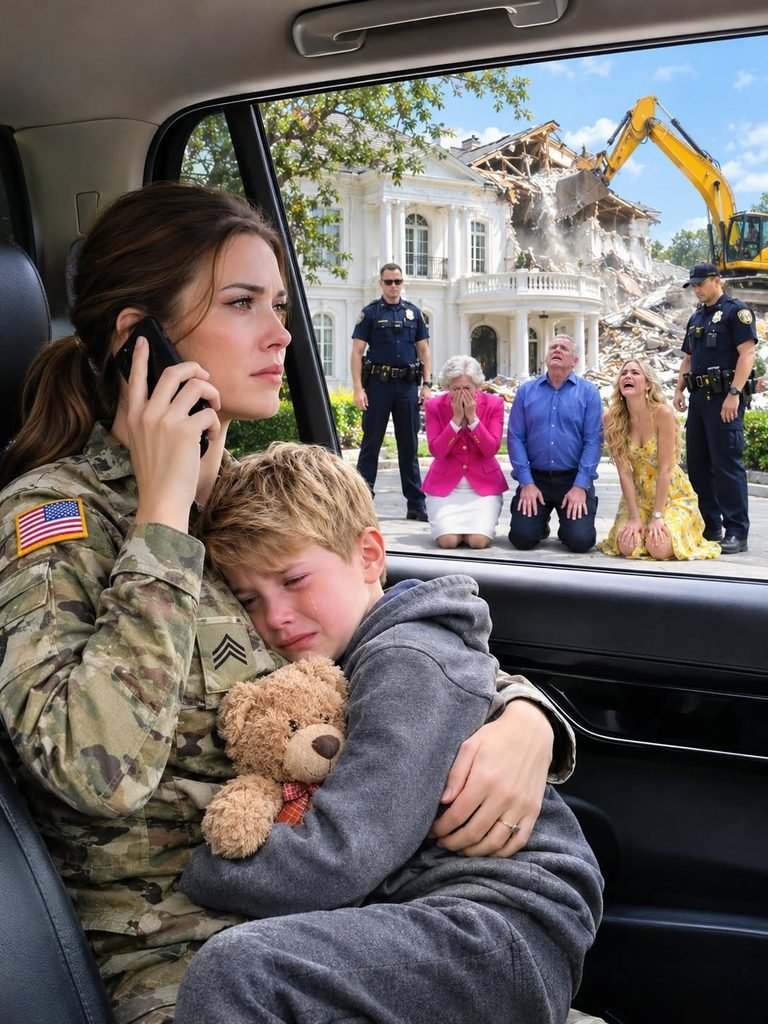
I didn’t argue or cry. I quietly cleaned my son’s ear, picked him up, and walked out. My family thought I was nothing more than a broke, desperate widow. They had no idea why a luxury car was waiting for me outside. Once we got in, I called my board and said, “Execute the plan tonight. By tomorrow, they’ll be the ones with nowhere left to go.”…
PART 1
The dining room went completely silent as my six-year-old son, Tucker, stumbled backward and fell onto the polished hardwood floor. The rich aroma of roasted garlic and expensive wine still filled the room, but nobody moved to help him or even expressed shock at what had just happened.
My sister, Lorna, immediately pulled her own son, Brady, into her arms and began gently stroking his hair, behaving as though he were the one who had been mistreated. Meanwhile, my mother stood beside the dining table, slowly lowering the hand she had just used to strike Tucker across the cheek, her diamond rings glittering beneath the enormous chandelier.
She turned toward me with the same icy, indifferent expression I had endured for thirty years. It was a look she had perfected over decades, one that made me feel insignificant without requiring her to raise her voice.
“Whitney, you need to teach your son some manners.”
Something inside me finally broke, although it wasn’t the love I had once felt for my family. Whatever affection remained had been fading for years, worn away by countless insults, humiliations, and reminders that I would never measure up to Lorna.
What disappeared in that moment was my desperate desire to earn my parents’ approval. Standing on their expensive Persian rug, I finally understood how much of my life I had wasted hoping they would someday treat Tucker and me as though we genuinely belonged in the family.
To them, I had always been the disappointing daughter, the unfortunate widow who supposedly struggled to keep her household finances under control. They considered me someone who deserved pity rather than respect, a woman whose life had gone wrong and who should feel grateful whenever they bothered to include her.
They were convinced they understood exactly who I was and what I was capable of doing. But they had made a terrible mistake, and the events of that Sunday dinner were about to reveal just how badly they had underestimated me.
The confrontation had started over a small toy car that cost very little money but meant the world to Tucker. His father, my late husband, had bought it for him shortly before his heart failed, making it one of the final gifts my son had ever received from his dad.
Since losing his father, Tucker had treasured the little car as a reminder of the man he missed every day. He carried it carefully, protected it from damage, and treated it with a tenderness that showed how deeply he understood its sentimental importance.
I had always respected his attachment to that toy because I knew it represented far more than a childhood possession. To Tucker, it was a connection to his father, and I never allowed anyone to dismiss its significance simply because it wasn’t expensive.
During dinner, Lorna’s son, Brady, had suddenly snatched the car directly from Tucker’s hands. Brady was accustomed to getting whatever he wanted, and Lorna rarely bothered teaching him to respect other people’s belongings.
Tucker hadn’t screamed, threatened Brady, or attempted to start an argument. He had merely reached toward his cousin, hoping to retrieve the precious toy that rightfully belonged to him.
Before he could take it back, my mother sprang from her chair and struck him across the cheek. Her sudden outburst startled everyone, but her anger was directed entirely at Tucker, as though he had committed some unforgivable offense.
“Don’t you dare lay your hands on my grandson!”
The force of the slap sent Tucker stumbling backward until he lost his balance and fell onto the floor. He immediately began crying, frightened and bewildered by the punishment, while Brady remained safely wrapped in Lorna’s arms.
Not one person asked whether Tucker was injured or tried to comfort him. Nobody questioned why my mother had responded so harshly when all he had wanted was the return of a toy that belonged to him.
Instead, my family watched in silence, apparently expecting me to accept the situation and apologize for my son’s supposed misbehavior. They had grown so accustomed to my silence that they seemed incapable of imagining I might finally refuse to tolerate their cruelty.
But this time, something had changed.
The familiar trembling I usually experienced whenever I confronted my family was gone, replaced by a calm determination I had never felt before. I no longer wanted to defend myself, justify my son’s actions, or convince my parents to acknowledge how unfairly they had treated us.
I walked across the dining room, my boots making steady sounds against the hardwood floor, and knelt beside Tucker. Then I gently lifted him into my arms, holding him close as he clung to me and continued crying.
Without addressing anyone at the table, I turned toward the entrance and began walking away. My mother immediately called after me, sounding more offended by my departure than concerned about what she had done.
“Whitney, where exactly do you think you’re going? We haven’t even finished dinner!”
I continued toward the door without looking back.
“I’m taking Tucker to the hospital.”
Lorna responded with a mocking laugh, making it clear that she considered my concern ridiculous. She remained beside our mother with Brady in her arms, apparently convinced that her son had done nothing wrong.
“Oh, please, Whitney. You’re being ridiculous. Tucker needs to learn how to share his things with normal children.”
I reached the front entrance and wrapped my fingers around the cold brass doorknob. Her words made me pause, and for a moment, I stood there holding my crying son while memories of years of mistreatment rushed through my mind.
I had tolerated their insults about my circumstances, their constant comparisons between Lorna and me, and their repeated suggestions that I was somehow less successful or deserving. For years, I had convinced myself that maintaining family relationships was worth enduring their judgment.
But watching them direct that same cruelty toward Tucker changed everything. I could no longer pretend that keeping my parents and sister in our lives was worth the emotional harm they were causing my child.
I tightened my grip on the doorknob before slowly turning to face them.
My mother remained near the dining table, looking irritated that I had interrupted the evening. Lorna stood beside her with Brady in her arms, while the other relatives watched silently, apparently waiting to see whether I would finally apologize.
I looked at each of them and understood that no argument could transform them into the loving family I had spent so many years wishing they would become. They had shown me exactly who they were, and I was finally ready to believe them.
When I spoke, my voice was quiet and controlled.
“You’re right. Tucker does need to learn something from what happened today.”
I paused, keeping my eyes fixed on my mother as I continued.
“And this family is about to learn a lesson of its own.”
For the first time in my life, I didn’t wait for permission, forgiveness, or approval. I opened the front door and carried Tucker into the night, leaving the lavish dinner and everyone seated around that table behind us.
Once we were safely away from the house, I reached inside my coat and removed a second phone. It was an encrypted device my family knew absolutely nothing about, one I had deliberately kept separate from the ordinary phone they had seen me use.
I selected a private contact and placed the call. Someone answered almost immediately, before the first ring had even finished.
“Desmond,” I said, my voice steady and completely free of hesitation. “It’s time to bring the whole thing down. Completely.”
PART 2: What My Son Had Been Carrying
“Mom,” Tucker said from the backseat, his voice thin and shaky. “Am I a bad kid? Is it my fault because I wouldn’t let Brady keep my car?”
In the rearview mirror, I could see the bruise spreading purple across his cheek and the thin cut by his ear where blood had crusted. I had wiped it clean with a napkin before we left the driveway. It was the only thing I’d said to anyone in that house after the slap.
I parked in the emergency room garage, climbed into the backseat, and took his small face in my hands.
“Listen to me, baby. You did nothing wrong. Protecting something Daddy gave you is not bad behavior. And when a grown-up hurts you, the shame belongs to the grown-up. Never to you.”
He stared at his lap. “Grandma says I’m the one who makes trouble.”
During Sunday dinner, my mother sla:pp:ed my 6-year-old son so hard that his ear began ble:ed:ing, all because his cousin had taken his toy. “Teach that feral boy some manners,” she sneered. “Without my money, you two would be homeless.”
“Grandma is wrong.”
I held him until his breathing slowed, and then we went inside.
The pediatric doctor on duty was Dr. Okonkwo, a soft-spoken woman with tired eyes and an easy way of kneeling to a child’s height. She checked the swelling, shined a light into his ear, and confirmed the bleeding came from a small tear in the outer canal, painful but not serious. Then she asked the question I had been dreading.
“Tucker, can you tell me how you got hurt?”
I answered for him. “My mother slapped him.”
Her expression sharpened, though her voice stayed gentle. “Has anything like this happened before?”
Old habits rose in me like a reflex. I wanted to say it was a one-time thing, that she’d had a stressful day, that families fight. I had spent thirty years building excuses for those people.
But Tucker spoke before I could.
“Not like this,” he whispered. “But Grandma squeezes my arm really hard where my sleeve covers it. And when Mom isn’t looking, she pinches the back of my neck.”
The room tilted.
“Tucker,” I said. “Why didn’t you tell me?”
“Grandma said if I told, I’d be a bad boy.” His eyes filled. “She said you were already sad about Daddy and I’d make it worse.”
My mother had taken a grieving child’s love for me and turned it into a lock on his mouth.
Dr. Okonkwo asked him to roll up his sleeves. On both upper arms were faint yellow-green smudges, the fading ghosts of fingerprints. I had bathed this child, and I had never seen them. That is how carefully she had chosen the places.
“There’s more,” Tucker said. He told us about a blue porcelain bowl Brady had dropped at Thanksgiving. His grandmother had decided Tucker would take the blame, because Aunt Lorna would cry if her boy got in trouble. When Tucker said it wasn’t him, she locked him in the dark laundry room until he agreed to apologize.
“I was scared,” he said. “I counted to a hundred four times.”
I couldn’t speak. I just kept my hand on his back and felt his heartbeat through his shirt.
Dr. Okonkwo straightened. “Whitney, I’m required by law to report this. A child protective services investigator and a police officer will come to speak with you both tonight. I’ll document everything.”
“Do it,” I said. There was no hesitation left in me. “Please. Document all of it.”
The detective, a calm man named Reyes, arrived within the hour, followed by a county caseworker, Ms. Alvarez. They interviewed Tucker with a child specialist in a room with beanbag chairs and crayons, and they photographed his arms and face. Through it all I sat in a plastic chair outside the door and watched the clock, thinking about the second phone in my coat pocket.
At 11:40 p.m., Desmond’s message arrived. Board is assembled. Waiting on your word.
I stepped into the hallway and called him back.
“Whitney.” Desmond Hale had been my late husband’s closest friend, and for four years he had been the only person who knew everything. “Is Tucker all right?”
“He will be. They put his father’s car in a little evidence bag so it wouldn’t get lost,” I said, and found I was nearly laughing and nearly crying. “I need you to go ahead.”
“Are you certain? Once the notice goes out tonight, there’s no recalling it.”
“I’ve been certain for four years,” I said. “I only needed a reason strong enough to stop being kind about it.”
To understand what happened next, you have to understand what my family never bothered to learn.
My late husband, Cole Pierce, was not a modest man who died young and left me struggling. He founded Pierce Meridian Capital, a private lending and investment firm, and when his heart stopped at forty-one, he left me his controlling interest and a board of directors who had been trained to take direction from me. I had been his partner in the business long before I was his wife. I just never wore it on my sleeve.
I stayed quiet afterward for a reason. When I told my parents about Cole’s death, my mother’s first question was whether there was life insurance. She never asked about Tucker. It told me exactly how my grief would be treated if they knew how much I had. So I let them believe what they already assumed. I drove an older SUV. I wore plain clothes. I accepted the occasional casual check from my mother, “so you two don’t starve,” and I deposited every one into an account for Tucker’s future, untouched.
And in the meantime, I watched.
My father, Gerald Prescott, ran Prescott Family Hotels, eleven properties across Texas and Oklahoma that had been in his family for three generations. Under his management, and with my mother and Lorna spending lavishly from the company’s accounts, the business had been bleeding for years. Two years ago, when his bank cut him off, a lender called Redwater Bridge Finance stepped in with a $42 million line of credit, secured by the hotels and by my parents’ house.
Redwater Bridge Finance was a subsidiary of Pierce Meridian Capital.
I had approved the loan from my kitchen table. Cole’s old team had advised me not to, but I’d wanted the hotels to survive, for the two thousand people who worked in them. I told myself it was kindness to a family that didn’t deserve it. The terms were fair, and the covenants were reasonable. They required timely financial reporting and a ban on diverting company funds to personal expenses.
My father had broken both. Repeatedly. I knew because Desmond had sent me the audits every quarter, and every quarter I had decided to look away.
That night, I stopped looking away.
“The board votes at midnight,” Desmond said. “Notice of default on the credit facility. Acceleration of the full balance, due in thirty days. And the house, Whitney. You know what that means.”
“I know.”
“Employees?”
“Protected,” I said. “I’ve already instructed the restructuring team. We’ll bring in a professional management company to take over operations and keep every hotel open. Every employee keeps their job and their pay. No front-desk clerk, no housekeeper, no cook pays for my father’s choices.”
“And your parents?”
“They will keep what the law lets them keep,” I said. “Which is a great deal less than they believe.”
There was a pause.
“For what it’s worth,” Desmond said, “Cole would have done this years ago.”
“Cole would have been kinder about it. That was the mistake.” I looked through the door window at my son, curled on a beanbag beside Ms. Alvarez, holding the empty spot where his car had been. “I’m done being kind to people who hurt him.”
The vote passed unanimously at 12:07 a.m.
The first call came at 7:30 the next morning.
I let it ring. So did the next fourteen. By nine, my mother had left voicemails that moved, in order, from fury to confusion to something that sounded almost like fear. By ten, my father’s number appeared, and then Lorna’s.
I answered my father’s call on the fifth attempt, standing in the kitchen of the small rental I’d chosen to keep Tucker feeling normal. I put it on speaker.
“Whitney.” His voice was strained, stripped of its usual pomp. “I’ve received a letter. From Redwater Bridge Finance. It says our credit facility is in default, and that the entire balance is due. There must be some mistake.”
“There’s no mistake, Dad.”
“Redwater is a lender. A lender I’ve worked with for two years. How do you know…” He stopped. When he spoke again, it was barely a whisper. “Whitney. Who owns Redwater?”
“Pierce Meridian Capital. Cole’s company. Mine now.”
The silence on the line went on for so long I checked whether the call had dropped.
“You’ve been the lender,” he said at last. “This whole time.”
“Yes.”
“You let us believe…”
“I let you believe what you already believed. That I was a poor, sad widow you could talk down to.” I kept my voice level. “You never asked me a single question about my life, Dad. Not one, in four years.”
“I didn’t know what your mother had been doing to Tucker. I swear to you.” His voice cracked. “The police came to the house at dawn. They took her statement. They said there were bruises, that Tucker had been…” He couldn’t finish.
“Mom pinched my son’s neck and locked him in a dark room for six years of Sundays. You were in the next room, Dad. You never noticed because you never looked.”
“Whitney, please. We can work this out. The company, the house, your mother’s age…”
“Here is what happens,” I said. “The default notice stands. The company will be transferred to professional management, and every employee will keep their job. You’ll have thirty days to settle what you owe. Your lawyers can contact mine. And Mom will have no contact with Tucker. Ever. That’s not a negotiation.”
“She’s your mother.”
“And he’s my son.”
I ended the call.
Lorna’s came next. I almost didn’t answer, but I wanted to hear it.
“What did you do?” she screamed. “Mom can’t stop shaking! Dad’s lawyer says we could lose the house! You’re destroying this family over a toy car!”
“Brady took something that wasn’t his,” I said quietly. “And you taught him it was acceptable because nobody ever corrected him. That’s what you’ve been doing to him his whole life, Lorna. I’m sorry for him. Truly.”
“You’re sick.”
“Goodbye, Lorna.”
The legal process moved faster than I’d expected, because the evidence was clean. Dr. Okonkwo’s records, Tucker’s recorded interview, the bruising photographs, and the testimony of the housekeeper, who, when Detective Reyes spoke to her, finally admitted she had seen my mother grab Tucker’s arm more than once and had been too afraid of losing her job to say so.
My mother was charged with injury to a child. Her attorney negotiated a plea: probation, a mandatory anger-management and parenting program, a permanent protective order barring contact with Tucker, and a public record she couldn’t scrub. At the hearing, she wore pearls and a cardigan and looked, for the first time in my life, small. She tried to meet my eyes across the courtroom. I looked at the judge.
The default proceedings took longer but ended the same way. The hotels stayed open under new management, and not one employee lost a paycheck. My father’s debts were settled through the sale of the house and several personal assets. Within three months, my parents moved into a two-bedroom condominium forty minutes from the old estate. Lorna’s husband, who had never liked the way the family operated, moved out the same month, taking Brady with him to his own parents’ home. I heard later that Brady, away from his grandmother’s indulgence, was finally in a classroom where someone told him no.
It would be a lie to say I felt triumphant. What I felt, mostly, was tired, and a little hollowed out, the way you feel after finally setting down something very heavy you’d carried so long you forgot it wasn’t part of your body.
My father wrote me a letter in the fall. Three pages, handwritten. He said he was ashamed. He said he had spent his life believing that if you paid the bills and kept up appearances, you had done your duty as a father, and that he had failed to notice what was happening in his own dining room. He did not ask me to forgive him. He asked only that someday, if Tucker ever wanted to know him, I would allow it.
I put the letter in a drawer. I didn’t answer for four months. When I did, I wrote only: If Tucker asks, I’ll let you know. Until then, please give us room.
EPILOGUE: One Year Later
Tucker is seven now. The bruise faded in a week, but the nightmares took longer. For the first three months, he slept with his light on and woke up counting. Then he started seeing a child therapist named Ms. Bellamy, a gentle woman with a basket of puppets, who taught him something I wish someone had taught me at his age: that his feelings were his, and that telling the truth is never a way of being bad.
One afternoon in spring, he came out of her office holding a drawing. It showed a boy, a woman, and a very large dog.
“That’s us,” he said. “And that’s Biscuit.”
“Who’s Biscuit?”
“The dog we’re getting.” He said it with total confidence. “Ms. Bellamy said it was okay to ask for things I want.”
We got Biscuit that weekend, a scruffy brown mutt from the county shelter, who promptly chewed a hole in my favorite slipper and slept at the foot of Tucker’s bed ever after.
The little toy car came back to us from evidence in a plain envelope. Tucker held it for a long time without saying anything. Then he asked if we could put it somewhere it wouldn’t get lost, and we built a small shelf by his window, and the car sits on it now, beside a framed photograph of Cole laughing on a boat.
“Do you think Daddy knows?” Tucker asked me once, looking at it. “About what happened with Grandma?”
“I think he’d be very proud of you,” I said. “You told the truth, even though you were scared. That’s the bravest thing there is.”
He thought about it. “I think he’d say you were brave too.”
I turned my face so he wouldn’t see my eyes.
I never made a show of my wealth. I kept the same house, the same plain SUV, and the same Sunday routine of pancakes and cartoons. But I put the money to work in ways that would have made Cole smile. I endowed a legal-aid fund for families dealing with child abuse, with attorneys who would never charge a parent a dime. I built a scholarship in Cole’s name at the community college where he’d first studied finance. And when Desmond suggested that I formally take the chair of the board, I said yes, finally, using my own name.
My mother tried to reach me twice that year, once by letter and once through a lawyer. I answered neither. The protective order held. I don’t know whether she’s changed, and I’ve stopped needing to know.
On the anniversary of that Sunday dinner, Tucker and I drove out to the lake and sat on the dock with Biscuit panting between us. The water was glassy, the sky going orange, and a pair of ducks drifted past as if they had nowhere to be.
“Mom?” Tucker said.
“Yes, baby?”
“I’m glad we left.”
I put my arm around him and felt his small, warm weight settle against my side.
“So am I,” I said. “So am I.”
For thirty years, I had waited at a table that never had a chair for me. In the end, I didn’t need to burn that table down. I only needed to stop sitting at it.
Out on the water, the light slipped away, and my son leaned his head on my shoulder, safe, and home, and finally free.
THE END.