I Nearly Reported the Elderly Grocery Clerk—Then a Teenage Bagger Told Me Why She Had Come to Work That Morning
“Ma’am, you charged me twice.”
My voice came out sharper than I intended, but I didn’t take it back.
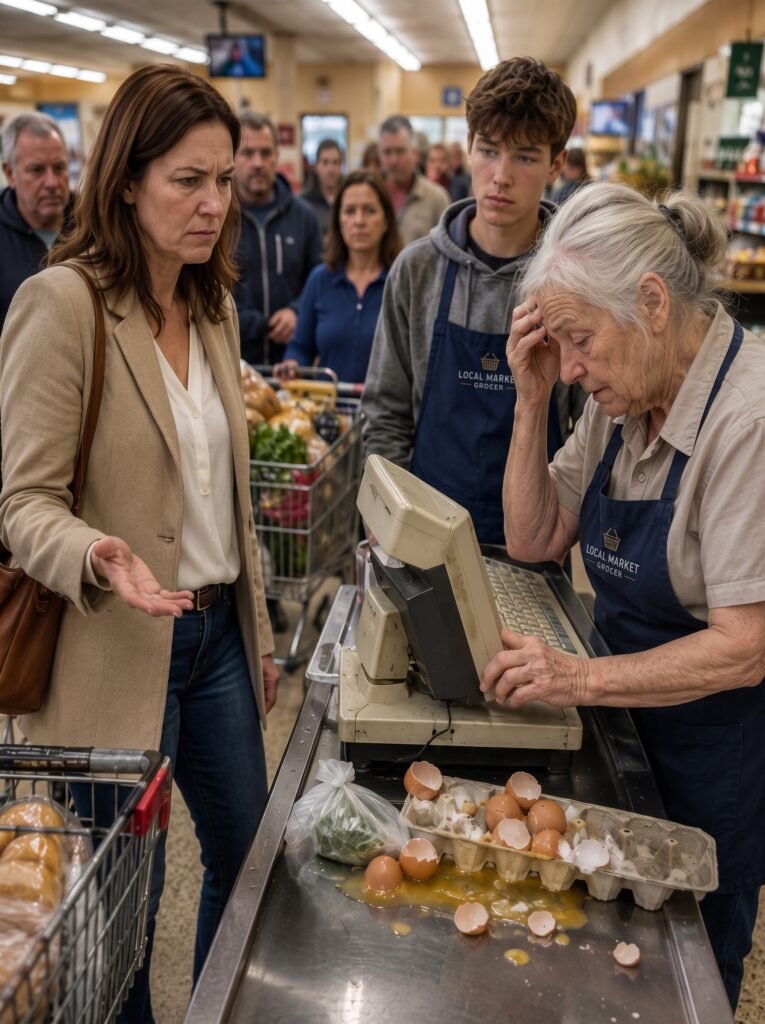
The elderly clerk stared at the register screen as if the numbers had suddenly become a foreign language. Her name tag said **DELIA**, and beneath it, in smaller letters, **18 Years of Service**.
“I’m sorry,” she whispered. “Let me fix that.”
Her fingers shook as she pressed several buttons. The register beeped angrily, and the line behind me grew longer.
Someone sighed.
A cart wheel squeaked.
A toddler began crying near the candy display.
I checked my phone. It was 5:42 on a Thursday evening, and I still had a presentation to finish before morning. I had stopped at the small grocery store in Cedar Falls for milk, eggs, coffee, and something easy to heat for dinner.
This should have taken five minutes.
Instead, Delia had scanned my bread twice, forgotten to bag the milk, and dropped my carton of eggs when she tried to move it toward the bagging area.
Two eggs cracked against the counter.
Yellow yolk seeped through the cardboard.
“Oh, goodness,” she said, pressing one hand to her mouth. “I’ll get you another carton.”
I closed my eyes and took a slow breath.
“Could you please call someone else?” I asked. “I really don’t have time for this.”
The words weren’t cruel, exactly.
But they weren’t kind.
Delia nodded quickly. “Of course.”
She turned toward the teenage bagger beside her. He was a lanky kid with messy brown hair and a grocery apron that looked two sizes too big.
“Micah, would you ask Mr. Raines to come up?”
The boy didn’t move.
He looked at Delia first, then at me.
“I can get the eggs,” he said quietly.
“That’s all right,” Delia replied. “The customer asked for someone else.”
Customer.
The word made the moment sound official, as though I were filing a complaint instead of standing in front of a tired woman who looked old enough to be my mother.
Still, I was irritated.
I had spent my entire day listening to people make excuses. A missed deadline. A forgotten email. A report full of mistakes.
I was a consultant. Details mattered. Time mattered. If people couldn’t do a job properly, someone had to say something.
That was what I told myself as Delia struggled to remove the duplicate charge.
Then she dropped the receipt paper.
She bent to retrieve it, but Micah reached it first.
When he stood, he gently placed a hand near her elbow.
“Mrs. Brooks,” he said, “maybe you should sit down for a minute.”
“I’m fine, sweetheart.”
“You haven’t eaten.”
“I’ll eat on my break.”
“You said that three hours ago.”
Delia gave him a look that was almost a smile.
“I’m all right.”
The boy’s face tightened. He turned toward me, lowering his voice.
“She came straight here from the hospice center.”
Delia froze.
“Micah,” she said softly.
But he continued.
“Her husband has been there for two weeks. She stayed beside him all night, and this morning the nurse told her he might not make it through the weekend.”
The sounds of the store seemed to fade.
The crying child.
The squeaking cart.
The impatient breathing behind me.
All of it disappeared beneath the sudden pounding in my chest.
Micah glanced down at the cracked eggs.
“She tried to call out,” he added, “but she already missed several shifts. She said she needs the money for their house payment and medicine.”
Delia’s eyes filled.
Not dramatically.
Not in a way that asked anyone to feel sorry for her.
She simply looked down at her hands and folded them together, as if she could hide the trembling by holding on to herself.
“I’m sorry,” she said to me again. “I know this isn’t your problem.”
That sentence broke something inside me.
Not your problem.
I thought about my mother, who had worked the front desk at a motel until she was seventy because my father’s retirement check didn’t cover everything.
I remembered how she used to rub her swollen feet at the kitchen table after late shifts.
She had died five years earlier.
Toward the end, I had become so busy that I called her while answering emails. I listened with half my attention. I promised to visit “when things slowed down.”
Things never slowed down.
Life simply ran out of time.
I looked at Delia’s silver hair, pinned carefully at the back even though several strands had fallen loose. Her faded wedding ring sat on a finger made thin by age.
“How long have you been married?” I asked.
She looked surprised.
“Forty-seven years next month.”
“What’s his name?”
“Gordon.”
The name left her lips with such tenderness that I could almost see the years behind it.
Forty-seven Christmas mornings.
Forty-seven summers.
Arguments over bills, cups of coffee on quiet porches, children raised, parents buried, ordinary Tuesdays that didn’t seem precious until they were almost gone.
“He was a mechanic,” she said. “He could fix anything. Never threw away a tool in his life.”
A small laugh escaped her, but it quickly became a shaky breath.
“He keeps asking me to come back. Even when he’s barely awake, he asks the nurse whether I’m coming.”
I looked at my cart.
Milk.
Coffee.
Bread.
The dinner I had been in such a hurry to buy.
Then I looked at the clock above the customer service desk.
5:48.
Six minutes had passed.
Six minutes I had treated like an emergency while this woman’s entire life was waiting in a hospice room.
“Please cancel my order,” I said.
Delia blinked. “I can finish it. I promise.”
“No,” I said gently. “I mean, cancel it because you’re leaving.”
Her eyebrows lifted.
I turned to Micah. “Can you find the manager?”
Mr. Raines arrived less than a minute later, wearing a white shirt with his sleeves rolled up.
Before he could speak, I said, “Delia needs to go be with her husband.”
Delia shook her head. “I can’t lose another shift.”
“You’re not going to,” the manager said.
She stared at him.
He seemed embarrassed.
“I didn’t know how serious it was,” he admitted. “You should have told me.”
“I didn’t want special treatment.”
“It isn’t special treatment to let someone be human.”
The people in line had gone quiet.
A middle-aged man behind me stepped forward and placed a twenty-dollar bill on the counter.
“For gas,” he said.
A woman holding a bag of dog food added ten dollars.
“Get something to eat on the way.”
Then an older gentleman near the end of the line removed his cap.
“My wife spent her last days in hospice,” he said. “Don’t miss a minute you can still have.”
One by one, people placed what they could on the counter.
Five dollars.
Ten dollars.
A folded twenty.
No speeches.
No one asked for credit.
They simply gave.
I opened my wallet and removed the grocery gift card my company had given me for the holidays. I had carried it for months without using it.
Two hundred dollars.
I placed it in Delia’s hand.
“For groceries,” I said. “And for whatever Gordon wants when he comes home.”
Her face crumpled.
“We don’t know if he will,” she whispered.
“Then use it for something that lets you stay beside him.”
Delia covered her mouth.
I wanted to apologize for my impatience, but the words felt too small. So I told her the truth.
“My mother worked when she should have been resting. People judged her when she was tired. I wish I had noticed sooner.”
Delia reached across the counter and squeezed my hand.
“Maybe you noticed today,” she said.
Micah helped her gather her purse and coat.
As she walked toward the exit, every person in that checkout line stepped aside.
No one complained about waiting.
No one checked the time.
We watched an exhausted wife hurry through the automatic doors toward the man who had spent forty-seven years waiting for her to come home.
I never finished my presentation that night.
Instead, I called my older sister, whom I had barely spoken to in months. We talked for nearly an hour about our mother, our childhood kitchen, and all the small things we had once believed would last forever.
The next afternoon, I returned to the store with a fresh carton of eggs and an envelope for Delia.
Mr. Raines told me Gordon had passed away shortly after sunrise.
But Delia had been beside him.
She had held his hand.
And his final words were the same ones he had asked the nurse all week.
“There you are.”
I stood in that checkout lane and cried for two people I had never truly known.
One was Gordon.
The other was the woman my mother had been when I was too busy to see her.
I had entered that store believing professionalism meant never making mistakes.
I left understanding that dignity sometimes means allowing people to be imperfect while their hearts are breaking.
Since that day, I have tried to pause before deciding someone is lazy, careless, rude, or slow.
The cashier may have spent the night in a hospital.
The driver may be carrying terrible news.
The coworker who forgot something may be holding a family together with both hands.
Most people will never announce the heaviest thing they are carrying.
They will simply show up, straighten their name tag, and try to make it through another shift.
Sometimes the kindest thing we can give another person is not our money, but the grace to remember that we cannot see the battle behind their tired eyes.
PART2
The envelope I brought back the next afternoon sat unopened in my bag for three days before I found the courage to actually give it to her. Mr. Raines told me Delia had taken bereavement leave, and gave me her address only after I explained, haltingly, that I just wanted to check on her, not intrude.
I almost didn’t knock. I sat in my car outside a small brick house with a well-tended garden and a mechanic’s workshop visible through the open garage door — tools hung with the kind of careful precision that spoke of decades of use, decades of a man who never threw away a tool in his life. I thought about turning around, about how strange it must seem for a stranger from a grocery line to show up at a widow’s door three days after her husband’s death.
Then I remembered my mother, and the visits I kept postponing until there was no more time left to postpone them, and I got out of the car.
Delia answered wearing a cardigan I recognized from the store, her silver hair loose around her shoulders instead of pinned back, looking smaller somehow without the register and the name tag and the eighteen years of service between us.
“You came back,” she said, not quite a question.
“I brought the eggs,” I said, holding up the carton, feeling suddenly foolish. “And this.” I held out the envelope. Inside was a card, and a check — not extravagant, but enough to help with whatever came next, whatever the gift card hadn’t already covered.
She didn’t open it right away. Instead, she stepped back from the door and said, “Would you like some coffee? Gordon always said nobody should stand on a porch when there’s coffee inside.”
I stayed two hours that afternoon, sitting at a kitchen table that still had a second coffee mug set out from habit, listening to Delia talk about a man I’d never met but somehow felt, by the end of it, that I understood a little. How he’d fixed the neighbor’s lawnmower for free every spring for twenty years. How he’d cried, secretly, the day their daughter left for college, then pretended he hadn’t when Delia caught him. How he’d started forgetting words near the end, but never once forgot her name.
“He asked for you, you know,” she said, near the end of our visit. “Not by name. He didn’t know you. But the nurse told me, the morning after you helped me leave the store, that he kept saying someone had been kind to his Delia. I think somewhere in that fog he understood something had shifted. That I wasn’t going to lose my job over him.”
I thought of the twenty-dollar bill from the stranger behind me in line, the folded bills from people who’d never met Delia or Gordon either, all of them stepping forward without being asked, without wanting credit.
“It wasn’t just me,” I said. “It was everyone in that line.”
“I know,” she said. “But you started it. Sometimes that matters too.”
I visited Delia every few weeks after that, not out of obligation, but because something in those afternoons at her kitchen table had become its own quiet gift — a reminder, repeated and reinforced each time, of exactly the kind of attention I’d stopped paying to my own mother in her final years.
My sister and I kept talking, too, the conversation that started the night Gordon died stretching into weekly calls, then monthly visits, slowly rebuilding a closeness we’d let atrophy under the weight of careers and distance and the particular busyness that convinces you there will always be more time later.
“I keep thinking about Mom,” I told her one evening, both of us sitting on my back porch during one of her visits, the same kind of ordinary Tuesday evening Delia had described as suddenly precious once so few of them remained. “About how much of her tiredness I just walked past. I was so focused on being professional, on managing my time, that I never stopped to wonder what she was carrying underneath all those late shifts.”
“We were young,” my sister said. “We didn’t know how to see it.”
“I’m not young anymore,” I said. “I don’t have that excuse.”
Delia returned to the grocery store three months later, part-time, mostly for the company as much as the income, since Gordon’s modest life insurance had covered the house payment she’d feared losing. Micah still bagged groceries most afternoons, checking on her between customers the same steady way he had that Thursday evening, and I made a point of stopping by her register whenever I shopped there, even when another line moved faster.
“How are you today, Mrs. Brooks?” I asked one afternoon, nearly a year after Gordon’s death.
“Some days are harder than others,” she said, scanning my groceries with hands that had steadied considerably since that trembling evening. “But I get up. I come here. I see Micah, and you, and the regulars who still ask about me even now. That’s something, isn’t it?”
“That’s everything,” I said.
She smiled, the same small, knowing smile I remembered from that first terrible, transformative evening. “You know, you still rush sometimes. I’ve noticed you checking your watch.”
“Old habits,” I admitted.
“Just remember what you learned,” she said, handing me my receipt. “That’s all any of us can do. Remember, and then try again tomorrow.”
I left the store that day without checking the time once, carrying groceries and something heavier and more valuable than anything on the receipt — the ongoing, imperfect practice of choosing patience over efficiency, of remembering that everyone standing in line, behind every counter, carrying every apron, was fighting some battle I couldn’t see.
Gordon had waited forty-seven years for Delia to come home each night. I’d spent five years since my mother’s death learning, slowly and imperfectly, how not to let anyone else’s tiredness go unseen the way hers so often had.
Some lessons, I’ve found, don’t arrive all at once. They arrive in grocery lines, in kitchen conversations, in the quiet, ordinary Tuesdays we don’t recognize as precious until we’re the ones running out of time to notice them.
Two years passed, marked by the small, steady rhythms of a life reshaped by that one Thursday evening in a grocery store — my sister and I now speaking every week without fail, Delia’s kitchen table becoming a place I visited as much for my own sake as for hers, Micah graduating high school and heading off to community college with plans to become a nurse, inspired, he told me once, by watching the hospice staff care for Gordon in his final days.
It was Micah who called me on a Tuesday afternoon in early spring, his voice careful in a way that made my stomach drop before he’d said more than my name.
“Mrs. Brooks had a stroke,” he said. “She’s at Cedar Falls Memorial. It’s not — the doctors think she’ll recover, but they’re saying she’ll need help. A lot of help, for a while.”
I was in my car within ten minutes, driving to a hospital I hadn’t visited in years, remembering with sudden, sharp clarity all the times I’d told my mother I’d visit “when things slowed down,” and how those words had cost me years I could never get back.
Delia was awake when I arrived, her speech slightly slurred, one side of her face drooping in a way that frightened me more than I let show, but her eyes found mine the moment I walked in, and something in them eased.
“You came,” she said, the words coming slower than usual but no less warm.
“Of course I came,” I said, taking the hand that wasn’t affected, the same hand that had squeezed mine across that grocery counter two years earlier. “You don’t get to have a stroke and expect me not to show up.”
She managed something close to a laugh. “Bossy,” she said. “Just like that day. Ordering me to go home to Gordon.”
“Best order I ever gave,” I said. “I’m about to give another one. You’re going to let people help you. All of us. No arguments about not wanting to be a burden.”
Her eyes filled, the same quiet, undramatic tears I remembered from that checkout line, and she nodded slowly.
We organized it the way that first grocery line had organized itself — not through grand gestures, but through small, steady contributions from people who’d been touched, in one way or another, by Delia’s story. Mr. Raines arranged a meal train through the store’s employees. My sister, who’d become genuinely close with Delia over the past two years of shared holidays and long phone calls, took on coordinating her physical therapy appointments. Micah deferred his first semester of community college by a term, moving in temporarily to help with the practical realities of her recovery — meals, medications, the small humiliations of relearning tasks a body once did without thought.
I visited three times a week, sometimes just to sit with her while she worked through speech exercises, sometimes to simply hold her hand while she cried through the frustration of a body that no longer moved the way it used to.
“I keep thinking about Gordon,” she told me one afternoon, months into her recovery, her speech nearly back to normal, her right hand slowly regaining strength. “How he waited for me every single day at that hospice, no matter how tired he was, no matter how much pain he was in. He never once complained that I made him wait while I finished a shift, or ran an errand, or just needed a moment to catch my breath.”
“He loved you,” I said simply.
“He did. Forty-seven years of it.” She looked at me, her eyes clear and steady despite everything her body had been through. “I think that’s why I never wanted to be a burden to anyone, all those years working when I should have rested. I watched him give so freely, and some old, foolish part of me thought accepting help back meant I hadn’t given enough myself.”
“You gave plenty,” I said. “You’re allowed to receive now too.”
She squeezed my hand — the good one, steadier now than it had been in months — and something settled between us that felt less like gratitude and more like the particular, hard-won equality of two people who’d taught each other, across a grocery counter and then across years of kitchen-table afternoons, exactly what it means to truly see another person’s exhaustion and choose to stay anyway.
Delia recovered enough, eventually, to return to the small brick house with the garden and Gordon’s workshop, though she never went back to the grocery store — retirement, this time, freely chosen rather than economically forced, funded partly by Gordon’s insurance and partly, she confessed to me once with a small, embarrassed laugh, by the two hundred dollars on that gift card she’d never quite spent, tucked away instead as a reminder of the day a line of strangers decided her exhaustion mattered more than their schedules.
I still think, often, about that Thursday evening — the cracked eggs, the impatient sigh I’d let slip before I understood what I was witnessing, the slow unraveling of my own carefully guarded busyness in the face of a woman’s quiet, unglamorous heartbreak. I think about my mother’s swollen feet at our kitchen table, and how many years it took me to finally understand what Delia taught me in six unexpected minutes at a register.
Most people will never announce the heaviest thing they’re carrying. They’ll simply show up, straighten their name tag, and try to make it through another shift.
I’ve spent the years since trying to notice anyway — not perfectly, not every time, but enough. Enough to call my sister without an agenda. Enough to sit with Delia through the slow, unglamorous work of recovery. Enough to remember, whenever my patience wears thin in a checkout line or a waiting room or anywhere else life moves slower than I’d like, that dignity sometimes means allowing people to be imperfect while their hearts are quietly breaking, one ordinary Tuesday at a time.
Gordon waited forty-seven years to say “there you are” one final time.
I like to think, in my own smaller way, I’ve spent every day since that Thursday evening trying to make sure the people in my life never have to wonder whether I’ll show up when it matters.
THE END