The voice on the satellite phone did not rise.
It didn’t need to.
“Lieutenant Frank Hale,” it said with measured precision, “this residence is surrounded by federal personnel. Place your weapon on the nearest flat surface, remove your hands from it, and step away from General Evelyn Voss immediately.”
Silence.
Not the peaceful kind.
The kind that squeezes the air from a room.
Frank swallowed.
For the first time since I had walked into my mother’s kitchen, he looked uncertain.
Outside, tires crunched over gravel.
Doors opened.
Heavy boots struck pavement in perfect rhythm.
Kyle stumbled backward another step.
“Dad…” he whispered.
Frank snapped his head toward him.
“Shut up.”
But the words had lost their weight.
Another knock echoed through the house.
Three measured strikes.
Nobody knocked again.
They didn’t have to.
The front door opened.
Frank had forgotten he’d never locked it.
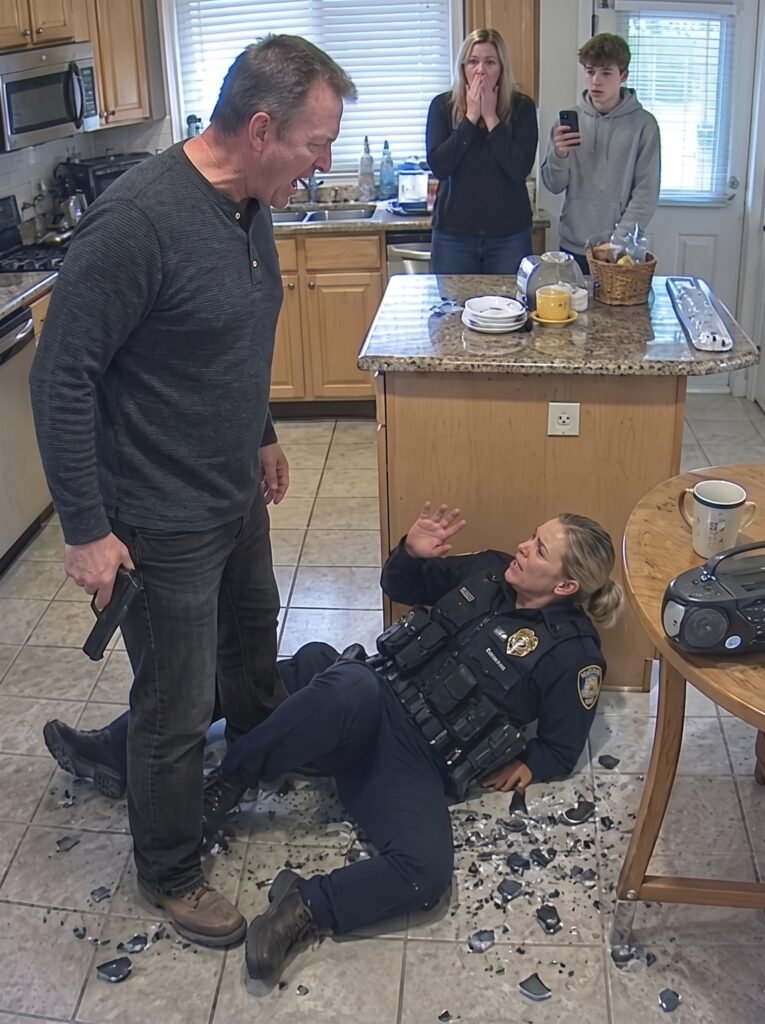
Six people entered in dark tactical uniforms without rushing, each movement calm and rehearsed. Their rifles remained pointed toward the floor, but there was no mistaking who controlled the room now.
A man wearing civilian clothes stepped in behind them.
Gray suit.
Silver hair.
Department of Defense credentials hanging from his neck.
He looked once at me.
Then at the handcuffs.
Then at Frank’s pistol.
His expression never changed.
“Lieutenant Frank Hale?”
Frank straightened instinctively.
“Who are you?”
The man ignored the question.
“Weapon.”
Frank hesitated.
One of the agents simply said, “Last warning.”
The pistol suddenly seemed much heavier in Frank’s hand.
It hit the kitchen counter with a dull metallic clack.
The room exhaled.
Two agents immediately moved forward.
One secured Frank.
The other knelt beside me.
“General Voss?”
“I’m fine.”
He examined the cut on my cheek anyway before unlocking the handcuffs.
The steel clicked open.
Blood rushed back into my hands.
Only then did I stand.
Not quickly.
Not dramatically.
Just carefully.
My mother stared at me as though she were seeing a stranger.
“Evelyn…”
I looked at her.
There were a thousand conversations waiting between us.
None belonged in that kitchen.
The suited official finally introduced himself.
“Deputy Undersecretary Daniel Mercer, Department of Defense.”
He turned toward Frank.
“You interrupted a classified military communication.”
“You unlawfully restrained an active-duty United States Army general.”
“You pointed a loaded firearm at that officer while the communication remained live.”
Each sentence landed harder than the one before.
Frank tried to recover.
“I… I believed she was impersonating—”
“You never verified her identity.”
“I was conducting an investigation.”
“You conducted an assault.”
“I was protecting my family.”
“You endangered them.”
Frank’s face reddened.
“I’m a police lieutenant!”
Mercer nodded once.
“You were.”
An FBI agent stepped through the doorway carrying a tablet.
“Sir.”
Mercer glanced down.
“Local police chief has been notified.”
Another pause.
“State authorities have accepted jurisdiction.”
Frank stared.
“What?”
“The Ashford Police Department has suspended your law enforcement authority effective immediately.”
“No…”
“Your service weapon is being seized.”
“No!”
“Your badge is revoked pending federal investigation.”
Frank lunged forward.
It lasted less than a second.
The agents restrained him effortlessly.
My mother burst into tears.
“Frank… stop…”
Kyle stood frozen beside the refrigerator.
His phone still lay on the floor recording everything.
One of the agents picked it up.
“Sir, the entire incident appears to have been captured on video.”
Mercer looked at Kyle.
“Did you record this voluntarily?”
Kyle nodded weakly.
“I… I thought she was lying.”
Mercer held out his hand.
“I’ll need the phone.”
Kyle surrendered it without a word.
Frank watched his son’s phone disappear into an evidence bag.
Something inside him finally cracked.
“This is ridiculous!”
“No,” Mercer replied quietly.
“This is accountability.”
The kitchen fell silent again.
Outside, neighbors had gathered behind police tape.
Everyone wanted to know why military vehicles, federal agents, and marked police cars had descended upon the quietest street in Ashford.
None of them knew the truth.
Not yet.
Mercer turned toward me.
“General, transportation is ready.”
I looked once more at the woman who had raised me.
She took one hesitant step forward.
“I… I didn’t know.”
I believed her.
That didn’t erase what she had allowed.
“I know,” I answered softly.
“It doesn’t change what happened.”
She covered her face and began to sob.
I walked past her.
Past Frank.
Past the shattered version of the family I had spent years trying to repair.
As I reached the front door, Mercer spoke one final sentence without raising his voice.
“Lieutenant Hale, by authority of the United States Government, you are under federal investigation for assault on a commissioned officer, interference with military operations, unlawful detention, and threatening the life of an active-duty general.”
The handcuffs closed around Frank’s wrists.
This time…
They were not coming off.
Flashing lights painted the quiet neighborhood red and blue long after I left.
From the back seat of the armored SUV, I watched my childhood home disappear behind rows of federal vehicles. The little white house where I had learned to ride a bicycle, where my mother had once tucked me into bed after nightmares, had become a crime scene.
I didn’t cry.
Generals rarely did in public.
But silence had always been my way of mourning.
Deputy Undersecretary Daniel Mercer sat across from me, reading reports as they appeared on his secure tablet.
“The Secretary has already been informed.”
“I expected that.”
“You also have calls waiting from the Joint Chiefs.”
“They can wait.”
Mercer looked at me over the edge of the screen.
“You almost died today.”
“I know.”
“No, General.”
His voice softened.
“You almost died because someone believed his pride mattered more than the truth.”
Neither of us spoke for the rest of the drive.
By sunrise, every federal agency involved had completed their preliminary reports.
Frank Hale had been booked into federal custody.
His law enforcement credentials had been suspended indefinitely.
His pension was frozen.
His security clearances—limited as they were—were revoked.
The investigation expanded beyond the assault.
Evidence recovered from his office revealed years of questionable arrests, falsified reports, and intimidation complaints that had somehow disappeared.
The Pentagon had unintentionally pulled on a thread that unraveled an entire career built on fear.
News broke before noon.
“LOCAL POLICE LIEUTENANT ARRESTED AFTER ARMED STANDOFF WITH U.S. ARMY GENERAL.”
Every station wanted interviews.
Every newspaper wanted photographs.
The cellphone video Kyle had recorded leaked within twenty-four hours.
Millions watched Frank shouting that I was a fraud.
Millions watched federal agents walk through the front door.
Millions watched him lose everything.
The internet never forgot.
My mother called thirty-six times during the first week.
I answered none.
Not because I hated her.
Because I wasn’t ready to hear the sound of her crying.
She left voicemail after voicemail.
“Evelyn…”
“I’m so sorry.”
“I should have believed you.”
“I should have protected you.”
Every message sounded smaller than the one before.
By the tenth message she wasn’t asking for forgiveness anymore.
She was simply hoping I was alive.
Meanwhile, Kyle disappeared.
Reporters surrounded his apartment.
His coworkers recognized him from the viral video.
Friends stopped calling.
He eventually resigned from his job without telling anyone.
I later learned he had moved into a motel nearly two hundred miles away.
Running was easier than explaining.
Three weeks after the incident, I received permission to review the evidence.
The recording played inside a secure conference room.
No reporters.
No cameras.
Only me.
For forty-three minutes I watched myself remain calm while a loaded pistol pointed toward my chest.
Then I watched something I had missed that day.
My mother.
She had stepped between us.
Only slightly.
Barely enough for anyone else to notice.
But she had moved.
Instinctively.
If Frank had fired…
She would have been hit first.
I paused the video.
Maybe love had survived inside her after all.
It had simply been buried beneath years of fear.
Frank’s attorneys attempted every defense imaginable.
He claimed confusion.
Stress.
Mistaken identity.
Self-defense.
Mental exhaustion.
None explained why he had ignored repeated federal warnings coming through the satellite phone.
None explained the illegal restraints.
None explained threatening a decorated Army General.
The prosecution possessed everything.
Video.
Audio.
Witnesses.
Federal communications.
There would be no miracle.
Months later, the courtroom remained packed.
Frank entered wearing prison clothes instead of a police uniform.
He looked twenty years older.
His hair had gone almost completely gray.
He refused to look at me.
The prosecutor didn’t need dramatic speeches.
He simply played the recording.
Again.
And again.
Every lie.
Every threat.
Every insult.
Until the courtroom became painfully quiet.
The verdict required less than two hours.
Guilty on every federal count.
The judge’s sentence echoed through the room.
“Fifteen years in federal prison.”
Frank closed his eyes.
The man who had spent decades placing handcuffs on other people now wore them himself.
Justice was rarely loud.
Sometimes it sounded like a judge quietly saying the word “guilty.”
Outside the courthouse, reporters crowded around me.
“General Voss!”
“Do you feel vindicated?”
“Do you forgive him?”
I stopped walking.
“I don’t celebrate ruined lives.”
Microphones lifted higher.
“But accountability protects innocent people.”
I looked directly into the cameras.
“Today wasn’t about me.”
“It was about making sure no badge is ever mistaken for permission to abuse power.”
Then I walked away.
For the first time in weeks…
The cameras didn’t follow.
That evening, someone knocked on my office door.
It was Mercer.
Without speaking, he handed me a small envelope.
“There was one letter.”
“From who?”
“Your mother.”
“I had it screened.”
I opened it slowly.
Inside rested a single photograph.
It showed me at eight years old, standing beside my mother after winning my first spelling competition.
Written on the back were only seven words.
You were always stronger than I deserved.
I stared at the handwriting for a long time.
Not because it erased the past.
Because it admitted it.
For some wounds…
That was the first step toward healing.
Winter arrived early that year.
Snow covered the cemetery where my biological father rested, untouched beneath a polished granite headstone.
I hadn’t visited in years.
Military life had taken me around the world, through deserts, mountains, and war zones.
Yet somehow returning to the place where he was buried required more courage than facing enemy fire.
I brushed fresh snow from his name.
“Colonel Nathaniel Voss.”
I smiled faintly.
“You’d probably laugh at all this.”
The wind answered for him.
“I finally came home.”
For a long time, I simply stood there.
No speeches.
No tears.
Just a daughter talking to the father who had inspired her to wear the same uniform.
Three days later, I finally called my mother.
She answered before the first ring finished.
“Evelyn?”
Her voice trembled.
“I’m here.”
She cried quietly.
“I didn’t think you’d ever call.”
“I almost didn’t.”
“I understand.”
“No.”
I interrupted gently.
“I don’t think you do.”
Silence.
“You didn’t pull the trigger.”
“No.”
“But every time he humiliated me…”
Her breathing became uneven.
“You looked away.”
“I know.”
“Every time he called me worthless…”
“I know.”
“When he told everyone my military career was fake…”
“I know.”
Her sobs became uncontrollable.
“I was afraid.”
“I believe you.”
“I thought keeping the peace protected everyone.”
“It protected him.”
She whispered one sentence that neither of us would ever forget.
“I failed to be your mother.”
The words hung between us.
Some apologies ask to be accepted.
Others simply deserve to exist.
“I can’t change what happened,” she said.
“I know.”
“But I want to spend whatever years I have left earning another chance.”
I didn’t answer immediately.
Finally, I said,
“Then start by becoming someone you can respect.”
Months passed.
She left Frank’s house permanently.
Sold nearly everything.
Started volunteering at a shelter for women escaping domestic violence.
No interviews.
No television appearances.
No attempts to profit from the story.
She simply worked.
Quietly.
Sometimes redemption looked ordinary.
Kyle surprised everyone.
He requested a meeting through federal attorneys.
Against several recommendations, I agreed.
He entered wearing a plain blue shirt.
No arrogance remained.
Only exhaustion.
“I owe you an apology.”
“You do.”
“I believed my father because it was easier than questioning him.”
I nodded.
“Most people do.”
He looked at the floor.
“When the agents came through that door…”
“I realized I’d spent my entire life confusing fear with respect.”
Neither of us spoke.
Finally he slid an envelope across the table.
Inside were hundreds of pages.
Department records.
Complaint copies.
Financial documents.
Evidence Frank had hidden.
“I found these after he was arrested.”
“You could have destroyed them.”
“I almost did.”
“Why didn’t you?”
He looked directly at me.
“Because people like my father survive when good people stay quiet.”
For the first time…
I saw someone trying to become better instead of simply appearing sorry.
The documents helped prosecutors reopen six cold misconduct cases.
Families who had spent years believing no one would ever listen finally received justice.
Kyle testified against his own father.
It destroyed what little remained of their relationship.
But it saved strangers he would never meet.
Sometimes courage arrived years late.
It still counted.
The Pentagon offered me a promotion the following spring.
Another star.
Another office.
Another title.
I accepted with one condition.
“I want expanded ethics training for every senior officer.”
The Secretary smiled.
“Still trying to fix everyone?”
“No.”
I answered honestly.
“I’m trying to remind them that rank doesn’t make us right.”
The program eventually spread across multiple commands.
Unexpectedly, police academies requested copies.
Then federal agencies.
Then universities.
A terrible afternoon inside one kitchen slowly became a lesson taught across the country.
Pain had finally produced something useful.
Five years later.
The auditorium held nearly two thousand graduating cadets.
Families filled every seat.
Flags lined the walls.
Military bands played softly as names echoed across the stage.
I adjusted the fourth star on my uniform.
General Evelyn Voss.
Even after decades of service…
The title still felt heavier than the metal itself.
The academy superintendent introduced me.
“The keynote speaker served in combat, commanded joint operations around the world, and reminds us daily that leadership begins with character.”
Applause filled the room.
I stepped to the podium.
Rows of young officers waited for advice about strategy.
About command.
About victory.
Instead, I told them a story.
Not classified missions.
Not medals.
Not battles overseas.
I told them about a kitchen.
About fear.
About a badge.
About a gun.
About how authority means nothing without integrity.
The room remained perfectly silent.
“When someone questions your rank,” I said, “prove it with your conduct—not your volume.”
“When someone insults you, answer with discipline.”
“And when you hold power over another human being…”
I paused.
“…remember that history rarely remembers the strongest person in the room.”
“It remembers the fairest.”
The audience stood.
Not because of my rank.
Because they understood.
After the ceremony, hundreds of new officers lined up to shake my hand.
One young lieutenant hesitated.
“My father was one of Officer Hale’s victims.”
I recognized the surname.
His family had been among those finally cleared after Kyle’s testimony.
“My mother watched your case every night.”
He smiled.
“She says your courage gave her ours.”
I returned the salute.
“No.”
I said quietly.
“Your family found that courage themselves.”
That afternoon, I drove alone to a small house outside town.
The porch had fresh flowers.
Wind chimes swayed gently.
My mother opened the door before I reached it.
Her hair had turned completely silver.
The fear that once lived in her eyes was gone.
In its place was peace earned the hard way.
“I watched your speech.”
“I figured you would.”
She laughed softly.
“You still talk exactly like your father.”
“I’ve been told.”
We spent hours drinking tea on the porch.
No pretending.
No rewriting history.
Only honesty.
Before sunset she reached for my hand.
“I’ll never stop regretting what happened.”
“I know.”
“Thank you for giving me time to become someone better.”
I squeezed her hand gently.
“Thank you…”
“For becoming her.”
Frank Hale died in federal prison two years later after a brief illness.
There was no headline.
No television coverage.
No crowds outside the prison.
Just paperwork.
His story ended exactly the way unchecked pride often ends—
Forgotten.
Mine didn’t.
Several months later, I returned to that same quiet neighborhood.
The old house had been sold.
Children now played basketball in the driveway.
Their laughter echoed through the evening air.
No one recognized me.
No one knew what had happened there years before.
And that was exactly how it should be.
Some places deserve a second chance.
Just like people.
As I walked back toward my car, I looked once at the front door where armed agents had once stepped inside to save my life.
For years, I believed surviving that day had been my greatest victory.
I was wrong.
The greatest victory came afterward.
Choosing not to let hatred become my legacy.
Choosing accountability over revenge.
Choosing compassion without surrendering justice.
Because medals tarnish.
Ranks eventually disappear.
Even history fades.
But character—
Character is the one uniform no one can ever take away.