The first thing my husband ever left me was a half-finished cup of tea.
The second was a fortune worth more money than I knew how to pronounce without feeling ridiculous.
The third was a secret that made me question nearly every important event of my life.
And the fourth—
The fourth was the truth about the night my parents died.
But I knew none of that when Carl asked me to marry him.
At the time, he was simply a dying man in a faded blue sweater, sitting beneath an old yellow lamp with a chessboard between us, his hands trembling slightly as he moved his bishop.
“Check,” he said.
I stared at the board.
“You’re enjoying this far too much.”
Carl smiled.
Cancer had taken most of the weight from his face, leaving his cheekbones sharp beneath pale skin, but when he smiled, he looked younger than forty-four.
Almost boyish.
“You underestimated me again.”
“You distracted me.”
“How?”
“You coughed.”
“I have stage-four pancreatic cancer, Claire. I think I’m legally permitted to cough.”
I laughed.
He laughed too.
And for thirty seconds, neither of us remembered he was dying.
That was what I loved most about visiting him.
Not that I loved him then.
At least I didn’t call it love.
Not yet.
1. THE MAN AT 17 HAWTHORNE STREET
Three times a week, I volunteered for the Willow Creek Hospice Companion Program.
I had started after my grandmother died.
She had spent her final weeks in hospice, and I remembered how frightened I had been by the silence surrounding death. Everyone whispered. Everyone avoided saying what we all knew.
My grandmother hated that.
“If I’m dying,” she once snapped at me, “at least let me die without everybody pretending I’m merely having a long nap.”
That was Grandma Rose.
Impossible until the end.
After she was gone, I wanted to repay some small part of the kindness strangers had shown us. So every Tuesday, Thursday, and Saturday, I visited patients who needed company, meals, errands, or simply someone willing to sit beside them.
Most were elderly.
Carl wasn’t.
When the coordinator handed me his information, I actually checked the age twice.
CARL REED. AGE 44. TERMINAL PANCREATIC CANCER. LIVES ALONE.
“No family?” I asked.
The coordinator hesitated.
“None listed.”
That should have struck me as strange.
It didn’t.
Carl lived at 17 Hawthorne Street, in a small gray bungalow at the edge of town where the lawns began giving way to pine forest.
His house was almost aggressively ordinary.
Cheap furniture.
Old books.
Mismatched mugs.
A television that had probably been manufactured before streaming existed.
There were no photographs.
That was the first unusual thing I noticed.
“Where’s your family?” I asked during my second visit.
Carl looked down at the tea he was stirring.
“Complicated.”
“That’s volunteer code for none of my business?”
His eyes lifted.
A tiny smile appeared.
“Exactly.”
So I didn’t ask again.
I brought soup.
Changed sheets.
Picked up prescriptions.
Took out his garbage.
On days when he had enough strength, we played chess or Scrabble.
On bad days, I simply sat beside him while music played softly from an old radio.
He liked classical music.
Mozart mostly.
Sometimes Debussy.
Never anything modern.
“You’re forty-four going on ninety,” I teased.
“I have an old soul.”
“You have an old radio.”
“Also true.”
He knew a surprising amount about everything.
Economics.
Literature.
Biology.
Architecture.
Foreign countries.
Once I mentioned that I had always dreamed about seeing Florence, Italy.
Carl described the city in such detail I assumed he’d visited dozens of times.
“You travel a lot?” I asked.
“Once.”
“Only once?”
“One trip can change you.”
There was sadness in his voice.
I learned not to press.
That was the strange balance of our friendship.
Carl knew almost everything about me. I knew almost nothing about Carl.
I told him I worked as an assistant librarian at Willow Creek Elementary School.
I told him my grandmother had raised me.
I told him my parents had died when I was six months old.
I told him I’d spent most of my adult life avoiding serious relationships because I had developed an embarrassing talent for choosing men who considered fidelity an optional hobby.
He laughed at that.
I told him I loved old houses, terrible mystery novels, mint chocolate ice cream, rainy mornings, children who asked impossible questions, and the smell of books that hadn’t been opened in twenty years.
And Carl listened.
Really listened.
He remembered everything.
Sometimes too much.
One afternoon I mentioned that my mother had loved larkspur flowers.
Carl’s hand froze around his tea.
Only for a second.
But I saw it.
“How do you know?” he asked.
“My grandmother told me.”
He nodded slowly.
“Beautiful flower.”
“You know it?”
“Yes.”
Something changed in his face.
Then it disappeared.
I thought nothing of it.
I wish I had.
2. HIS FINAL WISH
Three months after I began visiting Carl, winter came early.
Rain struck the windows for three days without stopping.
Carl’s condition deteriorated quickly.
His medication increased.
A hospital bed replaced the couch.
His skin turned almost translucent.
The hospice nurse quietly told me he probably had weeks.
Maybe less.
The news hurt more than I expected.
I drove home that evening and cried in my car.
I felt foolish.
Volunteers were taught about boundaries.
We were warned that attachment was inevitable, but we were supposed to remember our role.
Carl had somehow slipped through every wall I had built.
The following Thursday, I arrived carrying groceries and found him sitting at the kitchen table.
He wore his blue sweater.
The chessboard was ready.
“Feeling ambitious?” I asked.
“Very.”
I unpacked groceries.
When I turned around, he wasn’t looking at the chessboard.
He was looking at me.
There was a seriousness in his expression I had never seen before.
“Claire.”
“What?”
“Sit down.”
My stomach tightened.
“What’s wrong?”
“Nothing.”
“You’re dying, Carl. ‘Nothing’ seems unlikely.”
He gave a faint laugh.
“Fair point.”
I sat.
Rain tapped against the windows.
For several seconds he seemed unable to speak.
Then he said:
“Marry me.”
I stared at him.
He didn’t smile.
“Excuse me?”
“I want you to marry me.”
“Carl—”
“I know.”
“No, I don’t think you do.”
“I know exactly how ridiculous this sounds.”
“Ridiculous isn’t the word I was searching for.”
He folded his hands.
They were shaking.
“I’m not asking for a normal marriage.”
“What exactly constitutes an abnormal marriage?”
“This.”
He gestured toward himself.
“A man who probably won’t live another month asking a woman he’s known for barely three months to call herself his wife.”
I couldn’t speak.
Carl looked toward the window.
“I’ve spent most of my life alone, Claire.”
His voice softened.
“Some of that was circumstance. Most of it was choice. I convinced myself I preferred it.”
He swallowed.
“I was wrong.”
I felt tears pressing behind my eyes.
He continued.
“When you’re healthy, loneliness can disguise itself as independence. When you’re dying, it becomes harder to lie to yourself.”
“Carl…”
“I’m not asking you to promise forever.”
He looked at me.
“I’m asking you to give me whatever remains.”
I stood and walked toward the sink because suddenly sitting felt impossible.
“This is crazy.”
“Yes.”
“We hardly know each other.”
“I know.”
“You don’t know what kind of wife I’d be.”
“I think I know more about you than you realize.”
There was something about the way he said it.
Something strange.
But emotion swallowed the warning before I could examine it.
I turned toward him.
“Why me?”
His answer came immediately.
“Because you’re kind when nobody is watching.”
My throat tightened.
“That’s your qualification?”
“My only one.”
He smiled faintly.
“I’ve known rich people, brilliant people, powerful people, beautiful people. Kind people are rarer.”
He leaned back, exhausted by the conversation.
“You don’t have to say yes.”
“What happens if I say no?”
“I’ll still beat you at chess.”
Despite everything, I laughed.
Then I cried.
Carl didn’t try to comfort me.
He simply waited.
And somewhere between the ridiculousness and the sadness and the knowledge that this man had almost no time remaining, I realized something terrifying.
I wanted to say yes.
Not because I pitied him.
Not because I believed marriage would save him.
Not because I imagined some tragic romance.
I said yes because when I imagined Carl dying alone in that house, something inside me refused.
I wiped my cheeks.
“All right.”
His expression changed.
“Claire…”
“I’ll marry you.”
For a moment, he simply stared.
Then his eyes filled with tears.
“Are you sure?”
“No.”
He laughed through his tears.
“Probably the appropriate answer.”
I walked over and took his hand.
“But yes.”
His fingers closed around mine.
And Carl whispered:
“You have no idea what you’ve just given me.”
He was right.
I didn’t.
But neither did I understand what he was about to give me.
3. THE WEDDING
The wedding happened the next afternoon.
There was no church.
No photographer.
No reception.
No flowers.
Father Miguel from the local parish came to Carl’s house along with hospice nurse Dana and a lawyer I had never met.
His name was Adrian Cole.
He was perhaps sixty, silver-haired and elegantly dressed.
He greeted Carl with a familiarity that surprised me.
“Still causing trouble?”
Carl smiled.
“Trying.”
Adrian looked at me for a long moment.
Not suspiciously.
Almost sadly.
Then he shook my hand.
“It’s a pleasure to finally meet you, Claire.”
Finally.
The word bothered me.
“Have we spoken before?”
Adrian’s face changed almost imperceptibly.
Carl interrupted.
“Adrian’s getting old. He confuses everyone.”
Adrian gave Carl a strange look.
Then laughed.
“Apparently.”
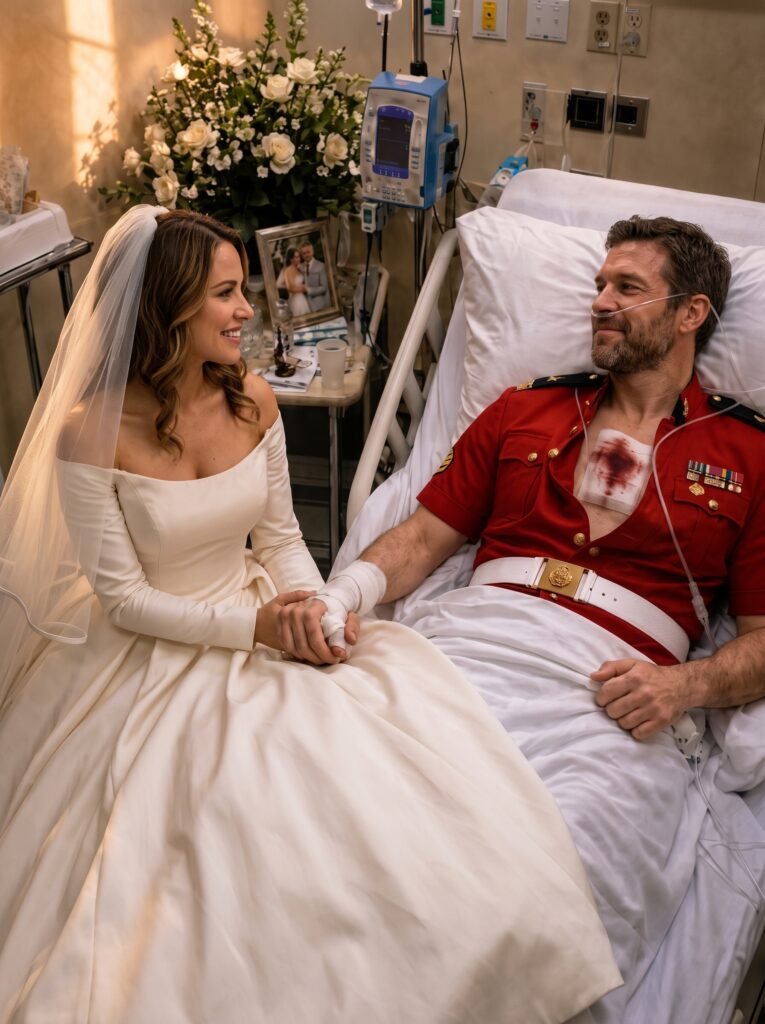
I had no wedding dress.
My closet contained exactly one white item—a plain cotton T-shirt.
So that was what I wore.
White T-shirt.
Black skirt.
Barely any makeup.
My hair tied back because I hadn’t washed it that morning.
Carl wore a white button-down shirt that was too loose around his shoulders.
We stood in his living room.
Father Miguel performed the ceremony while rain tapped softly against the windows.
When he asked whether I took Carl as my husband, my voice shook.
“I do.”
Then Carl answered.
“I do.”
Two words.
Nothing extraordinary.
Except I had never seen anyone look so happy while saying them.
After Father Miguel pronounced us husband and wife, Carl leaned toward me.
“May I?”
I nodded.
He kissed my forehead.
Not my mouth.
My forehead.
And somehow that almost broke me.
Dana cried openly.
Father Miguel pretended not to.
Adrian stood near the fireplace with his hands folded.
His eyes were wet.
After the ceremony, he asked to speak privately with Carl.
I went into the kitchen.
Their voices were low, but I heard one sentence.
Adrian said:
“Once you do this, Charles, there is no going back.”
Charles.
I frowned.
When Adrian came out, I asked:
“Who’s Charles?”
He paused.
“Middle name.”
Carl appeared behind him.
“Old family nickname.”
It didn’t make sense.
But newlyweds are supposedly entitled to a little trust.
So I let it go.
That night I slept in the chair beside Carl’s hospital bed.
Around three in the morning, I woke to find him watching me.
“What?” I whispered.
“Nothing.”
“You’re staring.”
“I know.”
“Creepy.”
He smiled.
“Sorry.”
Then his expression changed.
“Claire?”
“Yes?”
“Whatever happens after I’m gone…”
He stopped.
“What?”
“Don’t let anyone make you feel ashamed for saying yes.”
I sat upright.
“Why would they?”
He turned his face toward the window.
“They might.”
“Carl?”
He closed his eyes.
“Tomorrow.”
Tomorrow never came.
Not for that conversation.
4. TEN DAYS
We were married for ten days.
People imagine that when death is approaching, every moment becomes profound.
It doesn’t.
Some moments are profound.
Others involve arguing about yogurt.
“You bought strawberry.”
“You said strawberry.”
“I said raspberry.”
“You absolutely said strawberry.”
“Claire, I’m dying. Surely I deserve raspberry.”
“You’re weaponizing cancer to win a yogurt argument.”
“Effective, isn’t it?”
I threw a napkin at him.
He laughed so hard he started coughing.
Then I panicked.
Then he became annoyed because I’d panicked.
That was marriage.
Or at least ours.
We watched terrible movies.
Played chess.
He beat me nine times.
I beat him once.
I suspected he let me win.
He denied it.
On our fourth day, I asked him whether he regretted asking me.
“Not for one second.”
“Even the yogurt?”
“Especially the yogurt.”
On our sixth, he became too weak to leave bed.
On our eighth, he stopped eating.
On our ninth, the hospice nurse told me quietly:
“It won’t be long.”
I sat beside him all night.
Shortly after sunrise, Carl opened his eyes.
“Claire?”
“I’m here.”
He looked confused.
Then he focused on me.
“My wife.”
My chest cracked.
“Yes.”
His breathing was shallow.
He reached toward me.
I took his hand.
“You remember Florence?” he whispered.
“What about it?”
“Go.”
“Carl—”
“Promise.”
I cried silently.
“I promise.”
He managed the smallest smile.
“There are blue doors near Santa Croce.”
“What?”
“You’ll understand.”
Those were among the last words he spoke.
Two hours later, Carl died with his fingers wrapped around mine.
There was no dramatic final breath.
No music.
No revelation.
One moment he was breathing.
The next moment he wasn’t.
I held his hand for a long time afterward.
Dana finally touched my shoulder.
“Claire.”
“I know.”
But I didn’t let go.
Not immediately.
Because releasing his hand felt like confirming something I wasn’t ready to understand.
Eventually, I whispered:
“Goodbye, husband.”
And then I let him go.
5. THE FUNERAL
Carl’s funeral should have been small.
He had lived alone.
Had few visitors.
Never mentioned friends.
I expected perhaps Father Miguel, Adrian, some hospice workers, and me.
Instead, black cars began arriving.
One after another.
Then another.
Then another.
Men in expensive suits stepped out.
Women wearing clothes that looked like they belonged in magazines.
Security guards appeared near the cemetery entrance.
I stood beside Dana, stunned.
“Who are these people?”
She shook her head.
“I have no idea.”
Adrian approached me.
He wore a black suit.
“Claire.”
“What is going on?”
His eyes moved toward the arriving guests.
“Today isn’t the day.”
“Apparently it is for somebody.”
A tall woman in her sixties stepped from a limousine.
Silver hair.
Perfect posture.
Cold eyes.
She looked directly at me.
The hatred in her expression was unmistakable.
She marched toward us.
Adrian stepped between us.
“Evelyn.”
“So this is her?”
Her voice was low.
Controlled.
“Not here,” Adrian said.
Evelyn ignored him.
“You married my nephew ten days before he died?”
Nephew.
I looked at Adrian.
Then at her.
“Who are you?”
She laughed without humor.
“Oh, God.”
Behind her stood several people who shared Carl’s eyes.
Same gray-green color.
Same sharp cheekbones.
My stomach turned.
Evelyn looked me up and down.
“A hospice volunteer.”
“Evelyn,” Adrian warned.
She stepped closer.
“Did you know he was wealthy?”
“What?”
That seemed to satisfy her.
She smiled cruelly.
“You didn’t.”
Before I could answer, Adrian took my arm.
“Walk away.”
“What did she mean?”
“Claire.”
“What did she mean?”
His grip tightened slightly.
“Tomorrow.”
My blood went cold.
Carl had said the same thing.
Tomorrow.
The service began.
I barely heard a word.
I watched strangers mourn my husband.
Some seemed genuinely devastated.
Others whispered while looking at me.
The whispers grew worse when Father Miguel referred to me as Carl’s wife.
At the graveside, Evelyn stood opposite me.
Her stare never left my face.
When the coffin was lowered, something inside me broke.
Whatever secrets Carl had kept, whatever these people wanted, none of it mattered for those few minutes.
He was still the man who had argued about yogurt.
The man who cheated at chess.
The man who had asked me not to let him die alone.
I placed one white larkspur on his coffin.
Evelyn’s expression changed.
For the first time, she looked frightened.
“Where did you get that?”
I turned.
“What?”
“That flower.”
“My mother loved them.”
Evelyn became pale.
Adrian immediately stepped forward.
“Enough.”
“What is going on?” I demanded.
Neither answered.
I went home angry.
Confused.
Exhausted.
And less than two hours later, someone knocked on my door.
Adrian Cole stood outside.
In one hand, he carried a leather briefcase.
In the other, a thick cream-colored envelope.
His face told me my life was about to change.
“May I come in?”
I let him inside.
We sat at my kitchen table.
He placed the envelope between us.
“Carl instructed me to wait until after his funeral.”
“For what?”
“To tell you the truth.”
“What truth?”
Adrian inhaled slowly.
“About who your husband really was.”
My heart began pounding.
He pushed the envelope toward me.
“Read the letter first.”
My hands trembled as I opened it.
Inside were several pages covered in Carl’s handwriting.
I recognized it immediately.
The first sentence made the room disappear.
Claire, our meeting was not an accident. I’ve known you your entire life, and for nearly thirty years, I have quietly watched over you.
I stopped breathing.
Then I kept reading.
6. THE LETTER
If you’re reading this, I’m gone.
And if Adrian followed instructions, you’re probably furious with me already.
“You have no idea,” I whispered.
Adrian said nothing.
I continued.
There are several truths I should have told you while I was alive. I didn’t, partly because I was afraid you would leave, and partly because telling you would have placed you in danger before I could protect you.
My name was not Carl Reed.
I looked at Adrian.
He nodded once.
My full legal name was Charles Carl Ashford.
The name meant something.
Not immediately.
Then it clicked.
Ashford.
As in Ashford Biologics.
One of the largest pharmaceutical companies in the country.
The company whose advertisements appeared in hospitals.
The company whose logo was on cancer centers, research institutes, charity events.
I stared at Adrian.
“No.”
He said quietly:
“Yes.”
I looked back at the letter.
My grandfather founded Ashford Laboratories in 1963. My father, Victor Ashford, transformed it into Ashford Biologics. By the time I was twenty, my family controlled a corporation worth billions.
My palms became damp.
You probably understand now why my aunt Evelyn looked at you the way she did.
I almost laughed.
Almost.
But the money is not the important part.
You are.
My hands stopped.
Your mother was Dr. Elena Donovan.
My eyes filled instantly.
Even seeing my mother’s name hurt.
I had known her only through stories.
Photographs.
Grandma Rose’s memories.
Your father was Dr. Michael Donovan.
They both worked for Ashford.
“What?”
Adrian looked away.
I kept reading.
Your parents were not ordinary employees.
They helped build the company.
My vision blurred.
Your mother developed the molecular platform that became the foundation of three of Ashford’s most profitable medications. Your father designed the clinical monitoring system used in the early trials.
More importantly, they discovered something my father was determined to hide.
I stopped.
“What?”
Adrian’s voice was barely above a whisper.
“Keep reading.”
In 1997, during trials of an experimental treatment called Asterion, your parents discovered serious cardiac complications in pediatric patients.
Asterion was going to be worth billions.
My father had already promised investors approval within eighteen months.
Your parents demanded the trials be suspended.
Victor refused.
They gathered evidence.
They planned to go to federal regulators.
My breathing became shallow.
I knew what came next.
My parents had died in 1997.
Their car had gone through a barrier during a storm.
I had been six months old.
Grandma always told me it had been an accident.
Three nights before your parents were scheduled to meet investigators, their car left Briar Ridge Road and crashed into the ravine.
I pressed my hand over my mouth.
You were in the back seat.
A tear landed on the page.
You survived.
I looked at Adrian.
“My grandmother said a motorist found me.”
Adrian closed his eyes.
“No.”
My gaze returned to Carl’s handwriting.
Claire, the person who pulled you from that car was me.
Everything inside me went still.
I read the sentence again.
Then again.
I was seventeen years old.
I had followed your parents that night because I knew they were frightened. I had overheard an argument between my father and yours. Your father told Victor that if anything happened to him, copies of the research would survive.
I didn’t understand what he meant.
Not then.
When I reached Briar Ridge Road, your parents’ car had already gone over the barrier.
I climbed down.
Your father was dead.
Your mother was barely conscious.
I started sobbing.
She heard you crying.
She made me promise to get you out.
So I did.
I carried you up that hill in the rain.
Your mother died before help arrived.
I couldn’t continue.
The pages fell from my hands.
Adrian waited.
I don’t know how long.
Finally I whispered:
“He saved me.”
“Yes.”
“He never told me.”
“No.”
“Why?”
Adrian’s answer was devastatingly simple.
“Because that isn’t the whole story.”
7. THE ASHFORD NAME
Carl left me $184 million.
That was the number Adrian said.
I actually laughed.
Not because it was funny.
Because the human brain sometimes reacts to impossible information by behaving stupidly.
“One hundred and eighty-four what?”
“Million.”
“Dollars?”
Adrian almost smiled.
“Yes, Claire. Dollars.”
I stared at him.
“No.”
“There are properties as well.”
“No.”
“Investment accounts.”
“No.”
“And approximately twenty-seven percent of the voting shares in Ashford Biologics.”
I stood.
“Absolutely not.”
Adrian blinked.
“You’re refusing?”
“I don’t want it.”
“You haven’t heard everything.”
“I married a dying man because he was lonely. I am not taking one hundred and eighty-four million dollars from him.”
“Carl anticipated that.”
“Good. Then he knew I’d refuse.”
“He said you would probably react exactly this way.”
“Excellent.”
“He also said I should tell you that refusing the inheritance won’t solve anything.”
That stopped me.
“Why?”
Adrian opened his briefcase.
He removed another folder.
“Because you’re already being sued.”
I stared at him.
“For what?”
“Evelyn Ashford, Carl’s uncle Malcolm, and several family trusts filed an emergency petition this afternoon challenging the validity of your marriage and Carl’s final will.”
My knees nearly failed.
“They think I married him for money.”
“They intend to prove it.”
“But I didn’t know!”
“I know.”
“They can have the money.”
“They don’t only want the money.”
“What else is there?”
Adrian looked at me grimly.
“Control.”
Of Ashford Biologics.
Carl’s shares had been enough, combined with several trusts he controlled, to determine who effectively ran the company.
Without a spouse, much of that voting power would have returned to the Ashford family trust.
Because Carl died married, his voting rights transferred differently.
To me.
“He married me to control a company?”
The words tasted poisonous.
Adrian didn’t answer quickly enough.
I felt sick.
“Oh my God.”
“Claire—”
“He used me.”
“I didn’t say that.”
“He knew exactly what marriage would do.”
“Yes.”
“And didn’t tell me.”
“Yes.”
I grabbed Carl’s letter.
“Where does he explain that?”
Adrian hesitated.
“He doesn’t.”
That hurt more than anything else.
I looked at my wedding ring.
A simple silver band.
Carl had apologized for how plain it was.
I’d told him I loved it.
Suddenly it felt heavy.
“Get out.”
“Claire.”
“Please.”
“You need representation.”
“I don’t care.”
“You should.”
“I said get out.”
Adrian gathered his papers.
At the doorway he stopped.
“Carl expected you to hate him for a while.”
I looked at him.
“He left specific instructions.”
“What instructions?”
Adrian reached into his coat.
He handed me a small brass key.
“Go back to his house.”
I stared at it.
“Why?”
“Because there’s something there he believed you needed to find yourself.”
“What?”
Adrian shook his head.
“I don’t know.”
That surprised me.
“He didn’t tell you?”
“No.”
He opened the door.
“Carl trusted me with almost everything.”
He glanced at the key.
“Almost.”
8. THE HOUSE AFTER DEATH
Returning to Carl’s house was harder than attending his funeral.
Death had emptied the rooms.
His mug was still beside the sink.
His blanket was folded across the sofa.
The chessboard remained exactly where we’d left it.
His side.
My side.
The black queen was missing.
I stood looking at the board.
Then I remembered our final game.
Carl had taken my queen.
He’d held the piece between his fingers and said:
“People always protect the king.”
“So?”
“Sometimes they should pay more attention to the queen.”
I had rolled my eyes.
Now my skin prickled.
I searched the drawers.
Nothing.
Cupboards.
Nothing.
Bedroom.
Nothing.
Then I remembered something else.
Carl had a strange habit of tapping the white knight whenever he was thinking.
I picked it up.
Something rattled inside.
“What the hell?”
The bottom twisted open.
Inside was a tiny piece of rolled paper.
Four words:
SHE ALWAYS LOVED LARKSPUR.
My mother.
I searched the house for anything related to flowers.
Nothing.
Then I remembered a painting in Carl’s bedroom.
A cheap landscape of blue-purple flowers.
I’d seen it dozens of times.
I removed it from the wall.
Behind it was a small recessed safe.
The brass key fit.
Inside were three things.
A flash drive.
A photograph.
And a sealed envelope.
I picked up the photograph first.
My knees buckled.
It showed my parents.
Young.
Laughing.
Standing in front of a laboratory.
Beside them was a teenage boy.
Carl.
I recognized his eyes immediately.
He couldn’t have been older than sixteen.
My mother’s arm was around his shoulders.
On the back, someone had written:
Elena, Michael, Charlie — summer 1996.
Charlie.
Charles.
Carl.
I sat on the floor.
For the first time, he became real in my past.
Not a letter.
Not a story.
A boy who had known my mother.
I opened the envelope.
Inside was one line.
Watch the videos before you decide whether to forgive me.
I inserted the flash drive into Carl’s old laptop.
There were seventeen video files.
The first had been recorded six months earlier.
Before I met him.
Carl appeared on screen.
Healthier.
Heavier.
Still sick, but not yet fragile.
“Hello, Claire.”
My chest tightened.
“If you’re watching this, then either my overly complicated plan succeeded or Adrian ignored half my instructions.”
He smiled.
“Both are possible.”
Then his expression became serious.
“I owe you an explanation.”
He looked directly into the camera.
“Yes. I arranged our meeting.”
I closed my eyes.
He continued.
“I donated anonymously to Willow Creek Hospice for years. When I learned my cancer was terminal, I contacted the program director and requested a companion.”
My stomach turned.
“I requested you.”
He paused.
“You are allowed to be angry.”
“I am,” I whispered.
“I know.”
The prerecorded Carl almost seemed to hear me.
“I wanted to see you once before I died.”
His voice cracked slightly.
“I had watched from a distance for almost thirty years. School photographs. Graduation announcements. Newspaper clippings. I knew when you became a librarian. I knew when Rose died.”
He looked down.
“But I never approached you because I had promised your grandmother I wouldn’t.”
I froze.
Grandma Rose had known?
Another video.
I clicked.
Carl was younger in this recording.
Perhaps thirty.
He sat across from my grandmother.
My grandmother.
Alive.
My hands flew to my mouth.
Rose looked directly at the camera.
“If you’re seeing this, Claire, then I’m dead, Charlie’s probably dying, and apparently none of you learned how to have normal conversations.”
I started crying and laughing simultaneously.
That was exactly how Grandma spoke.
She turned toward Carl.
“Tell her everything.”
Carl nodded.
Grandma pointed a finger at him.
“Everything.”
“I will.”
“You’d better.”
The recording ended.
My grandmother had known.
All those years.
She had known Carl.
Known about my parents.
Known something was wrong.
Why hadn’t she told me?
The third video answered.
Grandma sat alone.
“Claire, sweetheart…”
Her expression softened.
“You were six months old when your parents died. The Ashfords were powerful. Too powerful.”
She swallowed.
“After the crash, Charlie came to me. Seventeen years old. Covered in your mother’s blood.”
I sobbed.
“He told me what he suspected.”
“He wanted to go to the police. I stopped him.”
I stared at the screen.
“I was scared.”
Grandma wiped her eyes.
“Maybe I was wrong. But I’d already lost my daughter. I wasn’t going to lose you.”
She explained that Carl’s father controlled police officials, politicians, lawyers.
There was no proof.
Not then.
Carl promised Rose he would watch over us from a distance.
And he had.
When Grandma’s medical bills exceeded her insurance, an anonymous foundation paid them.
When my college scholarship mysteriously increased after my first year, Carl had arranged it.
When the landlord of my first apartment suddenly agreed to release me from the lease after I reported an unsafe furnace, Carl’s attorney had called.
I felt both grateful and furious.
He had been everywhere.
Invisible.
The next video changed everything.
Carl appeared seated behind a desk.
“Now we talk about my father.”
Victor Ashford.
Carl described him without emotion.
Brilliant.
Charismatic.
Ruthless.
A man who believed morality was something invented by unsuccessful people to restrain successful ones.
“My father ordered your parents followed.”
Carl looked into the camera.
“I spent twenty-seven years trying to prove he ordered their deaths.”
My skin went cold.
“Three years ago, I finally did.”
He held up a folder.
“The evidence is in a secure archive. Adrian has part of the access.”
Part.
I remembered the brass key.
Carl continued.
“But exposing Victor became complicated when I discovered that what he did to your parents wasn’t the only crime Ashford buried.”
Patient deaths.
Falsified clinical trials.
Bribed regulators.
Payments to families disguised as charitable settlements.
Asterion had eventually been abandoned, but other compounds based on the same research were modified and sold.
Carl had spent years accumulating evidence.
“And then,” he said, “I got cancer.”
A bitter smile.
“I appreciate the irony.”
He had planned to expose everything himself.
The diagnosis changed the timeline.
“I needed someone who couldn’t be bought by my family.”
Then he said the sentence that wounded me.
“I needed you.”
I slammed the laptop closed.
Because suddenly Evelyn had been right.
Maybe not about my motives.
But about Carl’s.
I had been selected.
Not loved.
Selected.
I had thought our strange little marriage was about two lonely people finding comfort at the edge of death.
Instead, I was part of a plan.
9. THE FAMILY COMES CALLING
Evelyn Ashford arrived at my apartment the following morning.
No limousine this time.
She came alone.
I nearly shut the door.
“You’re not welcome here.”
“Five minutes.”
“No.”
“Carl destroyed my family.”
“Your family seems perfectly capable of doing that themselves.”
Her jaw tightened.
“Five minutes.”
I let her in.
Not because I trusted her.
Because I wanted answers.
Evelyn looked around my small apartment.
The expression on her face suggested she’d expected stolen paintings and suitcases full of cash.
Instead she found library books, secondhand furniture, and laundry drying over a radiator.
“You really didn’t know,” she said.
“No.”
For the first time, she seemed uncertain.
“I assumed…”
“I know what you assumed.”
“My nephew could be manipulative.”
That struck me.
“Carl?”
“You knew him for three months.”
“I knew him while he was dying.”
“You knew the version he wanted you to know.”
I hated that she had found the exact wound.
“What do you want?”
“Walk away from the estate.”
“I already offered.”
“Not enough.”
She placed documents on my table.
“Sign these. Renounce all claims arising from the marriage and transfer the voting shares back to the family trust.”
“Why are the shares so important?”
“Ashford employs thirty thousand people.”
“And?”
“If the company becomes entangled in Carl’s obsession, thousands of jobs could disappear.”
“Obsession?”
She looked at me.
“Your parents.”
My body stiffened.
“You know about them.”
“Of course.”
“Did your brother have them killed?”
“No.”
The answer came too quickly.
I stepped closer.
“Carl believed he did.”
“Carl hated his father.”
“Did he?”
“Victor was cruel to him.”
“That isn’t an answer.”
Evelyn sighed.
“The crash was investigated.”
“By police your family paid.”
“You have no idea what you’re saying.”
“Actually, I’m beginning to.”
She collected the papers.
At the doorway, she turned.
“Carl wasn’t the saint you think he was.”
“I don’t think he was a saint.”
“Good.”
She stared at me.
“Then ask yourself why a forty-four-year-old man who’d watched you since infancy suddenly decided he needed to become your husband ten days before dying.”
The cruelty of the question landed because it was valid.
She left.
I stood at the window watching her car disappear.
Then my phone rang.
Adrian.
“Don’t sign anything.”
“How did you know she was here?”
“Because Evelyn has used the same strategy for thirty years.”
I closed my eyes.
“Carl used me.”
Silence.
“Tell me I’m wrong.”
Adrian exhaled.
“He had strategic reasons for marrying.”
There it was.
I felt sick.
“But,” Adrian continued, “I don’t think you understand the whole situation.”
“Then explain it.”
“I can’t yet.”
“I’m getting really tired of hearing that.”
“The lawsuit forces us into court Monday.”
“Us?”
“Yes.”
“I haven’t agreed to fight.”
“If you don’t, Evelyn takes control of the shares.”
“Maybe she should.”
Adrian’s voice hardened.
“Thirty-two children died in trials whose records were falsified.”
I stopped.
“Thirty-two?”
“That we know of.”
The room became silent.
“Carl believed some families still have no idea what happened.”
This wasn’t inheritance anymore.
It wasn’t marriage.
It wasn’t even my parents.
Thirty-two children.
I thought about the kids in my library.
Missing front teeth.
Untied shoes.
Impossible questions.
I whispered:
“What happens if Evelyn gets the shares?”
“The board seals the archive.”
“Can they?”
“If they control the company, probably.”
I looked at Carl’s ring on my finger.
“What do I need to do?”
Adrian answered:
“Fight.”
10. MRS. ASHFORD VERSUS THE HOSPICE WIFE
By Monday morning, newspapers had discovered me.
BILLIONAIRE HEIR’S DEATHBED BRIDE.
HOSPICE VOLUNTEER MARRIES TERMINAL PATIENT DAYS BEFORE $184M INHERITANCE.
The photographs were worse.
One showed me leaving work looking exhausted.
Another showed Carl’s bungalow.
A television reporter actually stood outside the elementary school.
My principal called me into her office.
“We support you,” she said carefully.
That sentence usually means someone’s employment has become complicated.
“Take some time.”
“You’re suspending me?”
“No.”
“Paid leave?”
She avoided my eyes.
I understood.
By noon, strangers online had decided I was either a gold digger, a murderer, or both.
One headline called me THE HOSPICE HUNTRESS.
Carl would have laughed at how stupid that sounded.
The thought made me miss him violently.
The courthouse was packed.
Evelyn sat beside Malcolm Ashford, Carl’s uncle, and Grant Ashford, his cousin.
Adrian sat beside me.
Their attorney argued that Carl had been physically weak, heavily medicated, emotionally vulnerable, and manipulated by someone responsible for his care.
Me.
Then Adrian stood.
“My client received no compensation from Mr. Ashford during his lifetime.”
He presented my bank records.
My modest apartment lease.
My salary.
My volunteer history.
Then he produced something I hadn’t known existed.
A video recorded the morning of our wedding.
Carl sat beside a doctor.
The doctor asked:
“State your name.”
“Charles Carl Ashford.”
“Do you understand your diagnosis?”
“Yes.”
“Do you understand the legal implications of marriage?”
“Yes.”
“Are you acting under coercion?”
“No.”
“Why are you marrying Claire Donovan?”
Carl stared at the camera.
My breath stopped.
Then he said:
“Because I asked her, and she said yes.”
The doctor repeated the question.
“Why do you want her specifically?”
Carl hesitated.
Then smiled.
“Because she’s the best person I’ve ever known.”
I stared at the screen.
Evelyn looked away.
The judge upheld the marriage temporarily while allowing the estate challenge to continue.
Outside the courthouse, reporters surrounded me.
“Claire, did you love Carl Ashford?”
“Did you know he was worth millions?”
“Did you sleep with him?”
“Were you planning this?”
I froze.
Then someone shouted:
“How does it feel to become rich because a dying man fell for you?”
That did it.
I turned.
“He didn’t fall for me.”
The crowd became silent.
I wasn’t sure why I’d said it.
Maybe because I believed it.
Maybe because I was angry.
Maybe because I needed to protect myself from what his final ten days had meant.
“He had a plan,” I said.
“I’m still trying to understand it.”
And somewhere beyond the cameras, I saw Evelyn watching me.
Not triumphantly.
Almost with pity.
11. THE BLUE DOOR
Three days later, I found the second key.
It was inside Carl’s missing black queen.
Adrian and I returned to Hawthorne Street together.
The chess piece was behind the old radio.
Inside it was a small numbered token.
“Safe-deposit box,” Adrian said.
The number corresponded to a private bank in Boston.
The box contained no money.
Only documents.
One passport.
A research notebook.
And another letter from Carl.
The passport belonged to him.
But the address listed years earlier was in Florence.
I remembered his final words.
There are blue doors near Santa Croce.
Adrian examined the notebook.
His face changed.
“What?”
He showed me the cover.
Written in faded ink:
DR. ELENA DONOVAN — ASTERION PROJECT
My mother’s handwriting.
I touched her name.
For the first time in my life, I was holding something she had held.
Inside were formulas, observations, patient codes.
Near the back were pages filled with frantic notes.
Adverse responses intentionally excluded.
Victor refused suspension.
M. found duplicate books.
Charlie overheard argument. I’m worried about the boy.
Charlie.
Carl.
The final page contained an address in Florence.
Via delle Rose, near Santa Croce.
Beside it:
Blue door. Lorenzo has everything.
Adrian stared at the words.
“Carl never told me about this.”
“What is it?”
“I don’t know.”
“You’re his lawyer.”
“He spent half his life keeping information compartmentalized.”
“Why?”
“To keep everyone alive.”
That sentence convinced me.
Carl had asked me to go to Florence.
So I went.
Not because of the money.
Not because of the company.
Because my mother had written about a blue door nearly thirty years ago.
Florence was warmer than I imagined.
Beautiful too.
Almost unfairly beautiful considering why I was there.
The address led to a narrow building with faded stone walls.
The door was blue.
Deep cobalt.
I knocked.
An elderly man answered.
White hair.
Dark eyes.
He stared at me.
Then his hand rose toward his mouth.
“Elena?”
My heart stopped.
“No.”
His eyes filled with tears.
“Of course.”
He whispered something in Italian.
Then in English:
“You’re her daughter.”
“How do you know?”
He stepped backward.
“Come inside.”
His name was Lorenzo Bianchi.
He had worked with my parents.
Not at Ashford.
Before Ashford.
My mother had spent two years in Italy researching molecular protein binding.
Carl had visited with his family one summer.
“He adored your mother,” Lorenzo said.
“As a teenager?”
“As a child adores an older sister.”
Carl’s own mother suffered from severe depression.
Victor was often absent.
My parents became something like family to him.
Lorenzo opened a cabinet.
Inside were storage boxes.
“Your mother mailed these to me two days before she died.”
My hands trembled.
“What’s in them?”
“The truth.”
Not simply about the clinical trial.
About the company itself.
My mother had not merely worked for Ashford.
She had co-founded the technology platform on which Ashford’s modern empire was built.
The original licensing agreement granted her twenty-four percent equity.
Michael held twelve.
When I was born, both parents transferred their interests into a trust for me.
Thirty-six percent.
Billions today.
“What happened to it?”
Lorenzo gave a bitter laugh.
“Victor happened.”
After my parents’ deaths, forged documents appeared transferring their interests back to Ashford.
Grandma Rose had never known.
Carl apparently discovered the forgery years later.
“He came here when he was twenty-three,” Lorenzo said.
“He found me.”
“Why didn’t he expose it?”
“He tried.”
Victor threatened everyone.
Lorenzo’s family.
Rose.
Me.
Then Lorenzo said something I never expected.
“Carl gave up his inheritance.”
“What?”
“In his twenties. He told Victor he wanted nothing from him.”
“But he was worth millions.”
“Later.”
Carl had created his own investments.
Quietly.
Brilliantly.
The money I’d inherited wasn’t Ashford money.
Most of it was his.
“Then what about the shares?”
Lorenzo leaned back.
“Those are complicated.”
He opened another folder.
I studied the documents.
Then realized something impossible.
The shares Carl had supposedly left me were not originally his.
They had been purchased over decades through holding companies.
Piece by piece.
Carl had spent twenty years using almost every dollar he made to buy Ashford stock.
For me.
Not himself.
I whispered:
“He was buying my parents’ company back.”
Lorenzo nodded.
“One share at a time.”
I cried.
Then Lorenzo gave me the final box.
“There is something else.”
“What?”
“Something Carl asked me never to send.”
Inside was an audio cassette.
Recorded in 1997.
The night before my parents died.
My father’s voice.
Then Victor Ashford’s.
I listened through headphones.
The argument was vicious.
My father accused Victor of hiding deaths.
Victor threatened him.
Then another voice appeared.
Young.
Terrified.
Carl.
“Dad, stop.”
Victor shouted at him to leave.
Carl refused.
Then my mother spoke.
“If anything happens to us, Victor, the truth won’t die with us.”
A door slammed.
The recording continued.
My parents whispered.
Then my mother said:
“Charlie heard everything.”
My father answered:
“He’s just a kid.”
“He’ll try to help.”
“He’ll get himself killed.”
Then my mother said something that broke me.
“If something happens, Rose takes Claire. And Charlie needs to stay away from her. Victor will watch him.”
Carl hadn’t abandoned me.
My mother had ordered him away.
To protect me.
He had obeyed for twenty-nine years.
Until he was dying.
Until there was no future left for Victor’s family to threaten.
12. WHAT CARL DID NOT TELL ME
Back home, the legal battle intensified.
But now we had evidence.
Federal investigators became involved.
Ashford Biologics’ board suspended several executives.
Shares collapsed.
Former employees contacted Adrian.
So did families.
One mother had lost her eleven-year-old son during the Asterion trial.
For twenty-eight years she had believed his death was an unavoidable complication.
The medical records proved otherwise.
She sat across from me in Adrian’s office.
“They knew?”
I couldn’t lie.
“Yes.”
She closed her eyes.
“They knew.”
Her husband took her hand.
At that moment the money stopped mattering completely.
I announced publicly that if Carl’s estate remained mine, every dollar connected to Ashford Biologics would be placed into a compensation and medical research foundation.
Evelyn called it a publicity stunt.
Then Malcolm Ashford made a mistake.
He attempted to destroy records stored in an off-site archive.
Federal agents arrested him.
And everything began collapsing.
Emails.
Payments.
Forged signatures.
Private investigators.
Bribes.
Carl had collected pieces for twenty years.
My parents’ deaths were officially reopened.
Victor Ashford had died six years earlier, peacefully, surrounded by expensive art and expensive doctors.
He would never answer for what he’d done.
That bothered me.
Carl had died too.
The good and the guilty seemed equally unreachable.
One evening, Adrian came to my apartment.
He looked exhausted.
“We found the payment.”
“What payment?”
“Two days before your parents died, Victor transferred two hundred thousand dollars through a subsidiary.”
“To whom?”
“A former security contractor named Raymond Pike.”
My skin went cold.
“What happened to Pike?”
“Dead.”
“Of course.”
“Car accident. 2004.”
We sat silently.
Then Adrian said:
“There is another issue.”
“What now?”
“Carl knew about the payment.”
“When?”
“Twenty years ago.”
I stared at him.
“He had proof twenty years ago?”
“Not enough to connect it conclusively.”
“He could have gone public.”
“And risked retaliation against you.”
“That was my decision to make.”
“You were nine.”
“Later, then.”
Adrian looked away.
I understood.
Carl had kept choosing for me.
Year after year.
Protecting me.
Controlling information.
Deciding what danger I could handle.
He had loved me, perhaps.
But love does not automatically justify secrecy.
That night I watched another video.
Carl appeared gaunt.
It must have been recorded shortly before we met.
“If Claire discovers the archive,” he said, “she’ll realize I had opportunities to tell her sooner.”
He looked ashamed.
“I wish I had a noble explanation.”
He didn’t.
“I was afraid.”
I leaned closer.
“My father spent years reminding me that everyone near me could become leverage.”
Carl rubbed his face.
“When Rose died, I almost contacted Claire. Then I didn’t.”
He breathed shakily.
“I told myself it was protection.”
His eyes lifted toward the camera.
“Maybe some of it was cowardice.”
A long silence.
“If she hates me for that, she has earned the right.”
I stopped the video.
Then restarted it.
Not because it fixed anything.
Because Carl had finally done something unusual.
He had admitted he was wrong.
13. THE WOMAN WHO HATED ME
Evelyn requested a private meeting.
I almost refused.
Then she said:
“There’s something about the crash you don’t know.”
We met in an empty conference room.
She looked older than she had at the funeral.
Ashford’s collapse had aged everyone.
“What do I not know?”
She placed a photograph on the table.
Carl at seventeen.
Beside him stood Evelyn.
And Victor.
“You think Carl followed your parents because he was worried about them.”
“Yes.”
“That isn’t the complete truth.”
I waited.
Evelyn looked toward the window.
“He was in their car earlier that evening.”
My chest tightened.
“What?”
“He had run away from home.”
She swallowed.
“Carl stole documents from Victor’s office and took them to your father.”
The room seemed smaller.
“Victor discovered what he’d done.”
“He sent Pike after him.”
“Yes.”
I understood before she said it.
My parents hadn’t simply been driving somewhere.
They had been trying to get Carl away.
“He was the reason they were on Briar Ridge Road.”
Evelyn nodded.
My breath left me.
“He caused the crash.”
“No.”
“But if he hadn’t—”
“Do not finish that sentence.”
Her voice sharpened.
“The brakes were sabotaged before they left.”
I froze.
“What?”
“Pike had access to the car at Ashford headquarters earlier that afternoon.”
“Then why follow them?”
“To make sure the job was completed.”
My stomach turned.
Evelyn looked at me.
“Carl spent his entire life believing your parents would still be alive if he hadn’t gone to them.”
I remembered him asking me to marry him.
His strange sadness.
His insistence that one act could change a life.
“He blamed himself.”
“Every day.”
“Why do you know this?”
She laughed bitterly.
“Because I blamed him too.”
There it was.
The source of her hatred.
“For years I told myself my brother’s cruelty wasn’t the real problem. It was easier to blame a seventeen-year-old boy for disobeying.”
Tears filled her eyes.
“I told Carl at your parents’ funeral that he’d killed them.”
My chest hurt.
“He was seventeen.”
“I know.”
“You let him carry that?”
“Yes.”
She looked at me.
“That is why I hated seeing you wearing his ring.”
Not because she thought I’d stolen Carl’s money.
Not entirely.
She thought Carl had spent thirty years punishing himself.
And marrying me, the orphaned daughter of the people he believed he’d killed, looked like one final act of penance.
“Did he marry me because he felt guilty?”
Evelyn closed her eyes.
“I don’t know.”
That answer terrified me more than yes would have.
14. THE LAST VIDEO
Two weeks later, Ashford Biologics’ board agreed to cooperate fully with investigators.
Malcolm was indicted.
Two former executives were arrested.
The family dropped its challenge to Carl’s will.
Not because they’d developed morality.
Because discovery was exposing too much.
I became, legally, absurdly wealthy.
Adrian reminded me repeatedly.
I ignored him repeatedly.
The foundation began processing compensation claims.
I returned to the library.
Some parents whispered.
Most children didn’t care.
One eight-year-old hugged me and asked why I’d been gone.
“Grown-up problems.”
“Taxes?”
“Worse.”
He nodded solemnly.
“Divorce?”
I laughed for the first time in weeks.
Then one rainy Tuesday afternoon, Adrian visited.
He carried a small wooden box.
“Found this in the bank archive.”
“What is it?”
“Something Carl ordered me to give you only after the estate dispute ended.”
“Another secret?”
“Apparently your husband was incapable of linear communication.”
I smiled despite myself.
Inside the box was Carl’s wedding ring.
Hospice had removed it after he died.
I had wondered where it went.
Beneath it was one final flash drive.
I almost didn’t watch.
I was tired of revelations.
Tired of discovering new versions of a man I couldn’t confront.
But that night I inserted it into my laptop.
Carl appeared.
This recording was different.
He was wearing the blue sweater.
The same sweater from the day he proposed.
The date in the corner showed it had been recorded hours before I arrived.
Before he asked.
Carl stared at the camera for a long time.
Then smiled awkwardly.
“I’ve rewritten this twelve times.”
He inhaled.
“Claire is coming this afternoon.”
I felt my heart begin pounding.
“I’ve decided to ask her to marry me.”
He laughed nervously.
“I can’t believe I just said that aloud.”
He looked almost embarrassed.
“I need to explain something because someday people are going to tell her I married her for strategic reasons.”
My breath caught.
“They’ll be wrong.”
I moved closer to the screen.
“I’ve already completed the trust restructuring.”
What?
I paused the video.
Replayed the sentence.
I’ve already completed the trust restructuring.
Carl continued.
“She doesn’t have to marry me to receive anything.”
I stopped breathing.
“The Donovan interests, my personal estate, the voting block—everything has already been placed into an independent trust naming Claire as beneficiary.”
I whispered:
“No.”
“The marriage changes nothing material.”
Tears filled my eyes.
“Adrian thinks I’m being sentimental.”
Carl smiled.
“He’s right.”
I covered my mouth.
“I didn’t arrange for Claire to become my hospice companion because I planned to marry her.”
He looked down.
“I wanted to meet her once.”
A pause.
“That’s all.”
His voice softened.
“I wanted to see the woman that baby became.”
He laughed faintly.
“Then she walked into my house carrying terrible chicken soup and started criticizing my chess openings.”
I began sobbing.
“She didn’t know my name.”
“She didn’t know my money.”
“She didn’t know what I’d done for her.”
“She didn’t know anything except that I was sick and alone.”
He swallowed.
“And she kept coming back.”
My vision blurred.
“Tuesday.”
“Thursday.”
“Saturday.”
“Every week.”
Carl’s eyes became wet.
“She remembers how I take tea.”
A tear slipped down his cheek.
“She argues with me when I’m being difficult.”
“She sits beside me on the days when I smell like medicine and can barely speak.”
His voice cracked.
“And when she thinks I’ve fallen asleep, sometimes she fixes the blanket around my shoulders.”
I remembered doing that.
Never knowing he was awake.
Carl wiped his face.
“I spent almost thirty years watching over Claire because I felt I owed Elena and Michael.”
He shook his head.
“But that isn’t why I’m asking her.”
He looked directly into the camera.
“I’m asking because I fell in love with her.”
I broke.
Not elegant tears.
Not movie tears.
I folded over the kitchen table and sobbed.
Carl continued.
“I know how selfish this is.”
“She deserves someone who can give her fifty years.”
“I have maybe fifty days.”
His lips trembled.
“Probably less.”
“But I want one morning waking up knowing there’s someone in the world I’m allowed to call my wife.”
He smiled through tears.
“One breakfast.”
“One argument.”
“One stupid married joke.”
“Anything.”
I remembered the yogurt.
And laughed while crying.
Carl looked toward the door, as though imagining me arriving.
“If she says no, that’s okay.”
“I will never tell her.”
“She will still inherit what belongs to her.”
There it was.
The greatest secret.
The marriage had not been necessary.
Not for the money.
Not for the shares.
Not for the evidence.
Carl had already arranged everything before he proposed.
He hadn’t married me to use me.
He had simply wanted to be my husband.
Ten days.
That was all he’d asked from life.
Ten days.
The video continued.
“There is one more thing.”
I wiped my cheeks.
“I’ve spent decades wondering whether Elena and Michael died because of me.”
His expression changed.
“Recently I found evidence proving the brakes were sabotaged before I went to them.”
He inhaled.
“That should have freed me.”
“It didn’t.”
A faint smile.
“Guilt doesn’t respond to evidence as efficiently as lawyers do.”
Then:
“But Claire did something nobody else ever managed.”
I leaned closer.
“She made me want to live more than I wanted to punish myself.”
Silence filled my apartment.
Carl looked directly at me from a day that no longer existed.
“If you are watching this, Claire, then I failed at the living part.”
I laughed through tears.
“But maybe not completely.”
He reached toward the camera.
The screen trembled slightly.
Then steadied.
“Go to Florence.”
“I meant that.”
“Eat somewhere too expensive.”
“Buy something impractical.”
“Stand under the blue door.”
“And please stop letting me win at chess in your memories.”
I laughed again.
“You cheated.”
His final words came quietly.
“The only thing I ever wanted from our marriage was the marriage.”
Then the screen went black.
15. THE THING INSIDE THE TRUST
I thought that was the end.
It wasn’t.
Because three months later, Adrian called me from his office at seven in the morning.
His voice sounded strange.
“You need to come here.”
“What happened?”
“We completed the forensic examination of the original Donovan trust.”
“And?”
Silence.
“Claire, Carl misunderstood something.”
That sentence terrified me.
I drove there immediately.
Adrian wasn’t alone.
Two forensic accountants sat at the conference table.
Lorenzo joined by video from Florence.
A document lay beneath protective glass.
“What is that?”
“The original trust your parents created when you were born.”
I sat.
Adrian pointed to a clause.
“Carl believed this transferred thirty-six percent of their Ashford interests to you.”
“Yes.”
“It didn’t.”
My heart sank.
“What does that mean?”
“One word was misread in the scanned copy.”
He slid a magnified image toward me.
“The trust did not hold thirty-six percent.”
He paused.
“It held sixty-three percent.”
I stared at him.
“That doesn’t make sense.”
It did after twenty minutes.
My mother had quietly purchased additional founder shares years earlier through a research partnership.
My father had done the same.
Together, they held a controlling interest in the original company.
Victor’s entire corporate empire had been built on forged transfers of majority ownership that legally belonged to me.
Ashford Biologics wasn’t partly my parents’ company.
It had been stolen from them.
And now, subject to court findings, it was mine.
Not Carl’s gift.
Not an inheritance.
Mine since infancy.
Adrian laughed softly when he saw my expression.
“You might technically have been wealthier than Carl before you learned his real name.”
I stared at the documents.
Then something bothered me.
“If Carl didn’t know this…”
“He didn’t.”
“Then why did he spend his own money buying shares?”
“To restore what he thought had been stolen.”
I closed my eyes.
For twenty years Carl had sacrificed almost everything trying to return something that already legally belonged to me.
Not because he expected thanks.
Not because he expected marriage.
For most of those years, he had assumed I would never know his name.
That realization changed something permanently.
16. A COMPANY BECOMES SOMETHING ELSE
The lawsuits lasted more than a year.
The criminal investigations lasted longer.
Ashford Biologics survived.
Barely.
I could have sold everything.
Many advised me to.
Instead, I did something Carl might have considered reckless.
I took control.
Not alone.
I knew nothing about running a pharmaceutical company.
So I hired people who did.
Researchers.
Ethicists.
Patient advocates.
Independent scientists.
No Ashford family members.
We renamed the company.
Not after me.
Not after Carl.
The Elena-Michael Medical Foundation and Research Group.
The first board meeting under the new name lasted nine hours.
At the end, I walked into the lobby.
Thirty-two photographs hung on a temporary wall.
The children whose deaths had been hidden during early trials.
Families had given permission.
Below the photographs were Carl’s handwritten words:
No discovery is worth a lie about who paid its price.
I found the sentence in one of his notebooks.
It became company policy.
And eventually, something larger.
Every adverse trial result would be published.
All patient compensation decisions would include independent representation.
Executive bonuses could not be tied solely to approval schedules.
Some investors hated it.
I slept fine.
17. FLORENCE
A year after Carl died, I returned to Florence.
Alone.
I stood outside Lorenzo’s building.
The blue door had recently been painted.
Still blue.
Lorenzo joined me.
“You came back.”
“I promised.”
We walked to Santa Croce.
Carl had described everything correctly.
The stone.
The bells.
The way sunlight touched the buildings in late afternoon.
I bought gelato.
Mint chocolate.
Because obviously.
Then I sat near the river as evening descended over Florence.
In my bag was Carl’s last letter.
The real last letter.
Not the legal letters.
Not the explanatory letters.
A tiny note Adrian had found beneath Carl’s wedding ring.
I had read it hundreds of times.
That evening, I read it once more.
Claire,
There are people who enter our lives through doors.
Others enter through accidents.
You entered mine twice.
The first time, you were six months old, crying in a wrecked car while I was seventeen and terrified.
I carried you through the rain believing I was saving your life.
I understand now that years later, you returned the favor.
When you walked into Hawthorne Street carrying soup, I had already decided that dying was simply the final obligation remaining to me.
Then you made tea.
You complained about my curtains.
You cheated at Scrabble.
“I did not,” I muttered.
A couple walking nearby glanced at me.
I smiled.
Then continued.
You reminded me that even a small life is still a life.
Ten days as your husband was not a tragedy.
It was ten days more happiness than I had expected.
Do not make my mistake and measure life only by how long something lasts.
Sometimes the shortest things are the ones that remain.
—Carl
I folded the letter.
The bells began ringing.
For a while I simply watched people crossing the bridge.
Couples.
Families.
Tourists.
Children.
Ordinary lives moving beneath extraordinary history.
And I finally understood something Carl had spent decades failing to understand.
We cannot rewrite the moment that breaks us.
We can only decide what grows around the fracture.
Carl couldn’t save my parents.
He couldn’t undo Victor Ashford’s crimes.
He couldn’t reclaim the years fear had stolen from him.
And I couldn’t give him fifty years.
But we had been given ten days.
Ten days of tea.
Chess.
Rain.
Arguments about yogurt.
A plain silver ring.
A white T-shirt instead of a wedding dress.
No flowers.
No music.
No guests.
No future.
And yet it had been real.
I stood.
Before leaving, I placed one white larkspur beside the blue door.
“For Mom,” I whispered.
Then another.
“For Dad.”
I had brought a third.
Blue.
I held it for a moment.
Then placed it beside the others.
“For my husband.”
18. THE FINAL SECRET
I believed Florence was where Carl’s story ended.
But Carl had always been better at endings than I was.
Six months later, Lorenzo died peacefully at ninety-one.
His attorney mailed me a package.
Inside was an old photograph.
My parents.
Carl.
Lorenzo.
Grandma Rose.
And a woman I didn’t recognize.
On the back, my mother had written:
The people I trust with Claire. Whatever happens.
I called Adrian.
“Who’s the woman?”
He didn’t know.
Neither did Evelyn.
The photograph was taken shortly before I was born.
The woman stood slightly apart from everyone else.
Mid-thirties.
Dark hair.
Gentle smile.
Around her neck was a hospice volunteer badge.
That detail made my heart skip.
I enlarged the picture.
The badge carried an organization name.
Willow Creek Community Care.
The same organization that eventually became Willow Creek Hospice.
I drove there the next morning.
The director helped me search old records.
The woman’s name was Margaret Reed.
Reed.
Carl’s false surname.
My pulse quickened.
“She founded the companion volunteer program,” the director said.
“When?”
“1998.”
A year after my parents died.
“Why?”
The director opened an old letter.
“Apparently because of a promise to a friend.”
I read it.
Margaret wrote that a young mother she loved had once told her something:
No one should have to face death believing they are alone.
My mother’s words.
The entire hospice program existed because of her.
Margaret had been my mother’s closest friend.
After the crash, she created the program in Elena’s memory.
Years later, Carl became an anonymous donor.
And decades after that—
I became a volunteer.
I had believed Carl manipulated the entire chain that brought me to his door.
He hadn’t.
He had requested me only after seeing my name on the volunteer roster.
But he had never arranged for me to become a hospice volunteer.
That choice had been mine.
Except perhaps it wasn’t entirely random either.
My grandmother had once suggested volunteering after telling me how much kindness mattered near the end of life.
Grandma knew Margaret.
Margaret knew my mother.
My mother had planted an idea decades earlier.
The path from Elena to Margaret to Rose to me had stretched across twenty-nine years.
Until one Tuesday afternoon, I knocked on Carl’s door.
Not because he had designed my life.
But because the kindness of one dead woman had traveled through several people and eventually found its way back to the frightened seventeen-year-old boy who had once carried her baby out of a wreck.
I sat in my car outside the hospice center and cried.
Then I laughed.
Because suddenly Carl’s first letter meant something different.
Our meeting was not an accident.
He had believed that because he requested me.
But he had been wrong.
Our meeting had been planned long before Carl ever became sick.
Not by lawyers.
Not by inheritance trusts.
Not by billionaires.
Not even by Carl.
It had been set in motion by my mother.
By one sentence.
One act of kindness.
One promise passed between ordinary people.
That afternoon I drove to Carl’s grave.
The cemetery was quiet.
I sat in the grass.
“I figured it out,” I said.
Wind moved through the trees.
“You thought you brought me to you.”
I smiled.
“You didn’t.”
For once, Carl had not been several steps ahead.
My mother had.
I placed the old photograph against his headstone.
Then I took out a pocket-sized chessboard.
I had started carrying one when I traveled.
Ridiculous.
Sentimental.
Completely unlike me.
Or perhaps exactly like me.
I arranged the pieces.
Black and white.
King and queen.
Knight and bishop.
Then I moved my pawn.
“Your turn.”
Silence.
Obviously.
I smiled anyway.
“You’d probably cheat.”
A bird called somewhere beyond the trees.
I looked at Carl’s name carved into stone.
CHARLES CARL ASHFORD
Below it, according to his instructions, there was only one additional line:
HE WAS NOT ALONE.
My eyes filled.
For years Carl had believed his purpose was to repay a debt.
To protect the daughter of two people he couldn’t save.
To restore stolen money.
To expose a crime.
To balance some invisible scale before death.
But he had misunderstood his own life.
He hadn’t saved me because he owed my parents.
He had saved a crying baby because he was a frightened seventeen-year-old boy who still possessed enough goodness to climb down a ravine in the rain.
He hadn’t watched over me because guilt demanded it.
He did it because some part of him had remained connected to that moment.
And when I finally walked into his little gray house twenty-nine years later, neither of us understood the symmetry.
Once, Carl had carried me away from death.
Decades later, without realizing who he was, I walked toward his.
Neither of us could save the other.
That had never been the point.
I reached toward the chessboard and moved Carl’s knight.
Then my own.
The game continued.