My phone had buzzed twice against the conference-room table. The room smelled like old coffee and dry marker ink, and I was trying to keep my eyes on a budget slide when I finally answered.
“Hey, sweetheart. You okay?”
For a second, all I heard was Nell breathing. Broken. Wet. Scared. Then my four-year-old whispered, “Daddy… please come home.”
I pushed my chair back. “Where’s Mom?”
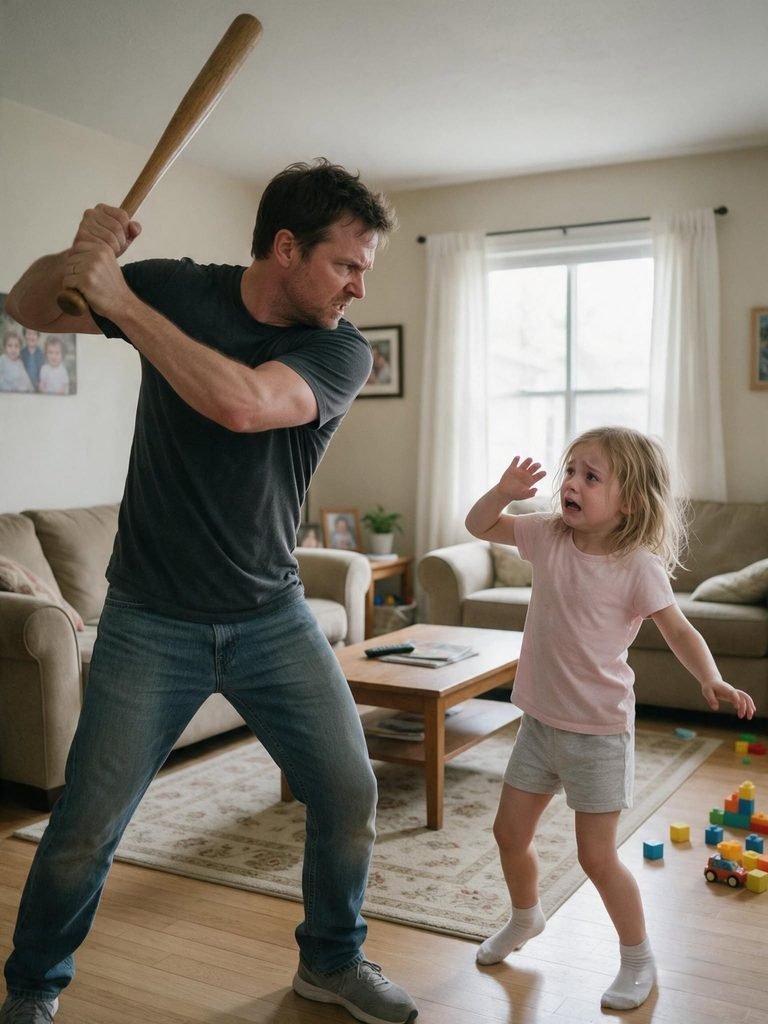
“She’s not here,” she said. “Mom’s boyfriend… Brock… hit me with a baseball bat. My arm hurts really bad. He said if I cry, he’ll hit me again.”
Then a grown man’s voice exploded behind her.
“Who are you talking to? Give me the phone!”
The line went dead.
The conference room froze around me. A woman from accounting stopped with her paper coffee cup halfway to her mouth. Pens hovered above legal pads. The air conditioner clicked while everyone stared at me, waiting for me to explain what they had just heard.
“My daughter has been attacked,” I said. “I’m leaving.”
By the time I reached the hallway, my hands were shaking hard enough that I nearly dropped my keys. It was 2:14 PM on a Tuesday. My call log showed Nell’s call and thirty-one seconds of audio that would later be entered in a police report with the dispatcher’s incident number.
But I wasn’t thinking about evidence.
I was thinking about distance.
Twenty minutes. Downtown traffic. Red lights. And my four-year-old alone in the house with the man who had just threatened to hit her again.
I knew I couldn’t get there fast enough. I knew someone else could. I knew exactly who.
My older brother, Gabe.
Gabe had been there since the day we brought Nell home wrapped in a pink hospital blanket. He taught her to fist-bump. He fixed her little bike after she bent a training wheel. He once stayed beside her bed all night during a fever.
He showed up. Always.
I dialed him while running for the elevator.
“Hey, what’s up?” he answered.
“I just got a call from Nell. Marissa’s boyfriend hit her with a baseball bat. I’m twenty minutes away. Where are you?”
There was a tiny pause.
“I’m about fifteen minutes from your house,” Gabe said. “Do you want me to go by?”
“Go now. I’m calling 911.”
“I’m already moving.”
Gabe had fought in regional mixed martial arts years earlier, before a shoulder injury ended it. But fighting wasn’t what made the change in his voice frightening. Control was.
He knew when to move. He knew when not to. He knew Nell was waiting.
I hit the parking garage and called 911. I gave the dispatcher Nell’s name, Marissa’s name, Brock’s first name, our address, what Nell had told me, and the threat I’d heard before the call ended.
“Is your child injured?”
“Yes.”
“Is the adult male still inside?”
“I believe so.”
She told me units were being sent. Then I told her Gabe was closer and already heading there.
“Tell him not to engage if he can avoid it,” she said.
Traffic barely moved. Every red light felt like another locked door between me and my daughter. Then Gabe’s name flashed on my phone.
“I’m two blocks out,” he said.
“Stay on the line.”
A few seconds later, his voice dropped almost to a whisper.
“I see the house.”
His engine cut. A truck door slammed through the line, and Gabe’s footsteps started up the driveway.
Part 2
Gabe kept the call connected as he crossed the driveway. I was still trapped in traffic, gripping the wheel while the dispatcher’s instructions repeated in my head: officers were coming, and Gabe should avoid engaging if he could.
But Nell was four years old.
She was inside that house. Brock was inside that house. And the last thing I had heard before her call ended was a grown man demanding the phone from her.
“Gabe,” I said, trying to keep my voice level. “Just get to Nell.”
His breathing stayed slow and controlled. That scared me more than shouting would have.
I could picture my brother moving toward the same front door I had walked through thousands of times, except now every second on that call felt different. He had been fifteen minutes away. I had been twenty. Those five minutes were the only advantage my daughter had.
Then Gabe reached the front door, wrapped his hand around the handle, and pushed it open while I was still listening.
Part 3
It wasn’t locked.
“Nell?” Gabe called, in a voice so calm and warm I barely recognized it. “Nellie-bean, it’s Uncle Gabe.”
Nothing. Then, from somewhere farther in the house, a man’s voice, low and ugly: “Who the hell are you?”
“I’m family,” Gabe said. “Where’s the little girl?”
“This is none of your business. Get out of here.”
I heard a floorboard creak. Another. Gabe’s voice stayed even, but I knew my brother. When he spoke that evenly, he was counting every step.
“I’m going to ask you one more time,” he said. “Where is she?”
I screamed into the phone. I couldn’t help it. “Gabe, don’t fight him! The police are coming!”
“I’m not here to fight,” Gabe said, to both of us. Then, quieter: “Nell. Honey. If you can hear me, say something.”
A tiny sound came from the direction of the hall. A cabinet door, opening, and a thin, shaky voice.
“Uncle Gabe?”
“I’ve got you,” he said, and I heard his breath catch. “I’ve got you, sweet girl. Stay right there.”
“Don’t you touch her,” Brock snarled.
I heard a heavy, quick movement, a door slamming, and then the sound of my brother’s voice, level, loud, and absolutely unafraid.
“Put the bat down. Put it down right now. The police are on their way, and every second you wait makes it worse.”
A long, awful silence. Then something hit the floor, wood on tile, and rolled.
“Smart,” said Gabe. “Now sit down. Don’t move.”
“You can’t tell me…”
“I can’t,” Gabe agreed. “But they can.”
Through the phone, faint and growing, I heard sirens.
Part 4
I reached the house four minutes after the first patrol car.
Two officers had Brock face-down on the kitchen floor, hands cuffed behind him. A third stood in the doorway, writing in a notebook. An ambulance idled in the driveway, its back doors open.
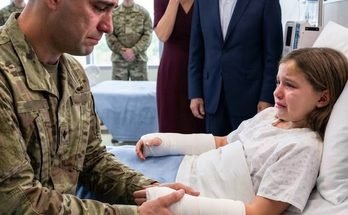
Gabe sat on the front steps with Nell in his lap, wrapped in his flannel shirt, her left arm cradled against her chest. She had stopped crying. She was looking at the paramedic, serious and wary.
“Daddy,” she said, when she saw me.
I dropped to my knees on the concrete. She reached for me with her good arm, and I took her gently, carefully, as if she were made of glass, and she pressed her face into my neck.
“I didn’t cry,” she whispered. “Like he said.”
“You don’t have to be quiet anymore,” I told her. “You never had to. You can cry as loud as you want.”
She did. I held her, and over her head I met Gabe’s eyes.
He didn’t say anything. He didn’t have to.
The paramedic, a woman with kind eyes and a braid, knelt beside us.
“We’re going to take her in, Dad. Her forearm looks like a fracture, and we need X-rays. I’d like you to ride with her.”
“I’m going,” I said.
“I’ll follow in the truck,” said Gabe. His voice was rough. His knuckles were bruised, though I couldn’t tell from what. I never asked.
Behind us, as they walked Brock out to the cruiser, I heard him shout something about it being an accident, about the girl being clumsy, about how she’d fallen off the couch.
The officer beside him said only, “Sir, there’s a recording.”
Part 5
At Children’s Hospital, a pediatric specialist named Dr. Okonkwo examined Nell’s arm. Fractured, she said, a clean break of the left forearm. It would heal. She would need a cast for six weeks.
She also, with a gentle hand and a quiet face, found two older bruises on Nell’s back and one on her thigh.
“Mr. Marsh,” Dr. Okonkwo said, quietly, in the hallway. “I’m required to report this. I want you to know that I believe your daughter has been hurt more than once.”
My knees almost gave out. Gabe caught my elbow.
“How long?” I asked.
“The bruises are different ages. At least a few weeks.” She paused. “I’m sorry.”
A social worker named Ms. Pruitt arrived within the hour, with a detective, a young man named Detective Ames who spoke to Nell in a low voice, kneeling beside her bed with a stuffed rabbit in his hand. Nell told him everything, slowly, in the careful sentences of a four-year-old. She said Brock got mad when she was loud. She said Mommy told her to be quiet and not tell Daddy. She said the bat was for “when she was bad.”
I listened from the doorway, with Gabe’s hand on my shoulder, and felt something in my chest go very still.
Marissa arrived at six, pale and shaking.
“Evan,” she said. “I didn’t know. I swear to God. I didn’t know he’d do that.”
“Where were you?”
“At work. I picked up an extra shift. Brock said he’d watch her, just for a few hours.”
“We have a custody order, Marissa. It says no one watches her but you, me, or my family. It says nobody else, without my written consent.”
She flinched. “I thought it was only for a little while.”
“She told the detective you said not to tell me.”
Marissa’s eyes filled. “I said that because I was afraid you’d take her.”
“You’re right,” I said. “I will.”
I said it quietly, with no triumph at all.
Part 6
Brock Hollister was charged with felony child abuse, assault with a deadly weapon, and witness intimidation. The prosecutor, a calm, tired woman named Ms. Delgado, told me that thirty-one seconds of audio, along with Nell’s statement, the medical records, and a doorbell camera that had recorded Gabe’s arrival, would make the case strong.
“I’ll be honest,” she said. “Cases involving very young children are hard. But this one has something that doesn’t happen often. We have the moment itself, recorded.”
Brock took a plea after four months, once his own lawyer had listened to the tape. Eleven years in state prison. The judge, an older man with a gravelly voice, looked at him over his glasses and said, “You struck a child who weighed thirty-eight pounds. I can think of nothing to say that would improve on that.”
Marissa’s case was handled separately. She cooperated fully, which counted for something. She was not charged with a crime, but the family court found that she had violated the custody order and failed to protect her daughter. Primary custody went to me. Her visits would be supervised, to be reviewed in a year.
She cried in the courtroom. So did I, a little, in the hallway afterward, where Gabe stood with a paper cup of terrible coffee and didn’t say a word.
“I keep thinking,” I said, “if I’d been in a meeting ten minutes longer, if I’d missed the call…”
“You didn’t,” said Gabe.
“If she hadn’t called me…”
“She did.” He looked at me. “She was four, and she was hurt, and she called the one person she knew would come. That’s not luck, man. That’s you.”
“It was you.”
“It was both of us,” he said. “That’s what a family is.”
Final Part
The cast came off in six weeks. Nell insisted on keeping it, covered in signatures and crayon drawings, in a shoebox under her bed. She had Gabe draw a dragon on it. She had me draw a smaller, lopsided one. She had her grandmother write her name, in cursive, which she then spent a week trying to copy.
She started therapy in the fall, with a gentle counselor named Dr. Ruiz, in a room full of puppets. For months, she flinched at sudden noises and wouldn’t sleep unless the hall light was on. She wouldn’t go near the baseball bat I’d taken out of the garage, so I gave it to Gabe, and he took it away without a word. We never saw it again.
Some nights she woke up crying. I’d carry her to the kitchen, and we’d eat toast together at two in the morning, and I’d tell her the same thing every time.
“You can always tell me. Every single time. No matter what.”
“Even if someone says not to?”
“Especially then.”
She considered this with the seriousness she brings to everything.
“Okay, Daddy.”
Marissa’s supervised visits began in the winter, at a small family center with a rug and a bin of toys. I sat in the lobby the first few times, with a magazine I wasn’t reading. Nell came out holding a drawing. It showed three stick figures holding hands, a tall one, a medium one, and a small one in a pink coat.
“That’s Mommy, and me, and you,” she said. “Gabe isn’t in it because he’s in the other one.”
She had a second drawing, in which a very large stick figure, with muscles and a grin, stood in front of a house with a huge dragon.
“He’s the dragon guard,” she said, with satisfaction.
Gabe, when I showed him, looked at it for a long time. He took it home, and when I visited his apartment a month later, it was taped to the refrigerator, above a photo of the two of us as kids, and a small, folded card in Nell’s careful print: Uncle Gabe. Thank you for coming.
On the first anniversary of that Tuesday, Nell turned five. We threw a small party in the backyard, with a bounce house, a cake shaped like a dragon, and six little girls shrieking in the grass. Gabe arrived with a gift the size of a refrigerator box and a look of such innocence that I knew it was going to be loud.
It was a drum set.
“Gabe.”
“She asked for it.”
“I did,” Nell said, from behind him, with her fist raised in triumph.
I put my face in my hands and laughed, really laughed, for the first time in what felt like years.
Later, after the guests had gone and the sun was slanting orange across the lawn, Nell climbed into my lap on the porch swing. The cast was long gone. Her arm was strong. She had a smear of frosting on her chin.
“Daddy?”
“Yes?”
“Remember the day Uncle Gabe came?”
“I remember.”
“I wasn’t scared when he came,” she said. “Because I knew you sent him.”
I held her a little tighter.
“I called him from the car,” I said. “I couldn’t get there fast enough.”
“I know.” She leaned her head against my chest. “But you sent someone. That’s what you do. You always send someone.”
I couldn’t speak.
From inside the house came a sudden, crashing explosion of drums, and Gabe’s voice crying out, “Sorry! Sorry! That was the cymbal!”
Nell giggled, bright and clear, and the porch light flickered on above us, and for the first time in a very long time, the whole world was loud in exactly the right way.
THE END