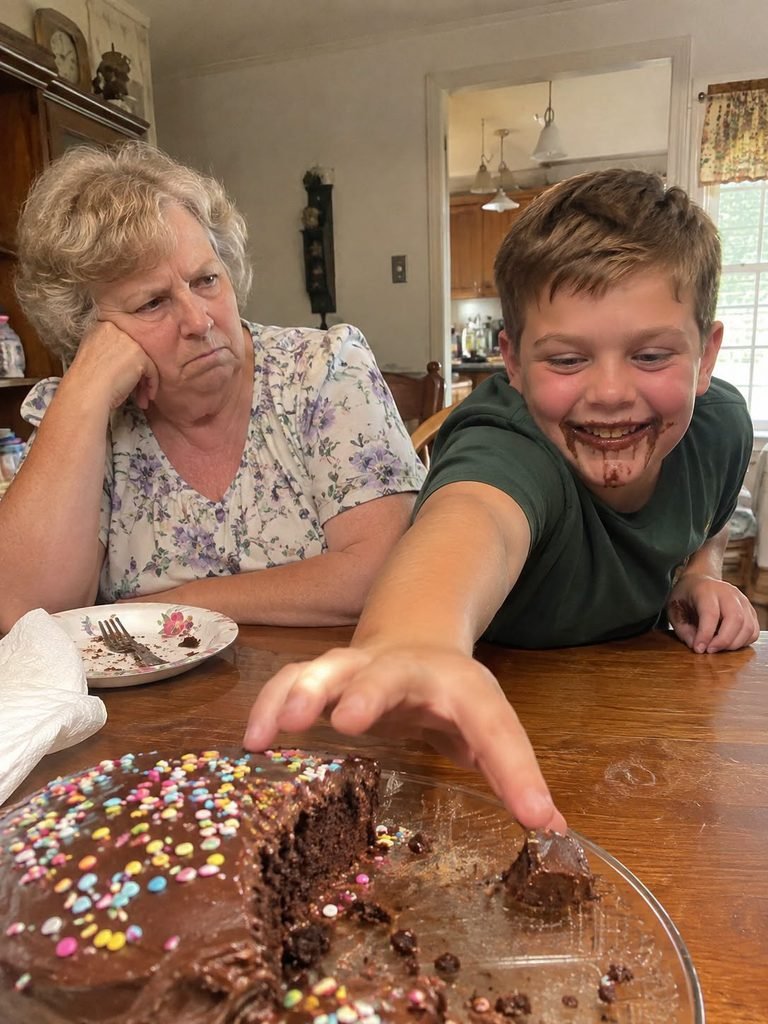
“Slow down, sweetheart!” my mother-in-law laughed. “You’re getting a little too curvy!”
A few relatives laughed with her.
My son, Oliver, froze with his hand halfway to the cake plate.
He’s seven. He was wearing the green dinosaur shirt he’d picked out himself that morning because he said it was “fancy.” He’d combed his own hair with water. He had been waiting all evening for that cake.
He looked around the table at all the faces. Twenty of them. Aunts, uncles, cousins, Patricia’s friends from church. Some of them were still smiling.
Then, slowly, he lowered his arm.
“Grandma,” he said, “I’m not fat.”
His voice was so quiet I barely heard it over the clinking forks.
He tugged the bottom of his shirt down over his stomach and held it there with both hands.
Patricia laughed again. She was wearing a gold paper crown one of the grandkids had made her, and it tipped to the side when she threw her head back.
“Oh, honey, look at that belly! You look six months pregnant!”
This time, Oliver didn’t answer.
He just looked down at the cake he hadn’t touched.
And I saw his little fingers tighten around the hem of his shirt until his knuckles went white.
I should explain something before I go any further.
Until a few months before that dinner, Oliver loved visiting his grandmother more than almost anywhere else in the world.
More than the park. More than the pool. More than the dinosaur museum two hours away that we’d taken him to twice.
If you asked him on a Friday night what he wanted to do tomorrow, he’d say, “Grandma’s,” before you even finished the question.
Patricia lived twenty minutes from us, in the same yellow house on Hawthorne Street where my husband David grew up. She’d been a widow for four years, since David’s dad, Frank, died of a stroke. The house was too big for her, and too quiet, and full of furniture that smelled like lemon polish.
In the front room, beside the big bay window, there was an old blue armchair. It was wide and soft, with a dent in the seat that was exactly the shape of Patricia. Nobody else sat in it. Not even Frank, when he was alive.
Except Oliver.
From the time he was two, every Saturday morning, Oliver climbed into Patricia’s lap in that blue chair, and she read him dinosaur books. The same ones, over and over. The one with the footprints. The one with the flying one. The one with the T. rex who was scared of the dark.
She’d do all the voices. She’d make the T. rex roar so loud the cat ran out of the room.
And almost every Saturday, Oliver would fall asleep on her chest before they finished the book. Sometimes she fell asleep too. I’d come to pick him up at noon and find them both snoring in that chair, with the sun coming in through the window and a dinosaur book open on the floor.
She called him Teddy Bear. Ever since he was a baby.
“How’s my Teddy Bear?” she’d say when he ran through her front door. And he’d throw himself at her knees and shout, “GRANDMA!” like he hadn’t seen her in a year.
That’s who Patricia was to my son.
That’s why what happened at that table felt like watching something break.
“Patricia, he’s seven,” I said. My voice came out harder than I expected. “Stop embarrassing him.”
The table went a little quieter.
Patricia waved her hand at me, the way you’d wave at a fly.
“Oh, relax, Sarah. I’m only joking!”
“It’s not funny to him.”
“Everything’s a big deal with you young mothers,” she said, and a couple of the older women at the end of the table nodded and smiled like they knew exactly what she meant.
I felt my face go hot.
That’s when my husband put down his fork.
David is not a loud man. He’s an accountant. He likes spreadsheets and quiet weekends and making pancakes in shapes on Sunday mornings. In twelve years of marriage, I had never once heard him raise his voice to his mother.
He didn’t raise it now, either.
He just set his fork down on his plate, very carefully, and looked down the long table at her.
“Mom,” he said, “can I ask you one question?”
“Of course, darling.”
“Why do you keep making jokes about Oliver’s stomach,” he said, “when you know what the doctor told us?”
Patricia’s smile disappeared.
Just like that. Gone.
The paper crown was still crooked on her head. But her face had gone completely still.
“David,” she said quietly. “Don’t.”
Three weeks before that dinner, Oliver had started complaining about stomachaches.
At first, they were small things. He’d rub his belly after breakfast and say it felt “pinchy.” He’d sit out a few minutes at soccer practice. I thought it was something he ate. Or nerves about the spelling test. Second grade spelling tests are a big deal when you’re seven.
Then I noticed his stomach looked a little swollen. Rounder, on one side, than it should have been. He’d always been a sturdy kid, solid and strong, but this was different. It was firm when I touched it. He flinched.
I took him to our pediatrician, Dr. Mendez.
Actually, Patricia took us. My car was in the shop that week, and David was at work, so she drove. She sat in the waiting room with Oliver on her knee and read him a magazine about tractors because there were no dinosaur ones.
When Dr. Mendez pressed on his belly, gently, in a few different places, her face changed. Just a little. Doctors are good at not letting their faces change, but I saw it.
“I’d like to get an ultrasound,” she said. “Just to take a look. It’s probably nothing, but I want to be sure.”
In the car afterward, Patricia was quiet. At a red light, she reached over and squeezed my hand.
“He’ll be fine,” she said. “Kids get all kinds of bumps.”
“I know,” I said.
“Make sure they look at it properly, Sarah. Don’t let them rush you.”
“I won’t.”
That was three weeks before her birthday.
Oliver had the ultrasound the afternoon before the dinner. A Saturday appointment, the only one they had. He lay on the paper-covered table while a woman rolled cold jelly over his belly with a wand. He watched the gray shapes on the screen and asked if he could see his lunch in there.
The technician laughed. But she was quiet for a long time after that, moving the wand over the same spot again and again.
“The doctor will call you with results,” she said when she was done. “Probably Monday or Tuesday.”
So we were waiting.
And Patricia knew all of this. Every bit of it. She’d sat in the waiting room. She’d squeezed my hand at the red light.
She knew.
David leaned forward across the table.
“He’s frightened enough, Mom,” he said. “Why would you make him feel worse?”
Patricia looked away. She picked up her napkin and folded it in half, then in half again.
Aunt Linda, David’s older sister, cleared her throat. “Okay, let’s just—maybe we should open presents?”
Nobody moved.
Then Oliver pushed back his chair.
The legs scraped across Patricia’s wooden floor.
“Mommy,” he said. “My tummy hurts again.”
I was out of my seat before I even thought about it. I knelt down next to his chair.
His face had gone pale. Not just a little pale. Gray-white, like paper. There were tiny beads of sweat on his upper lip.
“Is it like last time?” I asked.
He shook his head.
“Worse,” he said.
David came around the table and knelt down on Oliver’s other side.
Oliver grabbed his arm. He held on hard, with both hands, like he was afraid of falling.
“Daddy,” he said, “I feel funny.”
“Funny how, buddy?”
“Just funny. Like spinny.”
And that’s when my phone rang.
I almost ignored it.
It was buzzing in my back pocket, and my son was holding on to his father like he was drowning, and twenty people were staring at us, and I didn’t care who was calling.
But something made me pull it out.
I looked at the screen.
Dr. Mendez – Pediatrics.
My stomach tightened into a knot.
It was Sunday evening. Almost seven o’clock. Why would she be calling on a Sunday evening?
Doctors don’t call on Sunday evenings to tell you everything’s fine.
I answered with one hand still resting on Oliver’s shoulder.
“Hello?”
“Sarah, it’s Dr. Mendez. Are you with Oliver right now?”
I looked down at my son. He was clutching his father’s arm. His eyes were half closed.
“Yes,” I said. “He’s in pain. He just said his stomach hurts worse than before.”
There was a very short pause on the line.
“His scan showed something concerning,” she said. Her voice was calm, but fast. “I want you to take him straight to the emergency department at Children’s. Don’t wait until morning. I’m calling ahead so they’ll be expecting you.”
“What did it show?”
“I’d rather the team there explain it once they’ve examined him. Please go now, Sarah.”
David lifted Oliver into his arms before I’d even hung up.
He just scooped him up, the way he used to when Oliver was a toddler and fell asleep in the car. Oliver put his head on David’s shoulder and closed his eyes.
I grabbed my purse and Oliver’s little dinosaur backpack off the hook by the door. I don’t know why I grabbed the backpack. Habit, I guess. He took it everywhere.
At the dining table, nobody said a word.
The cake sat there in the middle with its seven candles burned down to nubs. The ones shaped like a seven and a zero.
Patricia was standing up. Her napkin had fallen on the floor. Her paper crown was still on her head.
“David,” she said. “What did she say? David?”
David didn’t answer her. He just carried our son out the front door and down the porch steps to the car.
I looked back once, from the doorway.
Patricia was standing alone at the head of her birthday table, with both hands over her mouth.
At the hospital, Oliver kept asking whether he had done something wrong.
He asked in the car. He asked in the waiting room. He asked the woman at the front desk who put the plastic bracelet on his wrist.
“No, sweetheart,” I told him, while a nurse in purple scrubs checked his temperature with a little wand against his forehead. “You haven’t done anything wrong. Not one single thing.”
“Then why is everyone looking at my tummy?”
I pulled the thin hospital blanket up over his legs.
“Because we want to find out why it hurts.”
He moved both his hands over his stomach and held them there. Like he was covering it up. Like it was something he needed to hide.
They did a lot of things that night.
They took blood. Oliver cried when the needle went in, and then apologized for crying, which almost made me cry. They did another ultrasound, and then a different kind of scan in a big white machine shaped like a donut. Oliver was very brave in the donut. He said it sounded like a spaceship.
A doctor with red glasses and a soft voice examined him, pressing gently on his belly. She asked him to point to where it hurt most. He pointed to his left side, just under his ribs.
Then she looked at his scans on a computer for a long time.
Then she asked David and me to step into the corridor for a minute, while a nurse named Tamika stayed with Oliver and let him play a game on her phone.
The corridor was bright and cold. There was a cart full of folded blankets against the wall. Somewhere down the hall, a baby was crying.
“I’m Dr. Hollis,” she said. “I’ve been looking at Oliver’s images, along with the ultrasound from yesterday.”
David took my hand.
“There appears to be a mass near one of his kidneys,” she said. “On the left side. It would explain the swelling and some of the pain he’s been having. Tonight, it looks like there may be a little bleeding around it, which is probably why he felt so much worse at dinner.”
“A mass?” I repeated.
The word didn’t seem real. It sounded like something from a science textbook.
She nodded.
“We need further tests,” she said. “And a specialist, a pediatric oncologist, is going to see him in the morning. They’ll be able to tell us exactly what we’re dealing with.”
Oncologist.
I knew that word. Everybody knows that word.
“Is it cancer?” David said. His voice was flat. “Is that what you’re saying?”
Dr. Hollis looked at both of us steadily.
“I know that’s frightening,” she said. “I’m not going to pretend it isn’t. But we aren’t going to make assumptions before we have the answers. Right now, he’s comfortable, he’s stable, and he’s in the right place. Let’s take it one step at a time.”
David nodded. He kept nodding, like he couldn’t stop.
I turned and looked through the glass window into Oliver’s room.
My son was lying small beneath a white hospital blanket. Tamika was showing him something on her phone, and he was smiling a little. He had his dinosaur backpack on the bed next to him.
He had one hand pressed flat against his stomach.
And I thought, Three hours ago, Patricia laughed at the size of his stomach in front of twenty people.
All that time, something had been growing inside him.
When I went back into the room, Oliver was tugging the hospital gown across his belly. Pulling it tight. Smoothing it down. Pulling it again.
“Does it hurt?” I asked, sitting down next to him.
“No.”
“Then why are you pulling it down, honey?”
He shrugged.
Tamika came over to adjust one of the stickers on his chest that connected to the heart monitor. She reached for the edge of his gown.
Oliver twisted away from her.
“Please don’t look,” he whispered.
Tamika paused with her hand in the air.
She looked at me. Then she looked back at him. Her voice got very gentle.
“I only need to check this little sticker, okay? Right here, by your shoulder. I promise I won’t look anywhere else.”
He nodded.
But he kept one hand pressed against the gown the whole time, right over his stomach.
I had seen that movement before.
That’s what I realized, sitting there in that plastic hospital chair.
I’d seen it at the dinner table, an hour earlier. Tugging his shirt down. Holding it with both hands.
But I’d seen it before that, too. I just hadn’t been paying attention.
In photographs, lately. At his cousin’s birthday party in August, when Linda said, “Stand up straight, Ollie, let’s get a good one!” He’d crossed his arms over his belly in every single picture.
At the swimming pool in July. He’d refused to take his T-shirt off. He swam in it. I’d thought it was because of sunburn.
At the shoe store. He’d asked me to go in the fitting room with him, and then he’d turned his back to me while he changed.
I had thought he was just becoming shy. Kids get shy around that age. That’s what everybody says.
Now I wasn’t so sure.
That night, David drove home to get some things. A toothbrush. Pajamas. His phone charger.
He came back at eleven with Oliver’s favorite stuffed animal. A big gray Triceratops named Gerald, with one horn that had been chewed flat when Oliver was teething.
Oliver hugged Gerald so hard his face disappeared into the fur.
David went down to the cafeteria to find us something to eat. I sat beside the bed and held my son’s hand.
The room was dark except for the little green lights on the monitor. Oliver was supposed to be sleeping. He wasn’t.
I tried to think of something to talk about. Something nice. Something that wasn’t scans or needles or stomachs.
“Do you remember,” I said, “how Grandma used to let you sit in her big chair?”
Oliver’s eyes moved toward me in the dark.
“The one by the window?”
“Yes. The blue one.”
He nodded.
“She’d read those dinosaur books until you both fell asleep,” I said. “Remember? I’d come to get you, and you’d both be snoring.”
I was smiling, remembering it.
Oliver wasn’t.
“She doesn’t do that anymore,” he said.
I stopped smiling.
“Have you asked her?”
“Once.”
“What did she say?”
He rubbed the corner of the blanket between his fingers. Back and forth. Back and forth.
“She said I was too big for her lap.”
I tried to smile again. I didn’t do a very good job.
“Well,” I said, “you’re growing up, honey. That’s all. You’re seven now. That doesn’t mean she doesn’t want you close.”
Oliver looked down at himself. At the blanket. At the shape of his stomach under it.
“She says my tummy’s getting bigger too,” he said.
My throat got so tight I couldn’t swallow.
“Grandma shouldn’t say things that make you feel bad,” I said finally.
He didn’t say anything for a while.
Then he said, “She used to call me Teddy Bear. Even when I was really little.”
“I remember.”
“Now she calls me her big boy.”
He said those last two words so quietly that I almost missed them.
Big boy.
I’d heard her say it a hundred times over the last few months. Look at my big boy. Here comes my big boy. I’d thought it was sweet. I’d thought she was proud of him.
I never once heard it the way he heard it.
“Do you miss sitting with her?” I asked.
He nodded. He didn’t look at me.
I wanted to tell him Patricia loved him. Because she did. I knew she did.
I wanted to promise that everything would be fine. That Grandma would read to him again. That his tummy would stop hurting. That tomorrow the specialist would come in and say it was all a big mistake.
But he was watching my face in the dark, waiting. He was waiting for an answer that meant something. Not a grown-up answer. Not a pat on the head.
So I said, “You can miss that, sweetheart. It’s okay to miss it. And you can tell her that it hurts when she jokes about your body.”
He didn’t answer.
Instead, after a long time, he asked a different question.
“Will she be mad?”
I didn’t sleep that night.
I sat in that plastic chair and watched the green numbers on Oliver’s heart monitor go up and down. I watched his chest rise and fall under the blanket. I watched his hand, which never once left his stomach, even after he finally fell asleep.
Will she be mad?
Not Will it make her stop.
Not Will she say sorry.
Will she be mad.
The next morning, David came back with two cups of coffee from the cart downstairs.
Oliver was still sleeping, with one arm around Gerald the Triceratops.
I took one of the coffees, and then I took David by the sleeve and walked him out into the hallway. I closed the door most of the way behind us.
“How long has your mother been talking about his weight?” I said.
David stared down at the cup in his hand.
“Sarah…”
“How long, David?”
He let out a long breath.
“She’s made comments before.”
“What kind of comments?”
“Just… you know how she is. Little things. Should he really have seconds? He’s getting a bit of a tummy on him. That kind of thing.”
“How long?”
“A few months. Maybe since the summer.”
I felt my face getting hot.
“Oliver says she doesn’t let him sit on her lap anymore,” I said. “He says she told him he was too big.”
David closed his eyes.
“He told me that,” he said.
For a second, I couldn’t say anything.
“When?” I said finally.
“A few weeks ago. He was upset after we visited Mom. In the car on the way home. You were at your sister’s that day, remember? It was just me and him.”
“And you didn’t tell me?”
“I thought I could handle it.”
I put my coffee down on the cart of folded blankets.
“What did you do?”
“I talked to her,” David said. “After the doctor’s appointment. The one she drove you to. I called her that night, and I told her the comments needed to stop. Especially now, when we didn’t know what was going on with his stomach. I told her Oliver was getting upset.”
“And?”
“She promised she would.”
I stared at him.
And I remembered the question he’d asked her at the dinner table. Very calm. Very carefully.
Why do you keep making jokes?
Keep.
He hadn’t been reacting to one terrible moment at a birthday dinner.
He had been sitting there watching a promise break. In front of twenty people. In front of our son.
“Why didn’t you tell me any of this?” I said.
David rubbed the back of his neck.
“Mom gets emotional when she thinks someone’s criticizing her,” he said. “You know that. Ever since Dad died, it’s worse. Everything turns into a big thing. I didn’t want a huge argument over something she’d already agreed to stop.”
“But she didn’t stop.”
“No,” he said quietly. “She didn’t.”
“What did you tell Oliver?” I asked. “In the car. When he told you.”
David studied the floor tiles.
“That Grandma loved him,” he said. “That she didn’t mean it.”
I waited.
He didn’t say anything else.
I kept waiting.
“And that he shouldn’t take the jokes so seriously,” David said.
For a moment, all I could hear was a cart rattling down the corridor. Wheels squeaking. A phone ringing at the nurses’ station.
“You told our seven-year-old son,” I said slowly, “to ignore something that made him ashamed of his body.”
“I know how that sounds.”
“Do you?”
David didn’t answer.
He just stood there with his coffee getting cold in his hand.
I looked at him. My husband. A kind man. A good father. The man who made pancakes shaped like stegosauruses on Sunday mornings and let Oliver add the chocolate chip eyes.
And I thought about him at seven years old, in that same yellow house on Hawthorne Street. In the same front room with the same blue chair.
I’d never asked him what Patricia used to say to him.
Inside the room, Oliver stirred.
Through the gap in the door, I could see him sitting up in bed. He was looking toward the doorway. Toward us.
David and I looked at each other.
We went back inside before he could see us arguing.
Oliver held up Gerald the Triceratops when we came in, like he was showing us he’d kept him safe all night.
“Daddy,” he said, “did Grandma call?”
David stopped beside the bed.
“She did,” he said.
He’d had his phone on silent. I’d seen it lighting up over and over during the night. Fourteen missed calls by six in the morning. All from Mom.
“Was she crying?” Oliver asked.
“She was worried about you, buddy.”
“But was she crying?”
David hesitated.
Then he nodded slowly.
Oliver looked down at Gerald. He stared at the Triceratops’s little plastic teeth for a long time.
Then he looked up at me.
“Is Daddy sad too?” he asked.
“Of course we’re worried, sweetheart,” I said. “You’re in the hospital. We’re both worried about you.”
Oliver shook his head.
“Not about my tummy,” he said.
He looked at David.
“About Grandma.”
David sat down slowly on the edge of the bed.
“Buddy,” he said. “What do you mean?”
Oliver’s lower lip started to tremble.
“Grandma cried,” he said, “the last time you told her to stop teasing me.”
David went completely still.
I looked from one of them to the other.
“You heard that?” David said.
Oliver nodded.
“When?” I said. “When was this?”
“At Grandma’s house,” Oliver said. “When Daddy went in the kitchen with her. I was supposed to be watching the dinosaur show. But I went to the bathroom, and I was in the hallway.”
David covered his mouth with his hand.
“You told her she made me sad,” Oliver said. “And then she cried. And she said you didn’t love her anymore. She said, First your father, and now you. And she cried really loud.”
“Oh, buddy,” David whispered.
“I didn’t know you were listening,” he said through his fingers.
“I was in the hallway,” Oliver said again. Like that explained everything.
“Oliver,” I said gently. I sat down on the other side of the bed. “Why didn’t you tell me? About the jokes? About the chair?”
He squeezed Gerald so hard the Triceratops’s tail bent sideways.
“Because you’d tell Daddy,” he said.
“And?”
“Daddy would tell Grandma.”
He paused.
“Then Grandma would cry again.”
Something inside me seemed to drop. Like stepping off a stair that isn’t there.
My son hadn’t been keeping quiet because the jokes didn’t hurt.
He’d been keeping quiet because he thought his hurt would make everyone else unhappy.
He was seven years old. And he’d decided, all by himself, standing in his grandmother’s hallway, that his feelings were dangerous. That if he said out loud that something hurt, the grown-ups would fall apart.
So he just stopped saying it.
He tugged his shirt down instead.
“Sweetheart,” I whispered. “You never have to hide something that’s hurting you. Never. Do you hear me?”
He looked past me, at his father.
“But Daddy gets sad when Grandma cries,” he said.
David reached for him.
Oliver turned his face away.
Not angry. Not dramatic. He just turned his face toward the window and looked at the parking garage across the street.
David’s hand stopped in the air.
He held it there for a moment. Then he put it down on the blanket, next to Oliver’s foot.
“I know, buddy,” he said. His voice was cracking. “I know I do. I need to do better.”
Oliver kept looking out the window at the parking garage.
A few minutes later, the nurse came in to take his blood pressure, and Oliver asked for his dinosaur backpack.
“I want Stomper,” he said.
Stomper was a small green plastic dinosaur that lived in the front pocket of his backpack. A Brachiosaurus, about the size of my thumb. One of his eyes had been scratched off at the playground two years ago. Oliver loved him more than any other toy because, he said, “He’s broken, but he’s still brave.”
David picked up the backpack from the chair by the window. He unzipped it and dug around inside.
He found Stomper first. He handed him to Oliver.
Then, as he was pulling his hand out, a folded piece of yellow card slipped out of the bag and fell onto the floor.
“Oh,” I said. “That’s his birthday card. For Patricia.”
He’d made it that Sunday afternoon, before the dinner.
He’d sat at our kitchen table for almost two hours with his markers and his crayons and a piece of yellow cardstock from my craft drawer. He wouldn’t let me see it. Every time I walked past, he covered it with his arm.
“It’s a surprise,” he said. “It’s for Grandma’s eyes only.”
“Not even a tiny peek?”
“Mommy. It’s a surprise.”
When he was done, he folded it very carefully and slid it into the front pocket of his dinosaur backpack. He zipped it shut.
“I’m going to give it to her after cake,” he told me in the car. “When everybody’s done. So it’s special.”
He never got to give it to her.
David bent down and picked the card up off the hospital floor.
There was a drawing on the front.
It was Grandma’s blue chair. I could tell right away. Beside the big bay window. There was a vase of red flowers on the windowsill, because Patricia always had flowers there. The cat was drawn on the floor in orange crayon, with whiskers going way past his face.
And in the chair, there was Grandma, with her gray hair and her glasses.
And on her lap, there was a small boy.
The boy was wearing a blue shirt with a dinosaur on it.
I knew that shirt. Oliver’s old blue Stegosaurus shirt. He’d worn it every Saturday when he was three and four. He’d outgrown it years ago. It was in a box in our basement.
In the drawing, Grandma’s arms were around him.
They were both smiling.
David opened the card.
I watched his face while he read it.
I watched it change. Very slowly. Like something was caving in behind it.
He didn’t say anything. He just handed it to me.
Inside was Oliver’s uneven handwriting, in green marker. The letters were big and wobbly. Some of them were backwards. He’d pressed so hard that the marker had soaked through the paper in places.
Happy Birthday, Grandma.
I wish I could be little again so you could hold me like before.
I still love you.
I read it twice.
Then I read it a third time, because I couldn’t believe what I was reading.
I wish I could be little again so you could hold me like before.
At dinner, he’d been sitting at that table with this card in his backpack. Waiting. Waiting for the cake to be over so he could hand his grandmother a picture of the very thing he thought he’d lost.
And then she’d made twenty people laugh at his body.
I looked over at Oliver.
He had curled onto his side while we were reading. The little green dinosaur with the missing eye was tucked under his chin. Gerald was squished against his back.
His eyes were closed.
I don’t know if he was really asleep. I think maybe he just didn’t want to watch our faces while we read it.
David sat down heavily in the chair beside the bed. He took the card back from me and laid it on his knee and pressed it flat with his whole palm, smoothing out the fold, over and over.
“I thought she was just teasing him,” he whispered.
“He told you he was hurt, David.”
“I know.”
He wiped his face with the back of his hand.
“I kept telling him she loved him,” he said. “Over and over. Like that would fix it.”
“Maybe he didn’t need you to tell him she loved him,” I said quietly. “Maybe he needed you to show him that you believed him.”
David nodded slowly.
He kept looking at the drawing of the little boy in the blue shirt.
Later that morning, while Oliver was having more blood drawn, David and I went down to the cafeteria. Neither of us ate anything. We just sat at a little table by the window with two trays of untouched eggs.
“Can I ask you something?” I said.
He looked up.
“When you were little,” I said. “Did your mom ever say things about your body?”
He was quiet for a long time.
“I was a chubby kid,” he said finally. “Did you know that? Up until about twelve.”
“I’ve seen the pictures.”
“She used to call me her little dumpling.” He laughed, but it wasn’t really a laugh. “In front of people. At church. She’d pat my stomach and say, My little dumpling. And everybody would laugh.”
“Did it bother you?”
“I don’t know. I guess.” He pushed his eggs around with his fork. “I remember once, at Christmas, I cried about it. In my room. And my dad came up and sat on my bed and told me Mom didn’t mean anything by it. He said she just said things without thinking, and it would hurt her feelings if I made a big deal of it.”
He stopped.
I watched him hear himself.
“Oh,” he said quietly.
“Yeah,” I said.
“That’s exactly what I told Oliver.”
“Yeah.”
He put his fork down.
“Her own mother was worse,” he said. “Grandma Ruth. She used to tell Mom she’d never get a husband if she didn’t lose ten pounds. Mom told me that once, laughing about it. Like it was funny.” He rubbed his eyes. “I guess everybody in my family’s been laughing about it for seventy years.”
Patricia arrived that afternoon, around three o’clock.
She was carrying a canvas grocery bag with clean clothes for Oliver, his pajamas with the rockets on them and a fresh pair of socks, and a box of his favorite crackers, the little ones shaped like goldfish.
She looked exhausted. Her makeup was smudged under her eyes. Her hair, which was always set perfectly, was flat on one side, like she’d slept on it in a chair. She was wearing the same blouse she’d worn to her birthday dinner.
She came down the corridor fast, almost running, and stopped in front of us outside Oliver’s door.
“How is he?” she said. “David, how is he? Nobody would tell me anything. I called all night.”
“He’s resting,” David said.
“What did they find? What is it?”
“They found a mass,” David said. “Near his kidney. They don’t know yet what it is. The specialist was here this morning. They’re doing more tests.”
Patricia put her hand on the wall.
“A mass,” she said. “Oh, God. Oh, my God.”
She sat down in one of the plastic chairs along the hallway wall. The grocery bag slid off her arm onto the floor.
“I’ve been sick with worry,” she said. “I didn’t sleep. I sat up all night by the phone.” She pressed a tissue under her eyes. “Your father would have known what to say at a time like this. He always knew what to say.”
David didn’t respond.
He just stood there in the hallway with his arms at his sides.
Patricia looked up toward Oliver’s door.
“Can I go in?”
“Not yet,” David said.
Her eyes filled with tears.
“David, please,” she said. “I’m his grandmother.”
David reached into the back pocket of his jeans.
He took out the yellow card. He’d been carrying it around all day. He held it out to her.
“Read this first,” he said.
Patricia frowned. She took the card from his hand.
She unfolded it.
I watched her eyes reach the drawing on the front.
Her whole face went soft.
“That’s my old chair,” she whispered. She touched it with one fingertip. “And there’s Biscuit, look, with his whiskers.” She laughed a little, a wet laugh. “And that’s my Teddy Bear.”
“Read the inside, Mom,” David said.
She opened it.
Her mouth moved silently while she read. I watched her get to the second line.
I wish I could be little again so you could hold me like before.
She stopped.
Her lips stopped moving.
She sat there in the plastic hospital chair, not looking away from the page, for what felt like a very long time.
“He made this for me?” she said finally.
“Yes,” David said. “Yesterday afternoon. He worked on it for two hours. He was going to give it to you after cake.”
Patricia touched the little drawing again. The boy in the blue shirt.
“I used to read to him there,” she said. “Every Saturday. He’d fall asleep on me before we finished the book. Every single time.”
“Then you started telling him he was too big,” David said.
“He was getting older, David.” Her voice got defensive. “He’s seven. He’s heavy. My back isn’t what it used to be. I didn’t think…”
“You told him,” David said, “that he had a pregnant belly. At your birthday dinner. In front of twenty people.”
Her face crumpled.
“I was joking,” she said. “It was a joke. Everybody laughed. I never thought he would take it like this.”
“He thought you didn’t want to hold him anymore.”
Patricia looked up at her son.
“That’s ridiculous,” she said. “I love that child. I love him more than anything in this world.”
David crouched down in front of her chair, so that his face was level with hers.
“Then why,” he said quietly, “did he think he had to become smaller to get his grandmother back?”
Patricia stared at the card in her lap.
She opened her mouth.
She closed it again.
For once in her life, she didn’t have an answer.
We stayed like that for a while. Patricia in the chair. David crouching in front of her. Me standing against the wall with my arms crossed. A nurse walked past and looked at us and kept walking.
“I was worried about his stomach,” Patricia whispered after a long time. “You know I was. I asked Sarah in the car to make sure the doctor looked at it properly. I asked you, David, on the phone. Didn’t I? I said, make sure they check it.”
“I know you did, Mom,” David said. “That’s why the jokes hurt even more.”
Patricia wiped her cheeks with her tissue.
“You knew something was wrong,” David said. “You knew he was scared. You drove him to the doctor. And then you sat at that table and laughed at the exact thing he was scared of.”
“I didn’t think of it like that.”
“I know you didn’t. That’s the problem.”
“Please,” Patricia said. “Please, David. Please let me see him.”
David glanced toward Oliver’s door.
He was quiet for a long moment.
“Not until he wants to,” he said.
Patricia started crying harder. Not quietly. The way she must have cried in her kitchen that day, with Oliver standing in the hallway listening.
“You’re shutting me out,” she said. “My grandson is sick, and you’re shutting me out. After everything. After your father. I’m alone, David. I’m all alone in that house. And you’re keeping me away from my own grandson when he might be…”
She couldn’t finish.
I saw it happen on David’s face. The thing I’d seen a hundred times in twelve years of marriage. The little flinch. The way his shoulders came up. The way he started to reach for her.
He’d been doing it his whole life. Since he was a chubby little boy crying in his bedroom at Christmas.
Then he stopped.
He took a breath.
He shook his head.
“Mom,” he said. “He’s the one who’s sick. This isn’t about making you feel better.”
Patricia lowered the card into her lap.
She looked at her son for a long time, like she was seeing someone she didn’t quite recognize.
She didn’t argue again.
After a while, she picked up the canvas grocery bag from the floor and held it out.
“His pajamas,” she said, in a small voice. “The rocket ones. And his crackers.”
I took the bag from her.
“Thank you, Patricia,” I said.
She nodded. She stood up. She held the yellow card against her chest with both hands.
“Can I keep this?” she said. “It’s mine. He made it for me.”
David looked at me. I nodded.
“Yes,” David said. “It’s yours.”
She walked away down the long hallway toward the elevators. She looked so small. Seventy years old, in yesterday’s blouse, holding a piece of yellow cardstock.
I’d been so angry at her all night. I was still angry.
But watching her walk away, I felt something else too. Something I didn’t want to feel.
Later that evening, David sat with Oliver while I went to get some water from the machine down the hall.
When I came back, I stopped in the doorway.
David was sitting on the edge of the bed. Oliver was propped up on his pillows in his rocket pajamas, with the goldfish crackers open on the tray table.
David was speaking softly.
“I should have listened,” he was saying, “when you told me Grandma’s jokes hurt. In the car. I should have listened, and I didn’t. I’m sorry, buddy.”
Oliver picked at Stomper’s missing eye with his fingernail.
“I didn’t want her to cry,” he said.
“I know.”
“Will she cry if I don’t want to see her?”
David thought about it. He didn’t rush. He didn’t say the easy thing.
“Maybe,” he said.
Oliver’s eyes went wide. Like he couldn’t believe his father had said it out loud.
David took his hand.
“Grown-ups are allowed to be sad, buddy,” he said. “It’s okay for Grandma to be sad. But it’s not your job to stop them. It’s never your job.”
“But then you’ll be sad,” Oliver said.
“I might be,” David said. “Sometimes. That’s not your job either.”
Oliver thought about that.
I could see him thinking. He has a little wrinkle that comes between his eyebrows when he’s working something out, like when he’s trying to sound out a long word. It was there now.
“Can I tell you,” he said slowly, “when someone makes me sad?”
“Every time,” David said. “Every single time. Even if it’s Grandma. Even if it’s me. Especially if it’s me.”
Oliver looked at him for a long time.
Then he leaned over sideways and put his head against his father’s chest.
David put his arms around him.
I stood in the doorway holding two paper cups of water and watched them.
And I realized that was the first time I’d ever seen my husband hold our son without looking over his shoulder toward his mother’s feelings.
The weeks that followed weren’t easy.
I won’t pretend they were.
The specialist, Dr. Kwan, was a tall, quiet man with a bow tie covered in tiny cartoon planets. He sat down on a rolling stool in Oliver’s room three days later, so that he was lower than Oliver, and he talked to Oliver first, before he talked to us.
“You’ve got a lump inside your tummy,” he told him. “Next to your kidney. Do you know what a kidney is?”
“It cleans your blood,” Oliver said. “And makes pee.”
Dr. Kwan raised his eyebrows. “That’s exactly right. Very good.”
“We learned it in science.”
“Well,” Dr. Kwan said, “this lump isn’t supposed to be there. It’s been growing, and that’s why your tummy got bigger, and that’s why it hurts. So we’re going to take it out. And then we’re going to give you some special medicine to make sure it doesn’t come back.”
Oliver looked down at his stomach.
“So my tummy wasn’t big because I’m fat?” he said.
The room went very quiet.
Dr. Kwan looked at me. Then back at Oliver. He took his time before he answered.
“No,” he said. “Your tummy got bigger because something was growing inside it that shouldn’t be. That’s not your fault, and it has nothing to do with how much cake you eat or anything like that. Okay? Nothing you did made this happen.”
Oliver nodded slowly.
He didn’t say anything else.
But that night, for the first time since the birthday dinner, he fell asleep with his hands down at his sides.
The growth was serious. Dr. Kwan explained it to David and me later, in a little room with a box of tissues on the table. It was a kind of tumor that happens mostly in young children. They’d caught it, he said, before it had spread very far. That was the good news. There was a lot of good news, actually, about this kind of tumor, if you had to have one.
But it was still cancer. That word was still in the room.
Oliver had surgery the following week. Four hours. David and I sat in the waiting room and didn’t speak. David held my hand so tightly my wedding ring left a mark.
When the surgeon came out and said, “It went well. We got all of it,” David put his face in his hands and cried. Loud. In front of the whole waiting room. He didn’t care who saw.
After the surgery came the treatment. Chemotherapy, every week for a while. Then every few weeks.
There were days when Oliver was tired. Days when he threw up in a pink plastic basin and then apologized to the nurse for making a mess. Days when he was frightened, and held my hand so hard during the needles that his fingernails left little moons in my skin.
And there were days when he was angry. Really angry. Angry about being in the hospital again. Angry about missing soccer. Angry about missing his friend Marcus’s birthday party, where there was going to be a magician.
One afternoon, he threw Gerald the Triceratops across the room and yelled, “I hate this! I hate it! I hate everything!”
Then he looked at me, scared, waiting to see if I’d be upset.
I picked Gerald up off the floor and handed him back.
“You’re allowed to hate it,” I said. “I hate it too.”
He looked surprised. Then, slowly, he started to laugh. And then he was crying, and laughing, and I was holding him, and we both said “I hate it” about twenty more times until it was mostly just funny.
His hair started falling out in the fourth week.
He found it on his pillow in the morning. Little clumps of brown. He held a piece of it in his hand and stared at it.
“Will I look weird?” he asked.
“You’ll look like you,” I said.
“Will people laugh?”
I didn’t promise that they wouldn’t. I couldn’t. I’d stopped making promises I couldn’t keep.
“Some people might say dumb things,” I said. “And if they do, you can tell me. Every time.”
“And you won’t tell me not to take it so seriously?”
He said it very casually, looking at the hair in his hand. But he said it.
David was standing in the doorway with a cup of coffee. He heard it.
He came and sat down on the bed.
“Never,” David said. “I’ll never tell you that again.”
That weekend, David shaved his own head, in our bathroom, with Oliver sitting on the counter holding the clippers for the last stripe. They laughed so hard they had to stop twice.
Patricia sent messages all through those weeks.
Long ones, at first. Paragraphs and paragraphs. How is he? Is he eating? Did the surgery go well? Please tell him Grandma loves him. Please tell him I’m praying for him every night. Please let me come.
David answered every one of them. He told her the truth about how Oliver was doing. He sent her a picture of Oliver after surgery, giving a thumbs-up from his hospital bed.
But he stopped promising visits on Oliver’s behalf.
One night, I heard him on the phone in our kitchen.
“No, Mom. Not this week,” he said. “I asked him, and he said he’s not ready… I know… I know it hurts. I’m sorry it hurts… No, I’m not going to make him… Because it’s his choice, Mom. That’s why… Okay. I love you too. Goodnight.”
He hung up.
He stood at the kitchen counter with his hands flat on it for a long time.
“Are you okay?” I asked.
“No,” he said. “But that’s not his job either.”
About a month after the surgery, Patricia called me instead of David.
That had never happened before. In twelve years, she’d called me maybe three times, and one of them was by accident.
“Sarah,” she said. Her voice was very quiet. “I wondered if you’d have coffee with me. Just you. Just for twenty minutes. You can say no.”
I almost said no.
I said yes.
We met at a little diner halfway between our houses. She was already there when I arrived, in a booth by the window, with a cup of tea she hadn’t touched. She was wearing a gray cardigan. No makeup. She looked older than I’d ever seen her.
“Thank you for coming,” she said.
I sat down.
For a long time, she didn’t say anything. She just turned her teacup around and around on its saucer.
“I keep reading his card,” she said finally. “Every night. I keep it on my nightstand.”
I didn’t say anything.
“I wish I could be little again so you could hold me like before.” She said it without looking at the card. She’d memorized it. “I keep thinking, what kind of grandmother makes a little boy wish he was smaller?”
“Patricia…”
“No. Let me.” She held up her hand. “I need to say this to someone, and I can’t say it to David, because he’ll try to make me feel better. He’s been trying to make me feel better his whole life.”
I closed my mouth.
“My mother used to weigh me,” she said. “Every Sunday morning. Before church. On the bathroom scale. And she’d write it in a little notebook. And if it went up, she’d sigh. That’s all. She’d just sigh. And she wouldn’t let me have any dessert at Sunday dinner. My brothers got pie. I got a glass of water.”
I stared at her.
“I was eight,” she said.
She turned the teacup again.
“I’m not telling you this so you’ll feel sorry for me,” she said. “I’m telling you because I swore I’d never be like her. I swore it. And I thought I wasn’t. I thought, I never weigh him, I never take away his dessert, I’m just joking. I’m just being funny. Everyone laughs.” She shook her head. “But I watched him at that table. I watched him pull his shirt down. And I knew that face, Sarah. I know that exact face. I’ve seen it in the mirror.”
She was crying now. Quietly. Not the way she cried at David.
“I just didn’t want to see it,” she said.
I didn’t forgive her that day. I want to be honest about that.
I sat there in that diner booth, and I felt sorry for the eight-year-old girl drinking water while her brothers ate pie. I really did.
But I’d also sat beside a hospital bed and watched my son cover his stomach with his hands while he slept.
“I appreciate you telling me,” I said finally. “I do. But Patricia, he’s the one who gets to decide. Not me. Not David. Not you.”
She nodded.
“I know,” she said. “I know he does.”
“And when he’s ready,” I said, “if he’s ready, you can’t make it about you. You can’t cry at him. You can’t tell him you were joking. You just have to say you’re sorry and then let him decide what happens next.”
She looked at me for a long time.
“I’ll do whatever he needs,” she said. “Whatever it takes.”
I believed she meant it.
I didn’t know yet if she could do it.
Two weeks later, at breakfast, Oliver put down his spoon.
“Is Grandma still sad?” he asked.
David and I looked at each other.
“Probably,” David said honestly. “She misses you.”
Oliver thought about it. The little wrinkle came between his eyebrows.
“Can she come over?” he said. “Just for a little bit? Not a long time?”
“Of course,” I said. “If you want her to.”
“I don’t know if I want her to,” Oliver said. “I just want to see what it’s like.”
She came that Saturday.
She came without a gift. David had told her not to bring one, and for once, she listened. No toy, no cake, no balloon. Just Patricia, in her gray cardigan, standing on our front porch, holding nothing.
Oliver was sitting on the couch in the living room with Gerald on his lap and a knit hat on his bald head. He didn’t get up when she came in.
Patricia stopped in the doorway of the living room.
She looked at him. At the hat. At how thin his face had gotten.
I saw her hand go to her mouth.
Then I watched her take it down again. I watched her swallow. I watched her decide not to cry.
She walked over and sat down in the armchair across from the couch. Not next to him. Across from him. With the coffee table between them.
“Hi, Oliver,” she said.
“Hi, Grandma.”
She folded her hands in her lap.
“I’m sorry I made jokes about your tummy,” she told him. “I was wrong. You didn’t deserve that. Not at my birthday, and not any of the other times either. It wasn’t funny. It was mean, and I’m sorry.”
She didn’t say I was only joking.
She didn’t say I didn’t mean it.
She didn’t say I love you so much or You know Grandma loves you or anything that asked him to make her feel better.
She just said it, and then she stopped talking.
Oliver looked at her hands. They were folded in her lap, very still.
He looked at them for a long time.
“Do you still think I’m too big?” he asked.
“No, sweetheart,” Patricia said.
“For your chair?”
Patricia swallowed. I saw her throat move.
“That chair,” she said slowly, “was never supposed to make you feel unwanted. That was my mistake. Not yours.” She took a breath. “You can sit beside me. Or on my lap, if you’re comfortable. Or across the room from me. You get to choose. Every time.”
Oliver didn’t say anything.
He didn’t get up. He didn’t hug her.
He looked down at Gerald on his lap, and he picked at the Triceratops’s flat horn.
Then he looked back up.
“Do you still have my dinosaur books?” he asked.
“I do,” Patricia said. “All of them. They’re on the shelf by the window. Right where you left them.”
“Even the flying one?”
“Even the flying one.”
He nodded slowly.
“Okay,” he said.
That was it. That was the whole visit, almost. She stayed for twenty minutes. They talked about his hospital. He showed her the scar on his tummy, very quickly, lifting his shirt just an inch and putting it back down. She looked at it and said, “That’s a very brave scar,” and nothing else.
When she left, she didn’t ask for a hug. She said, “Goodbye, Oliver. Thank you for letting me come.”
At the front door, out of his sight, she held on to the door frame for a second with both hands. Then she straightened up and walked to her car.
Over the following months, their visits were short.
Twenty minutes. Half an hour. Sometimes an hour, if Oliver was having a good day.
Sometimes he wanted her to read. Sometimes he didn’t. Sometimes he just wanted to show her his drawings, or tell her a long story about a dinosaur fight he’d imagined, which took twenty minutes and had no ending.
She listened to all of it.
She stopped commenting on his body. Completely. Not his tummy, not his hair, not how thin he’d gotten during treatment, not how much he ate or didn’t eat. She just stopped.
When he said he was tired, she listened. She’d stand up right away, in the middle of a sentence, and say, “Then I’ll go, and I’ll come back another day.” And she’d go.
Once, during a bad week, he didn’t want to see her at all. David called her and told her not to come.
She didn’t cry on the phone. David told me that afterward, like it was a small miracle.
“She just said, Okay. Tell him I hope he feels better,” David said. “That’s all. Then she hung up.”
The first time she read to him again was on a Sunday afternoon in early spring, in our living room.
She brought the dinosaur book. The one with the footprints.
Oliver sat at the other end of the sofa. As far away from her as the sofa would let him. Gerald was between them, like a fence.
Patricia opened the book to the first page, the one with the big muddy footprints crossing the paper.
“You remember this one?” she asked.
Oliver nodded. But he didn’t move closer.
She read anyway.
She read the whole thing from the other end of the couch. She did the voices, but softer than she used to. The T. rex didn’t roar quite as loud.
Halfway through, she got to a long dinosaur name and said it wrong.
“Pa-chy-SEPH-a-lo-saurus,” Patricia read.
“Grandma,” Oliver said. “It’s pachy-CEPH-a-lo-saurus. It’s a K sound.”
Patricia stopped. She looked at him over her reading glasses.
Then she smiled. A real smile. Not the big birthday-party smile. A small one.
“Pachy-ceph-a-lo-saurus,” she said carefully.
“Better,” Oliver said.
She kept reading.
When the book ended, she didn’t ask for a kiss. She didn’t say Come give Grandma a hug. She just closed it and put it on the coffee table.
“I’ll bring the next one,” she said, “if you want.”
After she left, Oliver came into the kitchen, where I was washing dishes.
He climbed up on one of the stools at the counter and sat there for a while, swinging his legs.
“Mom,” he said. “Was Grandma mad because I didn’t hug her?”
I turned off the water and dried my hands.
“No,” I said. “She wasn’t mad.”
“How do you know?”
“Because she smiled when you fixed her dinosaur word. Did you see?”
He thought about it.
“And even if she was disappointed,” I said, “you wouldn’t have done anything wrong. Okay? You never have to hug anybody to make them feel better. Not even Grandma. Not even me.”
He considered that for a long time. The little wrinkle came and went between his eyebrows.
“Can she bring the book with the flying one next time?” he said.
She brought the flying one the next Sunday.
He sat in the middle of the couch that time. Gerald was still between them, but Gerald was closer.
The Sunday after that, she brought the one with the T. rex who was scared of the dark. Oliver said it was a baby book. Then he asked her to read it twice.
By the end of April, Gerald had moved to the floor.
In May, Oliver finished his last round of chemo.
At the hospital, they have a big brass bell on the wall by the nurses’ station. When a kid finishes treatment, they get to ring it. Everybody on the floor comes out to clap.
Oliver rang it so hard the nurses had to cover their ears. He kept ringing it until Dr. Kwan gently took his hand and said, “I think they heard you in Canada, Oliver.”
David and I were crying. Tamika, the nurse from the first night, was crying. Dr. Kwan pretended he wasn’t, but he took his glasses off and cleaned them for a long time.
Patricia was there too. She stood at the very back, behind everybody, by the elevators. She’d asked if she could come, and Oliver had said yes.
When he finished ringing the bell, he turned around and looked through all the people until he found her.
He waved.
She waved back. She didn’t come forward. She just stood there by the elevators and waved, with tears running down her face.
One afternoon in June, several months after the birthday dinner, we had cake at home.
There was no birthday. No holiday. Dr. Kwan had called that morning to say Oliver’s latest scans were clear. Completely clear. No signs of anything.
“Celebrate today,” he said on the phone. “I mean it. Have some cake.”
So we did.
I baked a chocolate one, a little lopsided, and I let Oliver decorate it with plastic dinosaurs from his toy bin after I washed them in the sink. There was a T. rex on top, and a Brachiosaurus, and a big-headed Pachycephalosaurus right in the middle. Stomper, the one with the missing eye, was guarding the edge.
David’s sister Linda came, with her kids. A couple of neighbors. And Patricia.
Oliver was sitting beside Patricia at the dining table. Right beside her. Their chairs were touching. He was showing her a dinosaur he’d drawn on the back of a paper placemat, a giant purple one with wings and four legs and a long curly tail.
“It’s a new kind,” he was telling her. “Nobody discovered it yet. I’m going to discover it.”
“What’s it called?” Patricia asked.
“Oliversaurus.”
“That’s a very good name.”
“I know,” he said.
His hair was starting to grow back. Just a soft brown fuzz, like a peach. His cheeks were filling out again. He’d gotten a little sunburned on the back of his neck at soccer practice the day before. It was the first soccer practice he’d been to in seven months.
I brought out the cake and set it in the middle of the table.
Everybody said “Ooh.” Linda’s kids started arguing over who got the T. rex.
Oliver leaned forward and reached for a slice.
Then he stopped.
His hand was halfway to the plate. Just like at the birthday dinner. Frozen there, in the air.
He glanced sideways at Patricia.
My heart stopped. I saw David see it too. He went very still across the table.
Patricia didn’t say anything. She didn’t look at his stomach. She didn’t laugh. She just kept looking at the purple Oliversaurus on the placemat in front of her.
David leaned forward.
“Which piece do you want, buddy?” he asked.
Oliver looked at his dad.
Then he pointed.
“That one,” he said. “The one with the chocolate dinosaur. The one with the biggest head.”
David cut the slice with the Pachycephalosaurus on it and put it on a plate and handed it to him.
Oliver took a big bite.
He kept right on talking about dinosaurs, with frosting on his chin. About how the Pachycephalosaurus used its head to bonk other dinosaurs. About how its skull was ten inches thick. About how Grandma had said the name wrong but she was getting better.
Patricia laughed at that one. A real laugh. Oliver laughed too.
His shirt stayed right where it was.
And nobody at that table had anything to say about his stomach.