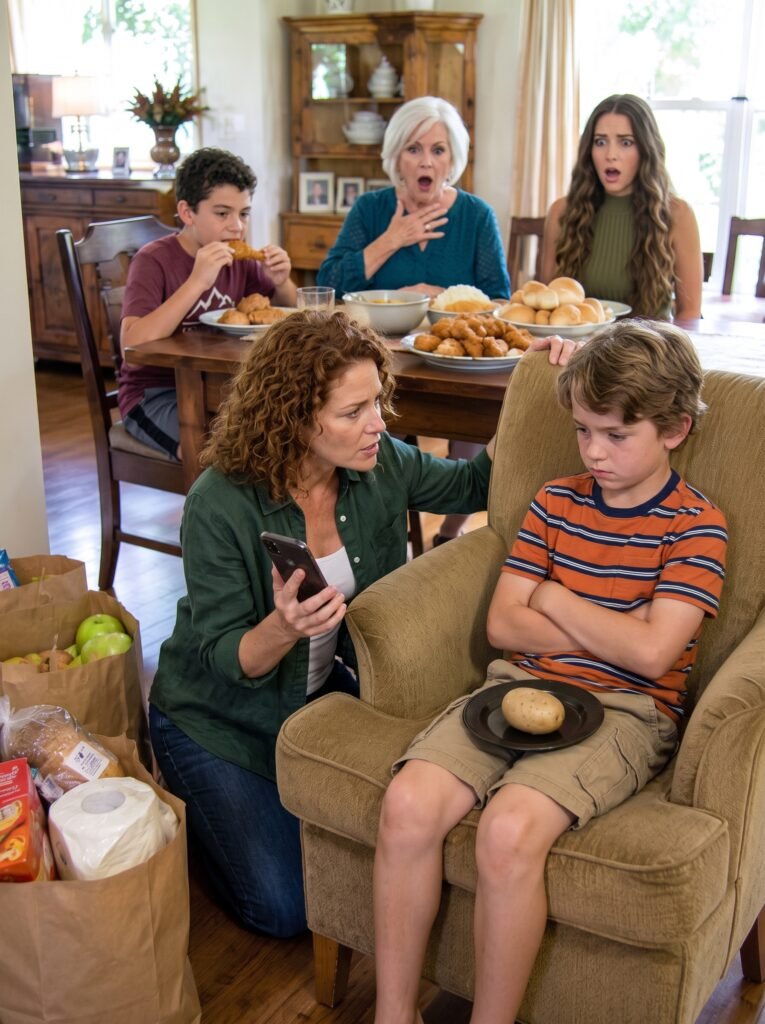
At our country house, my mother-in-law and sister-in-law were devouring fried chicken while my seven-year-old son sat alone in the corner eating a cold potato.
They said children who were not really family needed to learn their place.
I did not yell.
I took out my phone, gave them two hours to leave, and uncovered a recording that revealed what they had actually been trying to do.
“That boy isn’t sitting at this table until he learns where he belongs!”
My mother-in-law’s voice carried from the dining room as I pushed open the front door with my shoulder.
Two heavy grocery bags strained against my arms, their paper handles cutting into my fingers as I stepped inside and kicked the door closed behind me.
I had filled those bags with meat, sliced cheese, fruit, yogurt, dinner rolls, chocolate, and everything else I thought two little boys might enjoy during a summer weekend in the country.
After covering extra shifts all week, I finally had Friday off, and I had decided to surprise my seven-year-old son, Dustin.
I had not called ahead.
I had not texted my husband, Parker, or warned his mother that I was driving out to the house.
That was the only reason I saw what they never would have allowed me to see if they had known I was coming.
The first thing I noticed was the smell of fried chicken.
It was warm and rich, mixed with the buttery smell of dinner rolls and the faint sweetness of the chocolates I had bought before leaving Dustin there.
Then I noticed the table.
My mother-in-law, Alana, sat at one end beside my sister-in-law, Ellie, while Ellie’s son, Mason, leaned over a plate piled high with food.
There was crispy chicken, warm rice, sliced cheese, soft rolls, and an open box of chocolates between them.
Mason had a drumstick in one hand and another piece of chicken waiting on his plate.
Alana’s plate was just as full.
So was Ellie’s.
Across the room, away from the table, Dustin sat by himself in a worn armchair near the wall.
His knees were close together, and his shoulders were curled inward as if he were trying to take up as little space as possible.
A plastic plate rested in his lap.
On it was one cold boiled potato cut in half.
There was no butter.
No salt.
No cheese, chicken, rice, or bread.
When Dustin saw me, his eyes widened, but he did not jump up or run into my arms the way he normally did.
Instead, he quickly moved the plate behind his back.
He looked ashamed, as though I had caught him stealing food instead of sitting alone with the only meal the adults in the house had given him.
That small movement hurt more than anything Alana or Ellie could have said.
My son believed the humiliating thing in that room was not what they had done to him.
He believed it was the fact that I had seen it.
Alana stood so abruptly that her chair scraped against the floor.
“Oh, Clarissa,” she said, forcing brightness into her voice. “We weren’t expecting you. Why didn’t you call? We would’ve helped with the groceries.”
Ellie lowered her phone onto the table with the screen facing down.
Mason continued chewing without looking at me.
I placed the grocery bags on the counter before my hands lost their grip, then crossed the room and knelt in front of Dustin.
He still tried to keep the plate hidden.
“It’s okay,” I told him quietly. “Let me see it.”
He handed it to me with both hands.
The potato was hard and dry beneath my fingers, and the cut edges had already started to discolor.
It was not something they had just taken out of a pot.
It had been sitting there long enough to turn cold while they ate a full meal a few feet away.
I rose with the plate in my hand and looked at the table.
“Why is he sitting over here?” I asked. “And why are all of you eating fried chicken while he is eating this?”
Alana folded her arms and lifted her chin.
The startled hostess act disappeared, replaced by the hard expression she used whenever someone questioned her authority.
“He’s being punished,” she said. “He trampled my flowers, took toys that weren’t his, and kept slamming doors. The boy needs discipline.”
I turned toward Dustin.
He pressed his lips together before he spoke, as if he were already expecting to be called a liar.
“I didn’t step on the flowers, Mom,” he said. “My ball rolled into the garden. Grandma Alana said I was a burden, and she said she didn’t want to look at me while they were eating.”
Alana snapped her head toward him.
“What a liar,” she said. “Listen to the stories he makes up.”
Dustin flinched.
It was quick, but I saw it.
So did Ellie, though she immediately looked away.
I set my hand on Dustin’s shoulder and faced Mason.
“Was he punished too?”
Mason stopped chewing for a moment.
Before he could answer, Ellie gave a dry laugh.
“My son knows how to behave,” she said. “Dustin is always causing trouble. Mom is doing you a favor by watching him. You should be thanking her instead of walking in here and making accusations.”
Her answer told me more than she realized.
She did not deny that they had excluded Dustin from the meal.
She did not ask why he had received nothing but a potato.
She did not even pretend both boys had been treated equally.
She believed the difference between them was justified because Mason was hers and Dustin was mine.
Two weeks earlier, Alana had insisted that Dustin spend part of the summer at the country house.
She had told Parker that the fresh air would be good for him and that Mason needed someone his age to play with.
She had even acted offended when I hesitated.
“He’s family,” she had said. “You don’t have to treat me like a stranger around your child.”
I had wanted to believe her.
I had stocked both refrigerators before leaving, filled the pantry, placed spending money in the kitchen drawer, and bought games, treats, and outdoor toys for both boys.
I had written a short list of Dustin’s favorite breakfasts and left it near the coffee maker.
I had packed his blue hoodie because he sometimes got cold at night, even in summer.
I had done everything a mother does when she is trying to convince herself that her child will be safe without her.
Now the food I had purchased was spread across their plates while Dustin sat in a corner with a cold potato.
I finally understood who the groceries, money, treats, and games had really been for.
I carried the plastic plate into the kitchen.
Alana began talking behind me, explaining that children needed consequences and that I was making Dustin soft by believing everything he said.
I dropped the potato into the trash.
It landed with a dull thud against the bottom of the bag.
Then I put the empty plate in the sink, dried my fingers on a dish towel, and took out my phone.
I checked the time before I turned around.
“You have two hours to pack your things.”
Alana stared at me.
“What did you just say?”
“The train to Columbus leaves at 3:10,” I said. “At 2:30, I am locking this house and turning on the alarm.”
Ellie shot to her feet so quickly that her chair tipped backward and crashed onto the floor.
Mason finally looked up.
“This house belongs to Parker too,” Ellie said. “You can’t throw us out.”
“I bought this house five years before I married Parker,” I replied. “It is in my name.”
Ellie’s face tightened.
She pointed toward Dustin with open contempt, no longer making any effort to hide how she felt about him.
“You’re going to destroy your marriage because that boy didn’t get a piece of fried chicken?”
I looked at the full plates, the open chocolate box, the fallen chair, and then at my son, who was still standing beside the armchair where they had separated him from everyone else.
His hands were empty now, but he kept them close to his body.
“No,” I said. “You destroyed it the moment you decided to humiliate my child in my own home.”
Alana stepped between Ellie and me.
“You are overreacting,” she said. “This is exactly why the boy behaves the way he does. Every time someone corrects him, you rush in and make him the victim.”
“Making him sit alone with a cold potato while you eat the food I bought is not correction.”
“He needed to understand that his actions have consequences.”
“Then why did you tell him he wasn’t really family?”
Alana’s gaze shifted toward Dustin.
“I never said that.”
“I heard you before I opened the door.”
For the first time, she hesitated.
It was only a second, but it was enough.
She had been prepared to deny Dustin’s account because she assumed the only witnesses were Ellie and Mason.
She had not been prepared for me to have heard her myself.
Ellie bent down to lift her chair, but she kept talking.
“Mom said he needed to learn his place in this house. That is not the same thing.”
“What place is that?”
Ellie pushed the chair upright and looked directly at me.
“He is not Parker’s son.”
The words landed with a clarity that made every previous excuse useless.
This was not about flowers.
It was not about doors, toys, manners, or discipline.
It was about blood, ownership, and a seven-year-old child being treated like an intruder because he had existed before my marriage.
I reached for Dustin’s hand.
His fingers were cold, and he held on tightly without saying anything.
“Come upstairs with me,” I told him. “We’re getting your things.”
As we started toward the stairs, Alana moved as if she meant to follow us.
I turned before she reached the first step.
“Do not come upstairs. Pack your belongings and call for a ride.”
“You don’t give me orders,” she said.
“In my house, after what you did to my son, I do.”
I did not raise my voice.
I did not need to.
The steadiness in it seemed to bother them more than shouting would have, because shouting could have been dismissed as emotion.
A deadline could not.
Ellie grabbed her phone from the table.
“I’m calling Parker right now,” she said. “The second he hears what you did, he’ll put you back in your place.”
The phrase was almost identical to the one they had used about Dustin.
That told me their idea of family was built around positions they believed they had the right to assign.
Alana was the authority.
Ellie and Mason belonged at the table.
Dustin belonged in the corner.
I was supposed to pay for the food, provide the house, work the extra shifts, and stay quiet when they decided how everyone inside it would be treated.
Dustin and I went upstairs while Ellie called after us.
She said Parker would never forgive me for embarrassing his mother.
She said I was proving I had never respected his family.
She said no reasonable woman would break up a marriage over a child’s dinner.
Dustin climbed the stairs slowly, still gripping my hand.
When we reached the small bedroom he had been using, I saw that most of the toys I had packed were gone.
His blue hoodie lay folded at the foot of the bed.
His backpack was tucked against the wall, and his sneakers were lined up neatly beneath a chair.
The room looked less like a place where a child had been enjoying his summer and more like a place where he had been trying not to leave evidence that he was there.
I opened his suitcase and began folding his clothes into it.
Dustin stood beside the bed, watching me.
“Are you mad at me?” he asked.
I stopped.
“No.”
“Grandma said you’d be mad because I couldn’t behave for two weeks.”
I sat on the edge of the bed and pulled him gently toward me.
“I am not mad at you. I am sorry I left you with people who made you think you had to earn food or a place at the table.”
His face pressed against my shoulder.
He did not cry loudly.
He simply held on, and I felt the careful control in his small body give way a little at a time.
I wanted to go downstairs and demand an explanation for every moment he had spent feeling unwanted.
Instead, I kept packing.
Getting him out mattered more than winning an argument.
I placed his hoodie in the suitcase, gathered his toothbrush and books, and checked the drawers twice to make sure nothing was left behind.
From downstairs, Ellie’s voice rose and fell as she spoke to someone on the phone.
I could not hear Parker’s responses, but I knew she had reached him because she began describing the confrontation as though she had been the one attacked.
She said I had stormed into the house without warning.
She said Dustin had been disciplined for destructive behavior.
She said I had threatened to strand them.
She did not mention the full plates.
She did not mention the corner.
She did not mention the cold potato.
My hand tightened around the handle of Dustin’s suitcase.
The next conversation with Parker might end my marriage.
I understood that.
I also understood that any marriage requiring me to ignore the deliberate humiliation of my child was already broken in a way I could not repair by staying silent.
When we came back downstairs, Alana had begun packing, though every movement carried the sharp anger of someone who believed compliance was temporary.
Ellie stood near the dining table with her phone in her hand.
The plates were still there.
The chicken had gone cold, and grease had started to gather on the paper beneath it.
Mason sat quietly, looking between the adults.
I set Dustin’s suitcase near the front door and told him to wait beside me.
Ellie ended her call.
“Parker is furious,” she announced.
I did not ask whether he was furious with me or with them.
I had learned enough in the last half hour to stop accepting Ellie’s version of another person’s words without hearing them myself.
“You have less than two hours,” I said.
She lifted her phone as though she intended to call him again, but her expression changed when she looked at the screen.
The recording app was still open.
A timer had been running since before I entered the house.
Ellie had apparently started recording something at the table and set the phone down when she heard me come through the door.
In the confusion, she had never stopped it.
She moved her thumb toward the screen.
I reached the phone first.
“Give that back,” she said.
Her panic was immediate, and it was far stronger than anything she had shown when I threatened to remove her from the house.
That reaction told me the recording held more than our confrontation.
I stepped away from her and stopped the audio.
The file was long enough to include the conversation that had taken place before I arrived.
Ellie lunged for the phone, but Alana caught her arm and told her not to make things worse.
That warning confirmed what I was already beginning to understand.
I pressed play.
At first, there was the scrape of silverware and Mason asking for another piece of chicken.
Then I heard Dustin quietly ask whether he could have some too.
Alana’s voice answered that he had already been given what he deserved.
Ellie laughed and said he would run home to me soon enough if they kept reminding him that the country house was for Parker’s real family.
Alana replied that once Dustin begged to leave, they could tell Parker I had made the boy too spoiled to fit in.
Ellie said the important thing was making me react, because if I threw them out, Parker would be forced to choose between his wife and his mother.
The potato had never been a punishment.
It had been bait.
They had been trying to make a seven-year-old child miserable enough to ask to go home, then use my response as proof that I was the one dividing the family.
I looked at Alana and Ellie as their own voices continued through the phone.
Neither of them denied it now.
Dustin moved closer to my side, and I placed one arm around his shoulders while I saved the recording.
The two-hour deadline was no longer the most important clock in the house.
Parker was about to hear exactly what his mother and sister had planned, and whatever happened after that would tell me whether my marriage still had a place where my son and I truly belonged.