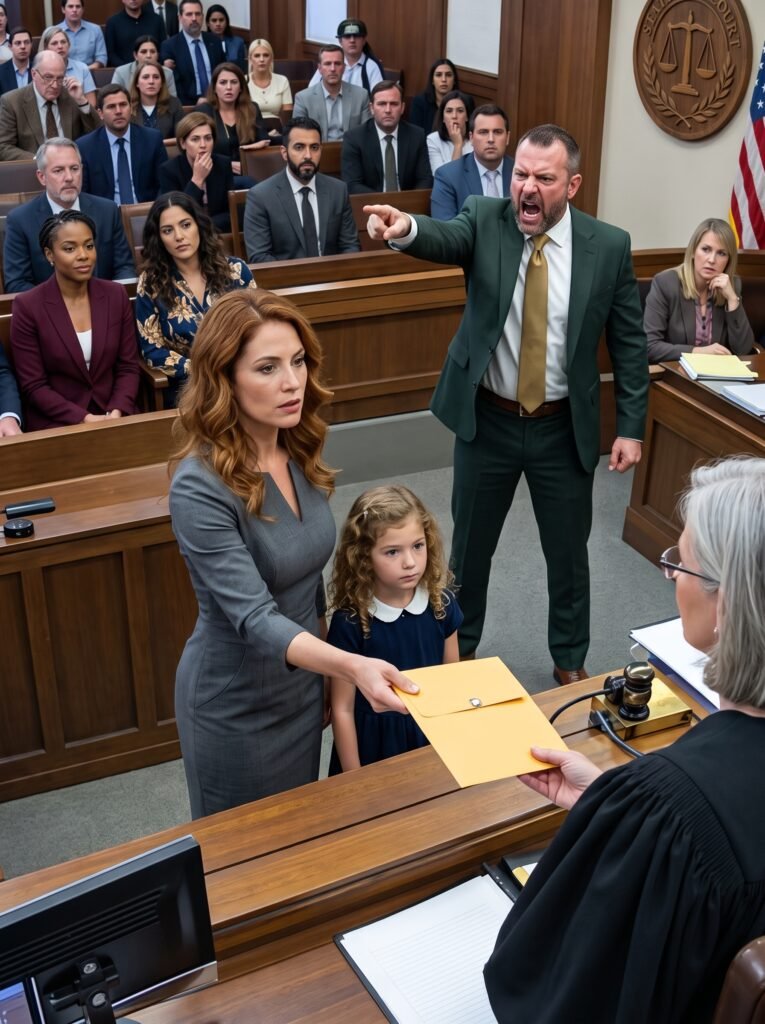
“He received electronic notice that additional documentation would be submitted under seal,” Nathan said. “Because the packet contains private trust records, financial account information, and material related to an ongoing forensic review, we did not distribute the contents without the court’s direction.”
Pike stood immediately.
“Your Honor, this is precisely the sort of tactic we’ve been dealing with. Mrs. Mercer controls the documents, controls the accounts, and now intends to surprise us with evidence we have not had an opportunity to examine.”
Judge Hall looked at Nathan.
“Counsel?”
“We are not asking for a final ruling based on undisclosed evidence,” Nathan replied. “We are asking the court to review the packet before deciding whether Mr. Mercer’s sworn asset statement should remain part of today’s hearing without amendment.”
That changed the atmosphere.
Until then, the hearing had been about property—who owned what, who deserved what, and how the pieces of a marriage should be divided.
Now it was about whether someone had lied under oath.
I heard a faint rustle behind Elliot.
My mother whispered something to Marissa.
Caleb shifted in his seat.
Nathan returned to our table and held out his hand. I opened my briefcase.
For one strange second, my fingers would not move.
I had spent the previous night sitting at the kitchen island in the house Elliot still called ours, staring at that envelope beneath the warm pendant lights.
It had been delivered by my father’s longtime attorney, Samuel Reed, only two days earlier.
Samuel had looked older than I remembered. His silver hair had thinned, and there were deep lines around his mouth that seemed to come from years of keeping other people’s secrets.
“Your father instructed me to release this only under certain conditions,” he had said.
“What conditions?”
“If anyone challenged the ownership of your trust or attempted to attribute Carter Vale Technologies to family investment.”
I had stared at him.
“Why would he expect that?”
Samuel’s expression had tightened.
“Your father expected many things he never explained.”
At the time, I had wanted answers. Instead, Samuel had placed the envelope in front of me and asked me to sign a receipt.
Now, in the courtroom, I lifted it from my briefcase.
The cream-colored paper was thick, the flap secured by a red legal seal. My name appeared across the front in my father’s unmistakable handwriting.
AUDREY CARTER—TO BE OPENED ONLY WITH COUNSEL PRESENT.
Seeing it again brought an ache so sharp that I briefly forgot where I was.
My father, Henry Carter, had been gone for four years. Long enough for people to speak of him in the past tense without hesitating. Not long enough for me to stop expecting his voice whenever I entered the old workshop behind my childhood home.
I handed the envelope to Nathan.
He carried it to the clerk.
Elliot watched every step.
Judge Hall examined the seal before allowing the clerk to open it. Several documents were removed and placed in a folder. The judge read silently.
No one spoke.
The courtroom’s air-conditioning clicked on, sending a cool draft across my hands. I folded them in my lap so no one would see them trembling.
The first time Elliot met my father, he had seemed nervous.
I remembered it clearly because Elliot rarely appeared uncertain about anything.
We had been dating for seven months. My father invited us to Sunday dinner, though “invited” was not the word Henry Carter would have used. He had telephoned me and said, “Bring the young man at six. Your mother is making too much food.”
Elliot arrived with a bottle of wine and a confidence that usually charmed everyone. But when my father opened the door, Elliot went quiet.
At the time, I assumed it was respect.
Now I wondered whether it had been recognition.
Judge Hall turned one page, then another.
Across the aisle, Elliot leaned toward Pike and whispered.
Pike’s face changed.
“Your Honor,” he said, standing again, “may we approach?”
The judge motioned both attorneys forward.
Their voices dropped too low for me to hear. Nathan spoke briefly. Pike responded with increasing agitation. Judge Hall raised one hand, and both men fell silent.
After several minutes, they returned to their tables.
Nathan sat beside me.
“What is it?” I whispered.
“The first document is your father’s original trust declaration,” he said. “The second is Elliot’s signed acknowledgment that the trust and all distributions from it would remain your separate property.”
I stared at him.
“I’ve never seen that.”
“It was signed three weeks before your wedding.”
My eyes moved across the aisle.
Elliot was no longer smiling.
A memory surfaced slowly.
Three weeks before our wedding, my father had asked Elliot to meet him at Samuel Reed’s office. Elliot told me afterward that they had discussed “family responsibilities.” When I asked for details, he kissed my forehead and said my father was protective.
I had believed him because I wanted to.
“Why didn’t Elliot disclose it?” I asked.
Nathan’s voice was quiet. “That’s a question he may have to answer.”
Judge Hall returned her attention to the courtroom.
“I am going to allow counsel thirty minutes to review the relevant portions of these documents,” she announced. “We will recess until eleven fifteen. The parties are not to leave the courthouse.”
The bailiff called for everyone to rise.
The moment the judge disappeared into chambers, sound rushed back into the room.
Pike grabbed the folder the clerk offered him and motioned Elliot toward a consultation room. Elliot looked at me once before following.
There was no anger in his expression.
Only calculation.
My mother stood from the second row.
“Audrey,” she called.
Nathan touched my arm.
“You don’t have to speak with anyone.”
But I was already turning.
Diane Carter had always carried herself as though posture could solve any crisis. Even now, her back was straight, her cream jacket perfectly pressed, her pearl earrings catching the courtroom light.
Marissa stood beside her, clutching the strap of her handbag. Caleb remained half a step behind them.
“What was in that envelope?” my mother asked.
“You heard the judge.”
“Not all of it.”
“No,” I said. “Not all of it.”
Her lips tightened.
“This concerns the whole family.”
“It concerns my divorce.”
“It concerns your father’s trust.”
The word trust came out too quickly.
Marissa looked at her.
A silence opened between us.
Nathan rose beside me, but I gave him a small shake of my head.
“What did you tell Elliot about Dad’s trust?” I asked.
My mother’s expression became carefully blank.
“Nothing that wasn’t true.”
“That wasn’t my question.”
Several people were still in the courtroom. Court staff moved near the clerk’s desk, pretending not to listen.
My mother lowered her voice.
“Your father always intended to provide for all of us.”
“He did provide for all of us.”
“Not equally.”
There it was.
Not grief. Not concern.
Resentment.
My father had left my mother the house, substantial investments, and enough income to live comfortably for the rest of her life. Marissa had received a separate inheritance and ownership of two rental properties.
I had received the trust.
For years, I had avoided asking why. I told myself it was because I had spent more time working beside him. I had helped him manage the small manufacturing business he owned before I launched Carter Vale Technologies. I had known which invoices were late, which machines needed replacing, and which employees had children starting college.
But maybe my mother had spent four years asking the same question in a very different way.
“Did you give Elliot documents?” I asked.
Her eyes flickered.
“Your husband came to us because he was worried about how secretive you had become.”
“I became secretive after I discovered he had been copying my financial records.”
Marissa stepped forward.
“He said you were moving money.”
“I moved company operating funds from an account Elliot had accessed without authorization.”
Caleb finally spoke.
“He was your husband. It isn’t unreasonable for him to know what was happening.”
I looked at him.
Caleb wore a brown suit that fit poorly across the shoulders. He had always presented himself as a man perpetually excluded from the room where decisions were made.
Six years earlier, he had asked me to make him chief operating officer of Carter Vale Technologies.
At the time, he was managing a regional furniture warehouse.
When I offered him a chance to apply for a midlevel logistics position, he refused to speak to me for two months.
“Knowing what was happening,” I said, “is different from downloading confidential files in the middle of the night.”
His face colored.
Marissa glanced at him, then back at me.
“We were trying to help.”
“Who?”
She opened her mouth but did not answer.
My mother stepped closer.
“You have always assumed the worst of your family.”
I almost laughed, not because anything was funny, but because the statement was so familiar. For years, whenever I questioned a decision, set a boundary, or asked why someone had used my name without permission, my mother accused me of being suspicious.
It was a clever way of turning evidence into a personality flaw.
“I assumed you came today to support your daughter,” I said.
“I came to support fairness.”
“You’re sitting behind the man trying to take my father’s inheritance.”
Her expression softened suddenly, and that was almost worse.
“You don’t need all of it, Audrey.”
The words struck more deeply than Elliot’s demands.
Perhaps because I had heard variations of them my entire life.
You don’t need the bigger room.
You don’t need another scholarship; Marissa had a harder year.
You don’t need praise for working; it comes naturally to you.
You don’t need help; you always figure things out.
My competence had become my family’s reason for offering me less tenderness.
Marissa looked down.
“Mom,” she murmured.
But Diane did not take it back.
Nathan stepped between us with quiet authority.
“The recess is limited. Audrey needs to meet with me now.”
My mother’s gaze remained fixed on mine.
“This could have been settled privately.”
“I tried to settle it privately,” I said. “Elliot filed a claim based on information someone gave him.”
For the first time, fear appeared in her eyes.
Not much.
Just enough.
Nathan guided me into a small conference room across the hall. The walls were pale gray, and the table bore scratches from years of hurried meetings.
He closed the door.
“What else was in the envelope?” I asked.
He did not sit immediately.
“That is what we need to discuss.”
My stomach tightened.
Nathan opened his legal pad.
“Your father included three categories of documents. First, the trust declaration and Elliot’s acknowledgment. Those are straightforward. Your inheritance remained separate unless you intentionally converted it into marital property. Based on what we have reviewed, you did not.”
I released a breath.
“Second?”
“A series of letters and financial records concerning the early financing of Carter Vale Technologies.”
“I financed the company myself.”
“You did.”
“Then what records?”
“Records showing your father declined requests from your mother, sister, and brother-in-law to invest in the company during its first year.”
I stared at him.
“They never asked to invest.”
“According to these letters, they did.”
Nathan turned the legal pad toward me. He had written three dates.
All from nine years earlier.
The year I founded Carter Vale Technologies.
The year I worked from a rented office above an upholstery shop, paying myself so little that I ate noodles four nights a week.
The year my family repeatedly told me my idea was too risky.
“What did Dad say?” I asked.
“He told them he would not pressure you to accept family investors. He also stated that any offer had to be made directly to you, with full disclosure of the source of the money.”
“They never made an offer.”
“No.”
“Why?”
Nathan hesitated.
“Because the proposed funds were not theirs.”
I sat back.
“Whose were they?”
“A private lender’s.”
“Which lender?”
“The paperwork identifies a holding company that dissolved seven years ago. We’re tracing it.”
My first reaction was confusion.
My second was an old, cold suspicion.
“Did they intend to gain ownership through someone else’s money?”
“That appears possible.”
“How much?”
“Two hundred and fifty thousand dollars in exchange for forty percent of your company.”
I stared at the scratched tabletop.
At the time, Carter Vale Technologies had consisted of one prototype, three provisional contracts, and a list of expenses I was afraid to total.
Two hundred and fifty thousand dollars would have seemed like rescue.
Forty percent would have become worth millions.
“They thought I would fail,” I said.
“Perhaps.”
“No. They said it constantly. Mom told me to find a stable job. Caleb called the company a vanity project.”
Nathan’s face remained neutral, but his eyes were kind.
“People sometimes want protection from both possibilities. They want to say they warned you if you fail and claim they supported you if you succeed.”
I thought of my mother sitting behind Elliot.
Supporting fairness.
“What is the third category?” I asked.
Nathan sat opposite me.
“A sworn statement from your father.”
The room seemed to grow quieter.
“About what?”
“About a conversation he had with Elliot before your wedding.”
My fingers tightened around the edge of the table.
“What conversation?”
“Your father believed Elliot was asking unusually specific questions about the trust, your company’s ownership structure, and what would happen to your assets if you died without children.”
For several seconds, I could not speak.
Those questions sounded terrible when grouped together.
But Elliot could make anything sound natural.
Concerned.
Responsible.
He had always known how to hide intention inside charm.
“What did Dad do?” I asked.
“He asked Samuel to prepare the acknowledgment. Elliot signed it.”
“Why didn’t Dad tell me?”
Nathan glanced down at his notes.
“Your father wrote that he did not want to interfere in your marriage based on suspicion alone.”
A painful laugh escaped me.
“That sounds like him.”
Henry Carter trusted facts more than instincts. He distrusted emotional accusations, especially his own. He would investigate a failing engine for hours before admitting he disliked the noise.
“Did he believe Elliot married me for money?”
“He didn’t say that.”
“But he considered it.”
“Yes.”
I looked toward the narrow window in the conference-room door. People passed in the hallway, their faces appearing and disappearing through the wired glass.
“How much of this will become public?”
“Very little, unless necessary. Judge Hall can review the documents under seal. Our immediate objective is to correct Elliot’s asset claims and establish that he withheld a signed agreement.”
“I don’t want this turned into a spectacle.”
“I know.”
“I mean it, Nathan. I don’t want reporters outside my office. I don’t want employees wondering if the company is in danger.”
“Then we proceed carefully. We ask the court to protect the business records and allow the forensic review to continue privately.”
“What forensic review?”
He looked at me for a moment.
“The one Samuel initiated after your father’s death.”
I felt as though I had missed a step in the conversation.
“Samuel has been investigating my family for four years?”
“Not your family specifically. He has been monitoring attempts to access the trust.”
“Why didn’t he tell me?”
“Because the trust permitted him to act independently as special counsel. Your father was concerned that telling you about every inquiry would create conflict.”
A pulse of anger rose beneath my confusion.
“My father appointed someone to watch my money without telling me.”
“To protect the trust.”
“From whom?”
Nathan closed the folder.
“That is the question Samuel has been trying to answer.”
A knock sounded.
The bailiff opened the door.
“Five minutes.”
Nathan thanked him.
As the door shut, I stood and walked to the window. From the third floor, the courthouse plaza looked bright and deceptively peaceful. People crossed the pavement carrying coffee, folders, and ordinary worries.
“I spent years believing my family resented the company because it took my time,” I said.
Nathan remained silent.
“What if they resented it because they thought they should own part of it?”
“That may be true for some of them.”
“Elliot knew about the trust before we married. He signed a document promising he would never claim it.”
“Yes.”
“And today he testified that no such agreement existed.”
“Yes.”
I turned.
“Why would he take that risk?”
Nathan’s expression told me he had asked himself the same question.
“Either he believed the document had been destroyed,” he said, “or he believed no one knew where the original was.”
When we returned to the courtroom, Elliot was standing near the far wall with Pike.
My mother and Caleb were nowhere in sight.
Marissa sat alone on the bench outside, twisting a tissue between her fingers.
As I passed, she said my name.
I stopped.
Nathan moved a few steps ahead, giving us space without leaving me alone.
Marissa looked smaller than she had in the courtroom. Without our mother beside her, the certainty had drained from her face.
“I didn’t know about the agreement,” she said.
“Which agreement?”
“The one Elliot signed.”
“How do you know what was in the envelope?”
“Caleb heard Mr. Pike mention it.”
I glanced down the hallway. Caleb was speaking with my mother near the elevators.
“What did you know?” I asked.
Marissa swallowed.
“That Dad made some kind of arrangement to protect the trust.”
“From Elliot?”
“I don’t know.”
“Marissa.”
“I don’t.”
Her voice cracked slightly.
My sister had always cried easily as a child. The tears would gather before she could finish explaining what hurt. As an adult, she learned to stop them, to press her lips together and wait until the feeling passed.
Now her eyes shone, but she did not look away.
“Mom said Dad’s decisions weren’t final,” she whispered. “She said there were papers proving he meant for the trust to support the family.”
“What papers?”
“A memorandum. He supposedly wrote it near the end.”
“Have you seen it?”
“Only a copy.”
“Who gave it to you?”
She looked toward Caleb.
The answer settled between us.
“When?” I asked.
“Last year.”
“Before or after Elliot filed for divorce?”
“Before.”
My heartbeat slowed into a heavy rhythm.
“How long before?”
“Two months.”
“Did you give Elliot the copy?”
“No.”
“Did Caleb?”
“I don’t know.”
It was not convincing.
She knew that.
I knew it.
But beneath the evasion, I saw something else—confusion that looked real.
“Why did you sit behind him today?” I asked.
Marissa folded the tissue into smaller and smaller squares.
“Mom said you were trying to cut all of us out.”
“Of my divorce?”
“Of everything.”
“Did you believe her?”
“I believed…” She stopped.
“What?”
Her gaze dropped.
“I believed you didn’t need us.”
The answer hurt because it was honest.
Not because it was true.
“I needed you when Dad died,” I said.
“You handled everything.”
“Because no one else would.”
“You chose the funeral home. You spoke to the lawyers. You cleaned out his workshop before I could even think.”
“I waited six months to clean the workshop.”
“I know.” Her voice trembled. “That’s what I mean. Six months passed, and I still couldn’t walk inside. You could.”
“No, Marissa. I couldn’t. I just did it anyway.”
She looked at me then.
For years, my family had mistaken action for absence of pain.
Maybe I had helped them make that mistake.
I had not told Marissa that I cried in my father’s truck the day I donated his coats. I had not told my mother that I kept his last voicemail saved in three places. I had not told anyone that I sometimes drove to the old workshop after midnight and sat outside because going in felt impossible.
I had become so skilled at surviving that people assumed nothing wounded me.
The bailiff called us inside.
Marissa caught my wrist gently.
“Audrey, there’s something wrong with that memorandum.”
“What do you mean?”
“The signature.”
Before she could explain, Caleb called her name from the elevators.
She released me.
“I’ll tell you later,” she said.
Then she returned to her husband’s side.
The hearing resumed at eleven eighteen.
Judge Hall entered carrying several pages from the packet. Her expression was composed, but the patience she had shown Elliot earlier was gone.
“Mr. Pike,” she began, “your client submitted a verified statement asserting that no written agreement existed concerning Mrs. Mercer’s trust.”
Pike rose.
“That statement was based on my client’s recollection.”
Judge Hall looked directly at Elliot.
“The document before me bears his signature, notarized on May fourteenth, two thousand seventeen.”
Elliot stood beside his attorney.
“Your Honor, I signed numerous documents at Mr. Carter’s request. I was not provided independent counsel.”
The judge glanced at the page.
“The acknowledgment contains a handwritten notation stating that you declined independent counsel after being advised to obtain it.”
“I don’t remember writing that.”
“Are you alleging the document was altered?”
Pike touched Elliot’s sleeve before he could answer.
“We would need an expert review before taking a position.”
Nathan stood.
“We have no objection to an expert review. The original has been preserved by Mr. Reed’s firm since execution.”
Judge Hall nodded.
“Then the original will remain in the court’s custody pending examination.”
She turned to Elliot.
“Until authenticity is resolved, you will not represent to this court that no written agreement exists.”
His jaw tightened.
“Yes, Your Honor.”
“As for the trust, the preliminary documentation supports its classification as separate property. I will not entertain claims against the principal at this stage.”
My mother inhaled sharply behind him.
I did not turn around.
“The business interest requires further analysis,” Judge Hall continued. “The company was formed before the marriage, but any marital contribution to its increase in value may be relevant. Both parties will cooperate with an independent valuation.”
Nathan placed one hand near his notes.
“That is acceptable.”
Pike agreed.
This was not a complete victory. It was not supposed to be.
The company would still be examined. Elliot could attempt to prove that his contributions increased its value during our marriage.
But he could no longer behave as though half belonged to him simply because he had asked loudly enough.
Judge Hall looked down at another document.
“I am more concerned by unexplained discrepancies in three accounts disclosed by Mr. Mercer.”
Elliot’s head lifted.
Pike turned sharply toward him.
The judge continued.
“Transfers totaling one hundred and eighty-four thousand dollars were made over twenty-six months to a consulting entity not listed in the verified statement.”
I felt Nathan go still beside me.
This was new to him too.
“The court requires a complete accounting of those transfers within ten business days.”
Pike whispered something to Elliot, but Elliot did not respond.
Judge Hall named the consulting entity.
“Blue Heron Strategic Services.”
Behind me, a chair scraped the floor.
I turned instinctively.
Caleb had gone pale.
Marissa stared at him.
My mother’s hand closed around her handbag.
Judge Hall’s gaze moved toward the second row.
“Is there a problem?”
“No, Your Honor,” Caleb said.
His voice was barely audible.
The judge looked back to Pike.
“Until the source and purpose of the transfers are established, neither party is to move, conceal, or dispose of financial assets outside ordinary living and business expenses.”
Nathan stood again.
“Your Honor, we request that the independent forensic accountant be authorized to subpoena Blue Heron’s ownership and banking records.”
Pike objected.
Judge Hall overruled him.
The order was entered.
The hearing ended eleven minutes later.
Elliot did not look at me as he left.
His confidence had not disappeared completely. That would have been too simple. Instead, it had hardened into concentration.
He was already adjusting.
Already preparing another explanation.
Pike guided him toward a private room before reporters or curious observers could approach. My mother followed, but Marissa remained seated.
Caleb stood beside her.
They were arguing in whispers.
Nathan gathered his files.
“Do you know Blue Heron Strategic Services?” I asked.
“No.”
“I think Caleb does.”
Nathan followed my gaze.
Caleb bent toward Marissa, speaking urgently. She shook her head.
“Don’t approach them here,” Nathan said.
“I wasn’t planning to.”
That was true.
For the first time that day, I did not want confrontation.
I wanted distance enough to think.
Outside the courthouse, the afternoon had turned warm. Sunlight reflected from glass towers, and traffic hummed along East Trade Street.
Nathan and I walked toward the parking structure.
“What happens now?” I asked.
“We obtain the Blue Heron records. We authenticate the agreement. We complete the business valuation.”
“And Elliot?”
“He decides whether to continue making claims that expose him to more scrutiny.”
My phone vibrated.
A message from Marissa appeared.
I need to talk to you without Mom or Caleb. Tonight.
I showed Nathan.
“You should not meet her alone,” he said.
“She’s my sister.”
“She sat behind your husband while he challenged your inheritance.”
“She may also be the only person willing to tell me what Caleb gave them.”
Nathan considered that.
“Public place. Tell me where. Do not accept documents without preserving how you received them.”
I almost smiled.
“You make coffee with my sister sound like an international negotiation.”
“At the moment, it may be more complicated.”
We reached my car.
Nathan handed me a copy of the court’s temporary order.
“Go back to your office. Keep your routine normal. I’ll speak with Samuel.”
I opened the car door, then paused.
“Why didn’t the envelope mention Blue Heron?”
“It may have.”
“What?”
“There were attachments the judge did not discuss in open court. Samuel included a ledger with coded references. I need time to compare them.”
A faint unease moved through me.
“Coded how?”
“Initials, dates, and transaction numbers.”
“Whose initials?”
Nathan looked toward the courthouse entrance.
“H.C., D.C., C.V., and E.M.”
My father.
My mother.
My company.
My husband.
“Was there an M.C.?” I asked.
Marissa Carter.
“No.”
I did not know whether to feel relief.
Nathan closed my car door gently.
“Tonight, listen more than you speak.”
It was the same advice he had given me before the hearing.
So I did.
At seven thirty, I met Marissa at a small bakery near Freedom Park. We chose a table in the back, away from the windows.
She arrived without Caleb.
Her hair was pulled into a loose knot, and she had changed from her courtroom dress into jeans and a pale blue sweater. She looked less like my mother’s ally and more like the sister who used to crawl into my bed during thunderstorms.
She set a large envelope on the table.
“This is the memorandum,” she said.
I did not touch it.
“Where is the original?”
“I don’t know.”
“Who made this copy?”
“Caleb said Mom found it in Dad’s desk.”
“Which desk?”
“The one in the workshop.”
“I emptied that desk myself.”
“I know.”
Our eyes met.
“You said something was wrong with the signature.”
Marissa slid the envelope toward me.
“I thought it looked normal at first. But last night I found an old birthday card from Dad. The H is different.”
“That could mean nothing.”
“It could.”
“What else?”
She took out her phone and opened a photograph.
It showed the final page of the memorandum. My father’s supposed signature appeared above the date.
I recognized it immediately.
Not because it looked like his signature.
Because it looked like mine.
My father and I shared similar handwriting, especially the angled C in Carter. But his signature ended with a long downward stroke. Mine curved upward.
The signature on the memorandum curved upward.
“That isn’t Dad’s,” I said.
“I didn’t think so.”
“Who else has seen this?”
“Mom. Caleb. Elliot.”
“Samuel?”
“No.”
I stared at the image.
The memorandum stated that my father intended the trust to be used for the “shared benefit and stability of the Carter family.” It was vague, emotional, and unlike every legal document he had ever signed.
But to someone who wanted to believe it, it could look meaningful.
“Why are you giving this to me now?”
Marissa’s eyes filled.
“Because Caleb lied about Blue Heron.”
The bakery seemed to fall silent around us.
“What is it?”
“A company he started with Elliot.”
“When?”
She hesitated.
“Before you and Elliot met.”
My fingers went cold.
“That’s not possible.”
“I found the incorporation papers this afternoon. Caleb kept them in our home safe.”
“Why would he do that?”
“I don’t know. He says the company never operated.”
“The judge identified nearly two hundred thousand dollars in transfers.”
“I know.”
“From Elliot to Caleb?”
“I don’t know.”
She pushed another photograph across the table.
It was older and slightly blurred, taken at a restaurant or hotel bar. Caleb stood on the left, raising a glass.
Elliot stood beside him.
They looked younger.
Relaxed.
Familiar.
On the back, someone had written a date.
Three years before Marissa supposedly introduced me to Elliot at her birthday dinner.
I looked at my sister.
“You told me you had never met him before that night.”
“I hadn’t.”
“But Caleb had.”
“Yes.”
“Did Mom know?”
Marissa looked toward the darkening windows.
“I asked her.”
“And?”
“She told me to stop digging into things that could tear the family apart.”
I thought of my father’s sealed envelope.
His suspicion before my wedding.
The investment proposal no one had ever shown me.
Elliot’s unexplained transfers.
Caleb’s consulting company.
And the man I had married pretending to meet my family for the first time.
Marissa reached across the table.
“Audrey, there’s something else.”
She opened the photograph on her phone and enlarged the background.
Behind Elliot and Caleb, partly reflected in a decorative mirror, sat another man.
Older.
Silver-haired.
His face was turned just enough to be recognizable.
My father.