I spent three nights sewing my daughter’s princess dress because I couldn’t afford to buy one. At her school play, another mother mocked us in front of everyone. I stayed silent, but when my six-year-old daughter took the microphone, she revealed something nobody saw coming.
My daughter Leslie was six when she asked whether princesses had to be rich.
I was washing dishes, an overdue electric bill in my other hand.
“I got the biggest part in the school play!”
“Why?”
“Mrs. Harper says I can be one. I got the biggest part in the school play!”
Leslie flung her arms around me. I laid the bill facedown.
“Then I’d better practice bowing.”
Over macaroni, she explained the story: a dragon, a lost crown, and a princess who saved her kingdom without a prince.
“She doesn’t even need a king,” Leslie said.
My husband had disappeared when Leslie was four months old.
Neither did we, apparently.
My husband had disappeared when Leslie was four months old. He left for work one morning and never came home. I reported him missing, but the search brought no answers. Eventually, with a baby to feed and rent due, I stopped waiting for his calls.
I cleaned offices before dawn and worked afternoons at a grocery store. My coworker Nina, who lived downstairs, helped get Leslie to school. We had little money, but Leslie rarely asked for anything.
Then the costume list arrived.
Even the cheapest rental exceeded our weekly grocery budget.
The paper was pink, with cheerful stars surrounding the title: Royal Celebration. I almost smiled until I read the instructions printed beneath Leslie’s role.
Under “Princess” it read: floor-length gown, decorative trim, matching accessories. At the bottom: Families provide their own costumes.
Even the cheapest rental exceeded our weekly grocery budget.
“Is it too expensive?” Leslie asked, watching me search my phone.
“We’ll figure something out.”
That night, I emptied my closet onto the kitchen table.
“I could be a tree instead. Trees don’t need dresses.”
“You earned the princess part.”
Her smile was small and careful.
That night, I emptied my closet onto the kitchen table: a cream blouse, an old blue shirt, and a sweater with unraveling sleeves. Then I found my grandmother’s sewing tin.
I hadn’t made anything more complicated than a button repair in years.
At two in the morning, I held up the dress.
The first night, I cut the blouse into a bodice and nearly ruined it. The second, I pieced the shirt and sweater into a skirt, stretching the fabric with leftover strips and hiding crooked seams. The third, I trimmed the sleeves with lace from an old pillowcase.
On the third night, the needle slipped and pricked my thumb. I pressed it against my apron and kept sewing.
At two in the morning, I held up the dress. The hem dipped to one side. None of the back buttons matched.
I thought it was beautiful.
I hung it against the cupboard door and imagined Leslie under the stage lights. For the first time that week, I felt hopeful.
She touched the blue skirt in awe.
The next morning, Leslie put it on.
“Close your eyes,” I said.
“Why?”
“Because I want it to be a surprise.”
She giggled but did as I asked.
I turned her toward the mirror.
I hugged her before she saw my tears.
“Okay. Open them.”
She touched the blue skirt in awe.
“I’m a real princess.”
“Oh, sweetie, I just threw it together. But I’m glad you like it.”
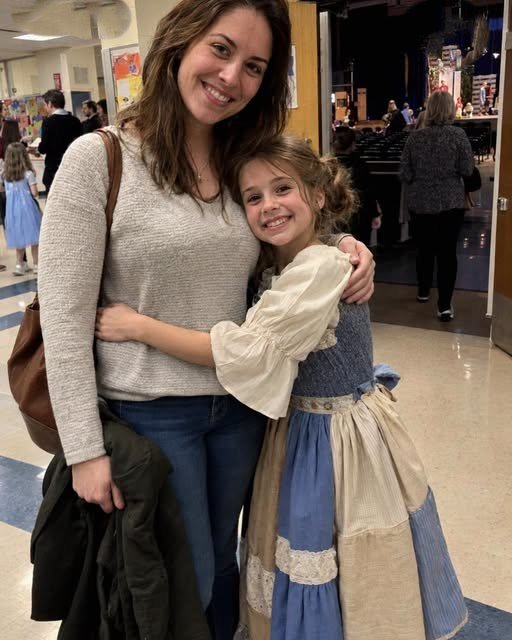
“No,” she said, throwing her arms around me. “You’re a magician.”
I hugged her before she saw my tears.
Beside her stood Samantha, the volunteer costume coordinator.
On Monday, Mrs. Harper asked me to bring the dress for a Wednesday fitting.
“Leslie says you made it yourself,” she said warmly.
“From things I already had.”
Beside her stood Samantha, the volunteer costume coordinator. I knew her from pickup. She always showed up in a spotless SUV and designer clothes, and often bragged about recent expensive purchases.
“It’s important for the children to look their best,” she said, glancing at my grocery-store uniform.
Mrs. Harper explained that Samantha ran an optional costume-planning group.
“That’s what I’m hoping for.”
Her smile barely moved.
Mrs. Harper explained that Samantha ran an optional costume-planning group. I hadn’t joined; between shifts, I struggled to keep up with ordinary school notices.
“Well,” Samantha said, “we wouldn’t want anyone disappointed on Saturday.”
At Wednesday’s fitting, Mrs. Harper checked Leslie’s hem.
Samantha studied the mismatched buttons.
“She looks lovely.”
Samantha studied the mismatched buttons. “Is that really suitable for the lead?”
My cheeks burned.
“Handmade costumes are absolutely welcome,” Mrs. Harper replied.
Samantha said nothing.
She wrote something on her clipboard, though, and I wondered why a costume that had already passed the fitting needed another note.
“Did something happen?”
When my manager called, Leslie was changing behind a screen. I stepped into the hallway to answer. Minutes later, I returned to find her sitting on a bench, fighting with her shoelaces.
She wasn’t smiling.
“Everything okay?”
“Yeah.”
“Did something happen?”
“Mom, could Mrs. Harper still make me a tree?”
She shook her head. Mrs. Harper was helping another child; Samantha was gathering her papers. I told myself Leslie was tired, though I kept thinking about Samantha’s question.
On Thursday, Leslie and I made a crown from a cereal box, foil, and beads from a broken bracelet.
“Mom,” she asked as I cut the cardboard, “could Mrs. Harper still make me a tree?”
I stopped cutting. “Why would she?”
“Maybe if she wanted somebody else to be princess.”
Nina watched Leslie during my late shift and gave her a tiny plastic flower for opening night.
“Did someone say that to you?”
Leslie shook her head and reached for the foil.
“Can the dragon have a crown too?”
“Of course.”
“Dragons deserve nice things.”
On Friday, Nina watched Leslie during my late shift and gave her a tiny plastic flower for opening night.
That night, I checked each button again while Leslie slept.
“You didn’t have to,” I told her.
“Just helping out however I can. I know how hard you work for her.”
That night, I checked each button again while Leslie slept. I told myself I was worried about the dress, but I kept remembering her question about becoming a tree.
Saturday morning, I ironed the dress twice. Leslie cleaned her shoes, packed her crown, and let me tuck Nina’s flower into her ponytail.
I could feel my daughter measuring herself against those expensive costumes.
The school auditorium buzzed with parents carrying cameras and garment bags. Satin gowns shimmered everywhere. One costume arrived in a box that looked more expensive than our television.
“Mine’s different,” Leslie whispered.
“Every princess is different.”
I could feel my daughter measuring herself against those expensive costumes.
“Even the crooked part?”
Samantha arrived with her daughter, Chloe, who wore a glittering silver dress and an enormous plastic crown.
“Especially that. It’s where I learned what I was doing.”
She searched my face as if I might change my mind once I saw the other costumes. I kept smiling until she finally smiled back.
She laughed, but as we approached backstage, she slipped her hand into mine.
Samantha arrived with her daughter, Chloe, who wore a glittering silver dress and an enormous plastic crown.
“It scratches,” Chloe complained.
“Stop touching it,” Samantha snapped. “You’ll ruin the photographs.”
“Some parents really will send their children out looking poor.”
Then she noticed Leslie. Her gaze traveled from the lace sleeves to the uneven buttons.
She smirked.
“Some parents really will send their children out looking poor and ragged instead of buying something proper.”
She laughed, loud enough for nearby parents to hear.
“Honestly, that dress would be more useful as a rag for the cleaning lady.”
Leslie tightened her grip. I almost reached for the crooked hem, then stopped. A father turned toward us. Chloe stared at the floor.
“Mom,” Leslie whispered, “did I do something wrong?”
I shook my head. I wanted to tell Samantha how cruel she was, but my daughter’s eyes were wet and the words wouldn’t come.
Instead, I held her hand.
Samantha turned away.
Mrs. Harper opened the backstage door. “Performers! Come on in!”
Leslie hesitated. I knelt to straighten her collar.
Leslie hugged me, then disappeared backstage.
“What does your princess do when the dragon gets scared?”
“She holds his hand.”
“Exactly. You know every line.”
Leslie hugged me, then disappeared backstage.
I sat beside Nina in the third row.
When Leslie appeared, I held my breath.
“What happened?” she asked.
“Nothing I want Leslie worrying about tonight.”
The lights dimmed.
When Leslie appeared, I held my breath. She scanned the audience, looking uncertain. Then the dragon lumbered onstage, and she smiled.
Her first line came out perfectly.
In their final scene, Leslie took her hand, and the girls grinned together.
Soon the audience was laughing. When the dragon lost his crown, Leslie offered him hers. When she told the king that kindness mattered more than treasure, everyone applauded.
Under the lights, the crooked hem swayed each time Leslie crossed the stage. I remembered the night I’d nearly given up on sewing it.
Even Chloe relaxed. In their final scene, Leslie took her hand, and the girls grinned together.
Then the children lined up for their bows.
Mrs. Harper stepped forward to thank the volunteers, but Leslie tugged at her sleeve.
“Why did you tell Mrs. Harper to pick another princess because my mom made my dress?”
“Can I say something?”
Mrs. Harper smiled, apparently expecting her to thank the audience. “Of course, sweetheart.”
She handed Leslie the microphone.
My daughter stepped forward and looked across the room.
Right at Samantha.
“Mrs. Samantha, why did you tell Mrs. Harper to pick another princess because my mom made my dress?”
So that explained Wednesday’s silence, and Thursday’s question about becoming a tree.
The applause stopped.
Samantha sat up sharply. “What?”
“I heard you on Wednesday when I was putting on my shoes. You said she should find somebody else.”
Leslie looked down.
“Did I do something wrong?”
So that explained Wednesday’s silence, and Thursday’s question about becoming a tree.
Mrs. Harper gently took the microphone and knelt beside her.
I wanted to run up to her, but I couldn’t. My daughter stood beneath the stage lights, waiting for an answer none of us had expected her to need.
Mrs. Harper gently took the microphone and knelt beside her.
“No, Leslie. You earned your part. Your dress is lovely, and nobody was going to take your role away.”
Then she faced the audience, unable to skip an explanation for a question so out of the blue.
“Samantha did ask me to replace Leslie because her costume was handmade. I refused.”
“I only wanted the production to look professional!”
Parents began murmuring.
“That was private!” Samantha shouted. “I only wanted the production to look professional!”
“We can discuss it afterward,” Mrs. Harper said firmly.
But Samantha continued protesting, and I saw Chloe crying silently among the performers. Whatever her mother had done, Chloe didn’t deserve this.
I stood. “Could we let the children finish their night?”
Backstage, I wrapped Leslie in my arms.
Principal Ortiz nodded from the aisle. Mrs. Harper led the cast in one final bow.
Both girls deserved their applause.
Backstage, I wrapped Leslie in my arms.
“I didn’t tell you what I heard,” she whispered. “I was scared Mrs. Harper would change her mind. And I didn’t want you to be sad.”
“You can always tell me when you’re frightened. You don’t have to keep it to yourself.”
She held on a little longer.
“I was only trying to maintain standards.”
I helped her change and folded the dress into its bag. In the lobby, I thought the evening was over, but I could hear Samantha’s voice all the way across the room.
“I don’t appreciate being embarrassed in front of the whole school!”
Mrs. Harper and Principal Ortiz stood nearby.
“I was only trying to maintain standards,” Samantha insisted.
“Then why did you tell us homemade costumes might be rejected?” a father asked.
“I never approved this.”
Samantha frowned. He pulled out his phone.
Mrs. Harper read it. “I never approved this.”
Other parents drew closer as Mrs. Harper studied the phone. I saw a few people checking their own messages, their expressions changing as they read.
“They were recommendations,” Samantha said. “Parents made their own choices.”
“Not everyone can afford your standards.”
A woman stepped forward.
“I’m Danielle. My son played the guard. I worked an extra cleaning shift to rent his uniform because I thought he’d lose the part otherwise. My sister offered to sew one.”
Samantha folded her arms. “Everyone wants a successful production.”
“Not everyone can afford your standards,” Danielle replied.
I recognized another tired, overworked mom in her.
Chloe stood alone by a row of chairs. Leslie walked over and took her hand.
“My daughter thought she’d be made a tree because we couldn’t afford a dress,” I told Samantha. “Other families spent money they didn’t have because they trusted you. You weren’t helping children look their best. You were making families feel they didn’t belong.”
Samantha looked away.
Principal Ortiz asked the father to forward the message and promised to speak to the affected families.
Nearby, Chloe stood alone by a row of chairs. Leslie walked over and took her hand.
I let the adults handle the rest.
“We’ve removed her as volunteer coordinator.”
By Wednesday, the principal called. After speaking with the group’s families, the school confirmed Samantha had sent misleading instructions to seven households. Four had bought or rented costumes because of them.
“We’ve removed her as volunteer coordinator,” Principal Ortiz said. “She won’t send school costume instructions or oversee future productions. We’re apologizing and arranging help with unnecessary expenses.”
Then she mentioned a costume-sharing closet and basic mending sessions.
“Would you help teach?”
Leslie helped younger children choose buttons.
“I’m hardly an expert.”
“We need someone who can show families how to fix a hem.”
I glanced at my grandmother’s sewing tin. “I can do that.”
Two weeks later, I carried it into the art room. Danielle brought scraps; Nina brought cookies. Parents arrived with torn sleeves, loose buttons, and clothes that needed altering.
Leslie helped younger children choose buttons.
“Can I learn too?”
Near the end, Chloe arrived with an adult who signed her in. She held a blouse with a torn sleeve.
“Mom says to throw it away,” Chloe whispered. “But I like it.”
I pulled out a chair. “Then let’s fix it.”
Leslie made room beside her.
“Can I learn too?” Chloe asked.
“Of course.”
“Now you know how to fix it.”
I showed them how to thread a needle. Leslie kept dropping hers, and Chloe laughed. When we finished the sleeve, she held up her blouse.
“It looks new!”
“Better,” Leslie said. “Now you know how to fix it.”
Chloe smiled.
Leslie leaned against my shoulder.
“I think that’s what a magician would say.”
“Mom, are you actually a magician?”
“No, sweetie,” I laughed. “We’re just helping out.”
She considered that.
“I think that’s what a magician would say.”