Close-up shot of a woman reaching for a lemon in the refrigerator | Source: Pexels
My father-in-law thought leaving one bite of food meant he hadn’t finished anything. After months of failed conversations, I found a way to challenge his logic. But his reaction exposed a family problem much bigger than leftovers.
“Dale, are you seriously putting that back?”
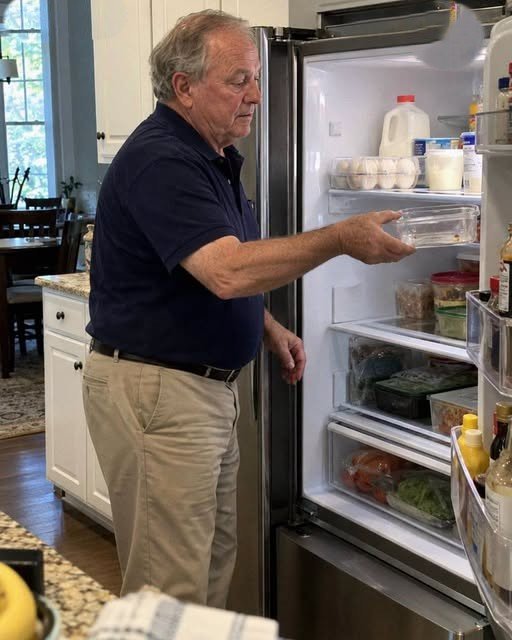
My father-in-law froze with his hand on the refrigerator door. Inside the plastic container he’d just closed was a piece of casserole barely bigger than a postage stamp.
“What?” he asked innocently. “There’s still food in there.”
“That’s hardly even a bite!”
He opened the lid, pointed at the tiny piece, and shrugged.
“Well, it’s not empty, is it? You can’t say I finished it.”
I stared at him.
Then, instead of arguing, I smiled.
“You’re absolutely right, Dale. There’s still food in there.”
He looked pleased with himself, apparently convinced he’d won.
What he didn’t know was that he’d just given me an idea.
My name is Blair, and my husband, Mark, and I have two children, Oliver and Stacy.
Mark’s parents, Dale and Molly, frequently spend weekends with us.
I’ve always welcomed them.
They’re loving grandparents, and our children adore them.
They make themselves at home, help themselves to whatever’s in the refrigerator, and generally treat our house like their own.
I’ve never had a problem with that.
Except Dale has one habit that drives me absolutely crazy.
He refuses to finish anything.
If there’s a bowl of soup in the refrigerator, he’ll eat almost all of it and leave one teaspoon.
If there’s lasagna, he’ll leave one tiny corner.
If someone bakes a cake, he’ll return the container with enough crumbs to suggest that a cake once existed.
Then he’ll carefully replace the lid and put the container back as though he’s generously saved everyone a meal.
I’ve lost count of how many times I’ve opened the refrigerator expecting leftovers for lunch, only to discover Dale’s little offerings.
Molly has complained about it for years.
“He does it at home too,” she once told me. “I’ve asked him a hundred times to stop.”
Eventually, I asked Mark to intervene.
“He’s your dad, Mark. Maybe he’ll listen to you.”
Mark promised he’d handle it.
Unfortunately, Dale ignored him too.
Which brought us to that Saturday afternoon and the ridiculous piece of casserole.
After Dale returned to the living room, I looked at the container again.
It suddenly occurred to me that I’d been approaching the problem incorrectly.
I’d spent months trying to convince Dale those scraps weren’t proper leftovers.
But what if I simply accepted his definition?
After his parents left Sunday afternoon, I transferred the casserole piece into a small freezer-safe container, labeled it, and put it in the freezer.
Mark watched me.
“What are you doing?”
“Saving your father’s leftovers.”
He frowned.
“Blair.”
“What?”
“Please don’t start another argument with Dad.”
I shut the freezer.
“I’m not starting anything. I’m taking him at his word.”
Mark looked suspicious, but I changed the subject.
The following Saturday, Dale and Molly arrived shortly after lunch. Oliver and Stacy rushed to greet them, and within minutes, the house was filled with their usual laughter.
I’d planned a hearty dinner, including roasted chicken, vegetables, potatoes, and homemade rolls.
Dale wandered into the kitchen while I was cooking.
“Something smells good,” he said.
“Thanks.”
“Hope you made plenty.”
“I made sure everyone has enough.”
He smiled, apparently missing my emphasis.
When dinner was ready, everyone gathered around the table.
I served the children first, followed by Molly and Mark.
Then I went into the kitchen and returned with Dale’s plate.
In the middle sat one tiny piece of casserole.
Dale stared at it.
“What’s this supposed to be?”
“Your leftovers from last weekend.”
He looked from the plate to my face.
“You’re joking.”
“No. Remember? You said there was still food in the container.”
Molly covered her mouth.
Mark glanced down at his plate.
Dale picked up his fork and nudged the casserole.
“Blair, this isn’t dinner.”
I raised my eyebrows.
“Really? Because last weekend you were quite clear that it counted as food.”
“That’s different!”
“How?”
He opened his mouth, then closed it.
I continued calmly.
“You said it wasn’t empty. You said you hadn’t finished it. So I saved it for you.”
Molly let out a laugh before she could stop herself.
Dale’s face reddened.
“You think you’re funny, don’t you?”
“I’m trying to show you what it’s like when somebody opens a container expecting food and finds practically nothing.”
He pushed his plate away.
“You’re deliberately embarrassing me.”
“I’ve got plenty of fresh chicken and potatoes, Dale. I’ll get you a normal serving right now.”
“Don’t bother.”
“Dale, nobody’s stopping you from eating.”
“I’ve lost my appetite.”
He stood up and walked into the living room.
For several seconds, nobody spoke.
Then Stacy looked at his empty chair.
“Is Grandpa mad?”
Molly gave her a gentle smile.
“Grandpa just needs a minute, sweetheart.”
Mark wasn’t smiling.
We finished dinner awkwardly.
Dale refused another offer of food, and although he eventually returned to sit with the children, he barely spoke to me.
Later, while Mark was helping Oliver and Stacy get ready for bed, Molly joined me in the kitchen.
I expected her to tell me I’d gone too far.
Instead, she looked toward the living room and sighed.
“That’s the first time I’ve ever seen him have to look at what he actually left somebody.”
I stopped wiping the counter.
“What do you mean?”
Molly picked up a dish towel.
“At home, I usually throw those containers away before he sees them again. Half the time, I don’t think he remembers what he left.”
“Then why does he keep doing it?”
“Because finishing something means dealing with what comes next.”
She began drying a plate.
“It isn’t just food, Blair. He leaves nearly empty containers of detergent, toilet paper rolls with practically nothing left, and chores that are almost finished. There’s always one little thing left for me.”
I frowned.
“Doesn’t he realize you’re the one handling everything?”
“Oh, he realizes. He just thinks those last little things don’t matter.”
She gave a tired smile.
“Funny how they never matter when he’s the one leaving them.”
I’d always assumed Molly’s complaints were about the refrigerator, just like mine.
Now I understood why she’d sounded so exhausted whenever she mentioned it.
“Why do you keep doing everything for him?” I asked.
“Because if I don’t, we argue. And eventually I still have to do it anyway.”
She folded the towel neatly.
“I love Dale. He’s a good grandfather, and we’ve had a good life together. But sometimes I get tired of being the person who finishes everything.”
Before I could respond, Dale appeared in the doorway.
“Molly, are you ready?”
She set down the towel.
Their visit ended earlier than usual.
After they left, Mark confronted me.
“Was that really necessary?”
I turned toward him.
“What?”
“Serving Dad that ridiculous plate in front of everybody.”
“He insisted it was a perfectly acceptable leftover.”
“You knew he’d be embarrassed.”
“I knew he’d finally understand why it bothers me.”
Mark sighed.
“You could’ve handled it privately.”
“I have. So have you. So has your mother. What exactly has changed?”
“Nothing, but you know how Dad gets.”
Something about that sentence bothered me more than anything Dale had said.
“Why does everybody have to know how your dad gets, but your dad never has to care how anybody else feels?”
Mark looked at me without answering.
I softened my voice.
“I’m not asking you to stop loving your father. I’m asking you to stop expecting me to tolerate something just because challenging him is uncomfortable.”
Mark said he needed time to think.
For the rest of the evening, we barely discussed it.
The next morning, while we were cleaning up breakfast, I asked him something.
“Did your dad do this when you were little?”
Mark gave a short laugh.
“All the time.”
“What happened when your mom complained?”
He thought for a moment.
“Usually they’d argue. Mom would get annoyed about some container in the fridge, and Dad would tell her she was making a big deal out of nothing.”
“And then?”
“Then she’d make something else.”
I waited.
Mark stopped loading the dishwasher.
I could see him reconsidering the memory.
“Actually,” he said slowly, “that happened a lot.”
He leaned against the counter.
“I remember coming home from school and Mom being upset because Dad had eaten almost everything she’d saved for dinner. He’d say there was still some left. Then they’d argue, and I’d wish she’d just drop it.”
“Who ended up making dinner?”
“Mom.”
“And who got blamed for the argument?”
He looked at me.
“Mom did.”
Neither of us spoke for a moment.
“I never thought about it that way,” he admitted.
“I know.”
Mark shook his head.
“I spent years thinking she complained about stupid little things. But Dad was the one creating the problems.”
That conversation changed something between us.
Mark apologized for dismissing my frustration.
More importantly, he promised he wouldn’t ask me to overlook his father’s behavior simply to keep him happy.
A few days later, Molly called.
She wanted to know whether the children were looking forward to their school activities. After we talked about Oliver and Stacy, I asked how things were at home.
She hesitated.
“Dale’s still upset.”
“I’m sorry the dinner became such a scene.”
“Don’t apologize for making a point he needed to hear.”
Then she told me something I hadn’t expected.
For several years, she’d been keeping certain groceries separate from the food Dale normally helped himself to.
At first, it was ingredients she needed for planned meals.
Eventually, she started setting aside things she’d bought specifically for herself.
“Not because we can’t afford groceries,” she explained. “I just got tired of looking forward to something and finding one mouthful left.”
She admitted she’d even stopped inviting friends over for casual lunches as often.
Dale sometimes ate food she’d prepared in advance, then insisted he’d left enough because the container wasn’t completely empty.
“I never knew what I’d find when I opened the fridge,” she said.
My anger gave way to sadness.
“Molly, have you told him how much this affects you?”
“Many times. But I’ve usually stopped after the argument starts.”
She paused.
“I think I’ve spent so long making sure he never has to think about these little things that sometimes I wonder if he even notices I’m doing them.”
I asked whether she’d be comfortable discussing it with Mark and Dale together.
She agreed, provided she could speak for herself.
That Friday, Mark called his father and invited both his parents over Sunday afternoon.
He explained that we needed to clear the air.
Dale agreed, apparently assuming Mark wanted me to apologize.
Molly arrived with him. Oliver and Stacy were spending the afternoon with a family friend, so we could speak without involving them.
Dale settled into the living room.
“Well,” he said, looking at Mark, “are we finally putting this nonsense behind us?”
Mark sat opposite him.
“I hope so, Dad. But there’s something we need to discuss.”
Dale’s smile faded.
Mark explained that although the dinner had been uncomfortable, the problem behind it was real.
Dale immediately objected.
“You’re all making a family crisis out of leftover food.”
“It’s not just leftovers,” Mark said.
“Then what is it?”
“Responsibility.”
Dale scoffed.
Mark continued.
“When you put those tiny pieces back, do you ever actually return and eat them?”
Dale frowned.
“Sometimes.”
“When was the last time?”
“I don’t keep records of my meals, Mark.”
“Okay. But if you don’t eat them, what happens to them?”
Dale waved his hand.
“Somebody can throw them away.”
Molly looked at him.
“Somebody?”
Dale glanced toward her.
“Well, it’s not complicated.”
“No,” Molly replied. “It’s not. But somehow I’m always the somebody.”
The room went quiet.
Molly explained how often she’d replaced groceries, cleaned containers, and finished chores Dale insisted were nearly done.
She mentioned the groceries she’d started setting aside.
Dale looked genuinely surprised.
“You hide food from me?”
“I save food for myself because otherwise I can’t count on it being there.”
“Why didn’t you tell me?”
“I did, Dale. You just never wanted to hear it.”
He looked away.
Mark spoke next.
“When I was growing up, I thought Mom was always starting arguments about things that didn’t matter.”
Molly turned toward him.
Mark swallowed.
“I’m sorry, Mom. I should’ve realized you were the one left fixing everything.”
Her eyes filled with tears.
Dale shifted uncomfortably.
“No,” Molly said. “But you keep deciding something isn’t important because you’re not the one dealing with it.”
Dale stood abruptly.
“Maybe I should just stop coming here if everything I do bothers everybody.”
I stayed seated.
“Nobody’s asking you to stop visiting, Dale. You’re welcome here. But being family doesn’t mean you can ignore how our home works.”
Mark nodded.
“And Mom shouldn’t have to spend her life finishing things you refuse to handle.”
Dale didn’t argue further.
He simply said he wanted to leave.
For the next week, we heard very little from him.
Molly visited the following Saturday without him. She spent the afternoon playing with Oliver and Stacy, and we didn’t pressure her to discuss what had happened.
But after she left, I admitted something to Mark.
“I never wanted this to turn into a family feud.”
He took my hand.
“It didn’t start with you. And I should’ve dealt with it long before you had to serve Dad that casserole.”
Three days later, Dale called Mark.
They spoke for nearly an hour.
Mark didn’t share every detail, but he told me his father had finally admitted he’d been thinking about Molly’s words.
That evening, Dale called me himself.
“Blair, I owe you an apology.”
I waited.
“I knew you didn’t like me leaving those containers,” he continued. “I kept doing it anyway because I didn’t think it was worth changing.”
“Thank you for saying that.”
“And I shouldn’t have made such a fuss at dinner. You offered me food. I was just angry because you made me look at what I’d been doing.”
I appreciated that he didn’t try to excuse himself.
“I’m not asking you to be perfect, Dale. I just want you to respect our home.”
“I understand.”
He hesitated.
“And Molly says she’s done cleaning up after me.”
I almost laughed.
“Sounds like she means it.”
“She does.”
The following weekend, Dale returned with Molly.
Things were slightly awkward at first, but Oliver and Stacy were delighted to see their grandfather.
By dinner, conversation had returned to normal.
After everyone had eaten, Dale wandered into the kitchen for another helping.
I happened to be standing near the refrigerator.
Only one small portion of casserole remained in the serving dish.
Dale looked at it.
Then he turned toward the dining room.
“Anybody want the last piece?”
Everyone declined.
So Dale took it, finished it, and carried the empty dish to the sink.
He washed it, dried it, and put it away.
Molly watched from the doorway.
Mark caught my eye and smiled.
I didn’t make a speech.
“Thanks, Dale,” I said.
He grinned.
“Figured I’d better not leave you another masterpiece.”
We laughed.
I knew one clean container wouldn’t undo years of bad habits. But Molly wasn’t silently cleaning up after him anymore, and Mark had stopped treating his father’s discomfort as everyone else’s responsibility.
As for Dale, he was finally learning that leaving something for somebody else wasn’t always an act of generosity.
Sometimes it was just leaving them a mess.
And for once, the refrigerator contained actual leftovers instead of the evidence that somebody had already eaten them.