“If you pass out again after dinner, it’s because you work too hard, not because anything strange happens here,” my husband said, laughing, while I tried to remember why the buttons on my blouse were fastened in the wrong places.
My name is Gwen Hartley. I’m twenty-seven, and I work as an auditor at a financial firm in downtown Houston. I had been married for three years to Brandon Pierce, a project manager for a construction company. His father, Howard, was a man with powerful connections in the real estate world, and for years he had advised on urban development projects across the city. His mother, Loretta, had been a high school chemistry teacher.
Brandon’s family had one untouchable tradition: on the first Sunday of every month, we had dinner at his parents’ house in River Oaks.
For three years, we never missed one.
The trouble began four months earlier.
That night, Loretta made filet in red wine sauce, creamy mushroom rice, and a salad. Howard insisted on serving me himself.
“Eat up, sweetheart. You’re much too thin.”
Ten minutes later, my head felt like it weighed a ton.
It wasn’t ordinary sleepiness. My legs stopped answering me, sounds seemed to come from far away, and I had to grip the table.
“I think I need to lie down,” I murmured.
Brandon walked me to the guest room.
Then, nothing.
When I woke, more than three hours had passed.
Brandon was sitting next to me, looking at his phone.
“You were completely out,” he joked. “Your blood sugar probably dropped.”
Then I noticed my blouse.
Two buttons were in the wrong holes.
I figured I might have rumpled it myself in my sleep.
A month later, the exact same thing happened.
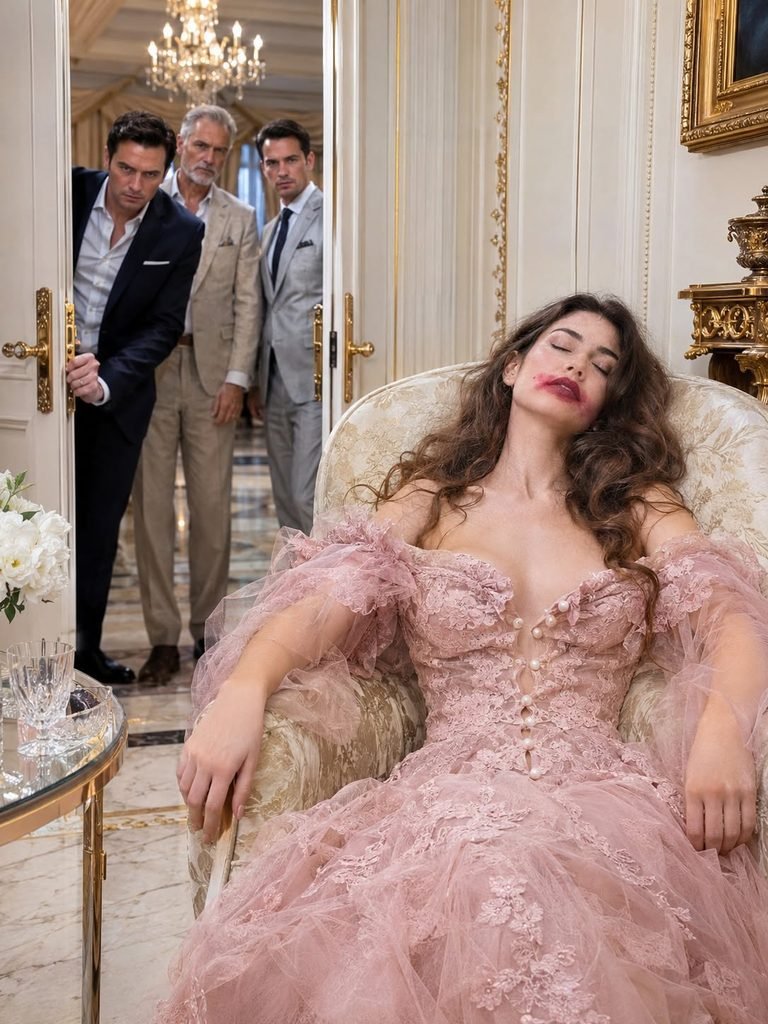
This time I woke with my lipstick smeared all the way to my jaw.
“What happened to me?”
Brandon didn’t even look up.
“You rubbed it off on the pillow.”
I began to grow suspicious.
For the third dinner, I ran a test. Before we left, I photographed how my blouse was buttoned, marked my wrist with a pen under my watch band, and synced my phone.
After a few spoonfuls of soup, I tasted that faintly bitter flavor again.
I pretended to be dizzy.
Brandon carried me to the room.
With my eyes barely open, I watched him take out his phone.
He took two photographs of me.
When he left, I fought the drowsiness until I could sit up.
The pen mark was smudged.
The blouse had been tampered with.
And in one of the photos that had synced to our family cloud account, beside the bed, was a man’s hand wearing a thick black ring.
I knew that ring.
It was Howard’s.
For a week, I pretended not to know anything.
I bought a small voice recorder and a hidden camera disguised as a USB charger.
Then Loretta called.
“Come early Sunday. Howard has two guests coming from Dallas.”
A chill ran through me.
When we arrived, two strangers were in the living room. One was named Dale. The other, Curtis, didn’t stop staring at me all through dinner.
Howard handed me a glass of wine.
I pretended to drink.
At seven, I said I felt dizzy.
Brandon took me to the usual room.
He laid me down.
“Rest, babe.”
Then I heard the lock turn from the outside.
I opened my eyes.
I was locked in.
Footsteps approached.
“She went down fast tonight,” Curtis said on the other side of the door.
Then I heard Howard’s voice.
“We gave her a little more.”
My blood turned to ice.
The door opened.
Three men came in.
Brandon.
Howard.
Curtis.
“Did you turn off the hallway camera?” Brandon asked.
“Yes.”
“And her phone?”
“It’s already offline.”
I lay still.
Then Howard said, with monstrous calm:
“Make it quick. Afterward, we need her signature to close the Harbor Point deal.”
A hand began to reach toward the collar of my blouse.
And in that instant, I understood that for months I hadn’t been getting sick at my in-laws’ house.
I had been drugged.
And I couldn’t yet imagine how far it went.
Part 2
When Curtis leaned over me, I reacted. I kicked him with everything I had and leapt off the bed.
“Don’t touch me!”
Brandon froze. Curtis fell backward, cursing, while Howard panicked.
“You’re awake?”
I let out a bitter laugh. “Disappointing, isn’t it?”
Loretta appeared in the doorway, completely pale.
I looked at her. “You knew, too.”
She didn’t answer. That was enough.
Howard recovered his composure with frightening speed.
“Gwen, listen before you do something stupid.”
“Something stupid?”
“There’s a lot of money at stake.”
He pulled out a chair and sat down as if we were negotiating a contract. He explained that a real estate deal at Harbor Point was stalled because certain property owners refused to transfer their rights and because some investors wanted guarantees before they would sign. For years, his group had used photographs, compromising recordings, and staged situations to pressure people.
I wasn’t just a victim. I was a piece on the board.
Through my work as an auditor, I had indirectly reviewed documents from several companies tied to the project. They needed my signature.
“Sign the assignment and it all ends,” Howard said. “I’ll put one and a half million dollars in a trust and two condos in your name and Brandon’s.”
I stared at him. He had put a price on my dignity.
“And you?” I asked my husband. “Did you agree to this?”
Brandon lowered his head.
“Just sign, Gwen. Then we’ll go far away.”
Something inside me broke.
“How many women were there before me?”
Nobody answered.
Loretta started to cry. “Please, don’t destroy this family.”
“The family was destroyed when you closed that door.”
Suddenly, a small electronic chime sounded from the living room.
Howard turned his head. The hidden camera had connected to the cloud. He ran to it.
Seconds later, he came back holding the fake charger.
“What did you record?”
He threw it on the floor and stomped it to pieces.
I said nothing. I didn’t need to. The recording was already out of that house.
Then we heard sirens. First one. Then several.
Someone pounded on the front door.
“Police! Open up!”
Howard’s face changed completely.
Agents from the district attorney’s office came in, accompanied by two federal investigators. They carried an urgent warrant relating to extortion, administration of controlled substances, and production of material used for blackmail.
They found a safe. Inside were flash drives, deeds, contracts, and electronic devices.
Brandon looked at me.
“Did you call them?”
“No.”
It was true. I had planned to hand over the recordings later. Someone else had sent the live feed to the authorities while it was happening.
That night, after hours of giving statements, I got a message from an unknown number:
DON’T TRUST ANYONE IN THAT FAMILY. NOT EVEN LORETTA.
The next day, Brandon was released under investigation while Howard stayed in custody. Brandon called me.
“My dad is going to take all the blame.”
“How convenient.”
“He says I didn’t know anything.”
“But you were in the room.”
“I was trying to keep things from getting worse.”
I hung up.
Hours later, another anonymous message arrived. A video.
Brandon was talking with Curtis in the hallway of his parents’ house.
“After Harbor Point, I’m done,” Brandon was saying.
Curtis laughed. “Don’t play the saint. You’re taking forty-five grand for every property we move.”
The phone slipped out of my hands.
Brandon hadn’t been dragged in by his father. He was getting paid.
And before the video ended, Curtis said something that took my breath away:
“Gwen wasn’t the first, and she won’t be the last.”
The DA’s office found three other victims. I was no longer facing a sick family. I was facing a network.
Three days later, the unknown number wrote again.
TOMORROW, 8:00 P.M. THE CAFÉ BY THE LAKE IN HERMANN PARK. COME ALONE IF YOU WANT TO KNOW WHO SAVED YOU.
I went, with investigators watching from a distance.
At 8:12, someone took the chair across from me.
When I looked up, the world stopped.
It was Loretta.
And when I saw the small hard drive she set on the table, I understood that I still hadn’t heard the most monstrous part of the story.
Part 3
“You have exactly twenty minutes,” I said. “Then I walk out and hand that drive to the people sitting at the table behind you.”
Loretta didn’t turn around. She looked older than she had a week ago, her silver hair uncombed, her hands folded as if she were back in front of a classroom.
“I know about the agents,” she said. “I’d have been disappointed if you’d come without them.”
“Why did you send the feed?”
“Because I couldn’t stop it any other way.” Her voice was dry and steady. “I’d been trying to stop it for eleven years.”
I said nothing.
“Howard started small,” she said. “Favors. A councilman’s daughter. A county commissioner who had a drinking problem, and a hotel room, and a photograph. He called it leverage. I told myself it was politics. Then one night a young woman named Dana Whitfield passed out at our table, and I understood he’d done it to her on purpose.”
“Dana Whitfield,” I repeated.
“A paralegal. She worked for a title company. Howard needed a signature.” Loretta’s jaw tightened. “She left Houston a year later and never spoke to anyone again. I looked for her afterward. I found her, living under another name in Oregon. She wouldn’t speak to me, and she was right not to.”
“You taught chemistry,” I said. “You made it.”
“I measured it.” Her eyes lifted to mine. “I was forced, Gwen, but I won’t hide behind that word. Howard threatened my sister’s nursing license. He threatened to ruin her husband. I told myself I’d find a way out, and each year I told myself the same lie.”
I thought of the bitter taste in the soup. “What did you do to my dose?”
She took a long breath.
“Starting the second dinner, I cut it. Every time. Howard thought he was giving you the same amount as the others, but I’d been shorting the compound and replacing the rest with a sedative so mild it would only make you drowsy. I knew you’d wake sooner than he expected. I couldn’t do more without being caught.”
The lake glimmered beyond the café window. Somewhere behind me, a child laughed.
“The night you woke,” Loretta said, “was supposed to be the night they stopped waiting. Curtis insisted. I couldn’t cut the dose any further. So I did the only thing I’d never been brave enough to do.”
“You called the FBI.”
“I’d been calling them for six months,” she said quietly. “Anonymously, through a lawyer, with copies of ledgers I stole from Howard’s safe a page at a time. I needed one thing to turn it into a prosecutable case: a victim who could testify and a recording of the act in progress. You gave them both.”
I put my hand on the drive. It was warm from her palm.
“I was the bait.”
“You were the witness,” she said. “I’m sorry. I’m not asking you to forgive me. I’m only asking you to take that and read it before anyone decides what I am.”
Part 4
Special Agent Vivian Ortega met me in a conference room at the federal building at nine the next morning, with a laptop, a thermos of coffee, and the exhausted calm of someone who had been awake for three days.
“Mrs. Pierce,” she began.
“Hartley,” I said. “I’m taking my name back.”
“Ms. Hartley.” She nodded once. “The drive your mother-in-law gave you is the best evidence of organized extortion I’ve seen in fifteen years.”
She turned the screen toward me.
There were eleven years of records. Photographs with dates and locations. A ledger of payments, many routed through shell companies. Audio files, some of them labeled with names I recognized from the local news. A county commissioner. A zoning board chairman. Two bank presidents. A judge.
“The group called itself the committee,” Agent Ortega said. “Howard Pierce built it with three partners, including the two men from Dallas. Dale Kessler brokered the real estate. Curtis Mabry handled what they referred to as arrangements.”
I swallowed. “How many people?”
“We’ve identified twenty-six victims so far,” she said. “Twelve women. Fourteen men who were compromised or coerced, some through staged situations, some through fabricated recordings, some through debt.”
“And Brandon?”
Her face did not change. “Brandon wasn’t a bystander. He was a recruiter. He introduced the women to his father, always as a daughter-in-law, a girlfriend, a friend. Before you, there were two others he dated and married briefly. Both left the city afterward without explanation.”
I couldn’t breathe for a moment.
“I thought I was in love with him,” I said.
“You loved the man he showed you,” Agent Ortega said gently. “That man was real to you. It doesn’t make you foolish.”
She slid a folder across the table. Inside were the photographs from the cloud account and the video that had arrived the night before.
“We traced the anonymous messages,” she said. “They came from a burner phone Loretta Pierce bought in March. She sent the video of Brandon and Curtis to make sure nobody could blame Howard alone.”
“She wanted him to go down too.”
“She wanted all of them to go down,” said Agent Ortega. “Including herself.”
Part 5
The grand jury indictment came in January.
It ran two hundred and twelve pages. Howard Pierce, Brandon Pierce, Curtis Mabry, and Dale Kessler were charged with conspiracy, extortion, drug trafficking, kidnapping, sexual assault, and wire fraud. A federal judge denied bail.
I testified for six hours.
I told the jury everything: the bitter taste, the missing hours, the buttons, the lipstick, the fake charger, the lock sliding closed. I told them about Brandon’s face when I asked how many women there had been before me, and the way he’d lowered his head.
Brandon’s lawyer, a smooth man in a gray suit, tried to suggest I had known about my husband’s activities and stayed quiet for profit.
“Ms. Hartley,” he said, “isn’t it true that you never reported any of these incidents until after you saw an opportunity?”
“I was drugged,” I said. “I couldn’t report what I couldn’t remember.”
“You suspected.”
“I investigated,” I said. “I’m an auditor. It’s what I do when numbers don’t add up.”
A juror in the front row, a retired schoolteacher with white hair, nodded slowly.
Howard Pierce didn’t look at me once during my testimony. When I stepped down, my eyes passed over Brandon at the defense table. He was thinner, his tie slightly crooked, and for the first time since I’d met him, he looked like a boy who had been caught.
He mouthed two words.
I’m sorry.
I looked away.
I didn’t owe him my face.
Loretta testified last.
She wore a plain gray dress and told her story without notes, in the same dry voice she had used at the café. She described the dinners, the dosages, the threats. She admitted her own part. She did not cry until the prosecutor asked her why she had finally come forward.
“Because a young woman woke up in a locked room and kicked a man in the face,” she said, “and in that moment I realized I’d spent eleven years being afraid of people who were afraid of her.”
Part 6
The verdicts came after nine days of deliberation.
Howard Pierce was convicted on every count and sentenced to life without parole. Curtis Mabry received forty-two years. Dale Kessler, who cooperated in the final month, got twenty-two. The judge, a woman in her sixties, with a slow voice, read out Brandon’s sentence last.
“Mr. Pierce,” she said, “your attorney has argued that you were a follower. The evidence shows you were a procurer who recruited women into harm and collected payment for each one. I sentence you to thirty-five years.”
He didn’t react. He just bowed his head.
Loretta pleaded guilty to conspiracy and obstruction. The judge, citing the evidence she had provided and the six months of cooperation before the arrests, gave her seven years, with eligibility for early release in five. As the bailiff led her out, she turned and looked at me once across the courtroom.
I didn’t wave. I didn’t smile. But I didn’t look away either.
Twelve women stood on the courthouse steps that afternoon, some together, some alone. We hadn’t known one another a month earlier. Now we linked arms in front of the cameras, in our different coats, in the cold January light.
Dana Whitfield had flown in from Oregon. She was in her late thirties now, with short dark hair and a quiet face, and she didn’t say anything to the press. She just stood next to me and squeezed my hand.
“I was twenty-six,” she said, finally. “I told myself it was my fault for eleven years.”
“It wasn’t,” I said.
“I know that now.” She almost smiled. “It took a stranger to say it out loud.”
Final Part
A year later, I sat in a small office in Midtown Houston with a plaque by the door that read The Dana Fund.
It had started as a conversation on the courthouse steps and grown into a nonprofit that provided legal help, medical care, and counseling to victims of drug-facilitated assault and coerced blackmail. We had a staff of nine. Dana ran the intake desk. A retired prosecutor named Marian Wells ran the legal clinic. And I handled the audits and the grant paperwork, because numbers had always been the thing I trusted most.
I had left my firm. The partners were kind about it, kinder than I expected, and offered me a year of paid leave. I took four months and then quit.
“You’ll be back,” one of them said at my farewell lunch.
“No,” I said. “But I’ll still check your books if you ask nicely.”
My divorce was finalized in the spring. I took back my maiden name and sold the condo Brandon and I had bought together, then used part of the money to pay off my student loans and the rest to seed the fund.
I didn’t hear from Brandon, except once.
A letter arrived in July, handwritten, forwarded through his attorney. It ran four pages. He said he was in therapy. He said he finally understood what he had done. He said he hoped I would someday forgive him.
I read it once, standing at my kitchen counter.
Then I put it in a drawer, next to the voice recorder I had bought on the worst day of my life, and I didn’t write back.
Loretta wrote too. Her letters were shorter. She never asked for forgiveness. She sent news instead: that she was teaching a chemistry class to other inmates, that she had started a reading circle, that Dana Whitfield had written to her once, a single paragraph, with no greeting and no sign-off, which she kept folded in her pocket.
I wrote back to her exactly once.
I read the drive. All of it. You’re not forgiven, but you’re not erased. Do something good with the years you have left.
She replied with one line: I will try.
On the first Sunday of October, on the anniversary of the night I woke up in that locked room, I drove out to a quiet stretch of Buffalo Bayou and sat on a bench by the water.
The leaves hadn’t turned yet, but the air had a new edge in it, crisp and clean. A woman jogged by with a stroller. Somewhere upstream, a heron lifted off the shallows.
I thought about that dinner table, and how many Sundays I’d sat at it, smiling, passing the salt, believing I was loved. I thought about the taste of that soup, and the sound of the lock, and the moment I’d opened my eyes and chosen to fight.
I had spent so long wondering what I’d missed. Now I knew what I hadn’t.
I had not been weak. I had not been careless. I had trusted people who were skilled at being trusted, and when the truth surfaced, I had been strong enough to face it.
My phone buzzed.
A text from Dana: New client at 10 tomorrow. She’s scared. Can you sit in?
I smiled and typed back: I’ll be there.
Then I stood, brushed off my coat, and walked back toward my car, past the water and the leaves and the long gold afternoon.
I was twenty-eight years old. I had my name, my work, and a table of my own to sit at.
And the door, for once, was open.
THE END