I asked airport police to stop a man who seemed to be secretly photographing me. What appeared on his phone showed I was only one part of a much bigger pattern.
The first photo on his phone was of me.
Not from the airplane.
From the gate in Chicago.
I was standing in line for coffee with my back turned.
The next one showed me sitting near the charging stations.
Then there was a picture of my carry-on bag.
A close-up of the luggage tag.
My name was visible.
I stopped breathing.
“That’s me.”
The airport police officer holding the phone looked at the man.
“You took these before you boarded?”
The man shrugged. “I take pictures when I travel.”
The officer swiped again.
Then his expression changed.
“Dear God…”
I stepped backward.
There were dozens of women.
Maybe hundreds.
Some were walking through airports.
Some were asleep on airplanes.
Some were waiting alone at gates.
Others had clearly been photographed from angles no stranger had any reason to photograph them from.
And under several of the pictures were screenshots.
Social media profiles. Names. Workplaces. Home cities.
One folder was labeled: TRAVELING ALONE
My name is Jessica. I’m 29, and until last Friday, my biggest concern about flying was whether the person in front of me would recline their seat.
I was traveling from Chicago to Miami to visit my best friend, Lauren.
The flight was packed.
I had a window seat. A woman named Denise was beside me, and a college kid wearing headphones had the aisle seat.
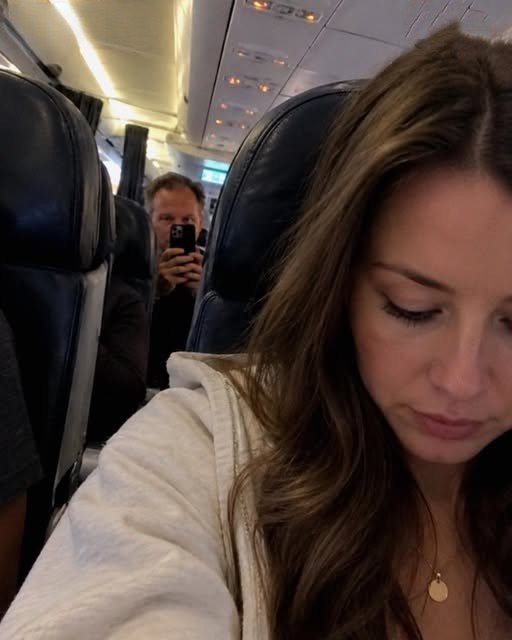
About 20 minutes after takeoff, I noticed a man several rows ahead and across the aisle holding his phone strangely.
Not up like someone taking a normal picture.
Low.
Half-hidden near his chest. Pointed toward me.
The first time, I ignored it.
People take pictures through airplane windows.
Maybe he was filming something behind me.
Then I looked again.
He dropped the phone immediately and started scrolling.
I thought: You’re being paranoid.
So I went back to my book.
Five minutes later, I caught him again.
Phone angled toward me. Eyes on the screen.
When I turned my head, down it went.
That happened four times.
Denise finally leaned toward me.
“Is that guy filming you?”
The fact that someone else had noticed made my stomach drop.
“I think so.”
“He’s been doing it since we took off.”
“You saw it too?”
She nodded.
“Every time you look over, he moves the phone.”
I suddenly felt exposed. I wasn’t doing anything unusual.
Jeans. Sweater. Hair tied up. Reading a paperback.
None of that mattered.
There is something uniquely unsettling about realizing a stranger may be collecting images of you without your knowledge.
Denise whispered, “Want me to say something?”
“No.”
I didn’t want a confrontation at 30,000 feet.
Maybe that sounds cowardly.
I don’t care.
We were trapped in a metal tube with him for another two hours.
I wanted professionals involved.
When a flight attendant came down the aisle, I quietly asked if I could speak with her near the rear galley.
Her name was Michelle.
I explained what we’d seen.
She asked which passenger.
I pointed discreetly.
Michelle watched him for a moment.
Then she said, “Please return to your seat and don’t engage with him.”
“Can police meet the flight?”
“I’ll inform the captain.”
I asked, “Can they stop him before he leaves?”
“We’ll coordinate on arrival.”
That answer calmed me slightly.
For the rest of the flight, I tried not to look at him.
The problem was the window.
I could see his phone reflected in it.
At least twice more, he raised it.
Denise noticed too.
At one point she muttered, “This guy is unbelievable.”
When we landed, Michelle asked us to stay seated for a moment.
Two uniformed airport officers came aboard near the front.
The man immediately looked nervous.
One officer spoke to him quietly.
I couldn’t hear everything.
Then I saw him shake his head.
He laughed. Actually laughed.
As he passed my row, he looked directly at me.
Not angry. Almost amused.
That frightened me more.
The officers escorted him off the plane.
Denise and I followed a few minutes later and were taken to a small interview room near the gate.
I gave my statement.
Denise gave hers separately.
The man was in another room.
His name, I later learned, was Craig.
One officer came back and asked me a series of very specific questions.
Had he touched me?
No.
Had he spoken to me?
No.
Had I seen exactly what was on his screen?
No.
Could I be certain he’d photographed me?
“No,” I admitted. “That’s the problem. I couldn’t prove it.”
The officer nodded.
“Your seatmate reported the same behavior.”
I asked, “Can you make him delete the pictures?”
The officer didn’t promise anything.
That was when I realized something uncomfortable.
Simply photographing someone in a public place is not automatically a crime.
Even creepy behavior can exist in a gap between morally wrong and clearly illegal.
About fifteen minutes later, another officer came in.
“He says he hasn’t done anything inappropriate.”
I laughed nervously.
“Of course he does.”
“He has offered to show us his recent photos.”
I looked at him. “Seriously?”
“He says it’ll prove you misunderstood.”
That was Craig’s mistake.
Not mine.
Not the police forcing open his phone.
His.
He apparently believed whatever was in his normal photo gallery would make him look innocent.
The officers asked me to identify myself if I appeared in anything he showed them.
I stood near the doorway while Craig sat across the room.
He unlocked his phone himself.
The first image was me standing in line for coffee.
I felt cold.
“That’s me.”
Craig immediately said, “See? It’s just a normal picture.”
I looked at him. “Why were you taking a normal picture of me?”
He didn’t answer.
The officer swiped.
Me getting coffee. Me sitting near an outlet. My carry-on.
Then the close-up of my luggage tag.
I stepped close. “Why do you have my name?”
Craig said, “It was visible.”
“That’s not an answer.”
The officer swiped again.
The next picture wasn’t me.
It was another woman.
Then another.Then another.
Different terminals. Different days.
Craig’s confidence disappeared. “That’s street photography.”
The officer kept going.
Some women were walking.
Some eating.
Some sleeping on planes.
Then came the pictures that made everyone stop pretending this might be harmless.
There were images taken from deliberately invasive angles.
Some had clearly been captured without the women’s knowledge.
Others showed serious violations of their privacy.
These weren’t ordinary travel photographs.
Denise gasped beside me.
Craig immediately said, “I didn’t take all of those.”
The officer looked at him. “They’re on your phone.”
“People send me stuff.”
“Who?”
Craig didn’t answer.
The officer stopped scrolling. He called another officer into the room.
They spoke quietly.
Then one of them asked Craig, “Do we still have your permission to continue looking through the gallery?”
Craig looked from them to us. “No.”
The officer stopped.
Immediately.
That detail stayed with me.
No dramatic movie scene where the police just keep digging because he’s obviously creepy.
They stopped the voluntary review and handled the next steps themselves.
Denise and I were moved to another room.
I thought that was the end of what we’d learn.
It wasn’t.
An officer returned nearly forty minutes later.
He couldn’t tell us everything.
There was now an investigation.
But he needed another statement from me about the photographs taken before boarding.
“Why?”
“Because we’re trying to establish when he began following or photographing you.”
Following.
That word made my skin crawl.
“He was following me?”
“We don’t know that yet.”
I remembered my morning.
I had arrived early. Checked my suitcase.
Went through security. Bought coffee.
Sat at one gate before realizing my flight had been moved.
Craig had apparently photographed me at several points during that period.
Not just once.
I asked, “Why me?”
The officer said, “We don’t know.”
Then he asked if Craig had access to my address through the luggage tag.
My mouth went dry.
The tag had my name and phone number.
Not my home address.
Thank God I’d changed it the year before.
The officer asked whether my social media profiles were public.
Instagram was.
I opened it.
My stomach dropped.
There was a photo I’d posted two days earlier.
Miami this weekend. Finally escaping Chicago weather.
Lauren had commented, “Guest room ready!”
I suddenly felt unbelievably stupid.
The officer must have seen it on my face.
“You didn’t cause this by posting about a trip.”
I nodded, but I still changed my account to private before I left the room.
Denise stayed with me even though she could’ve gone home.
Her husband had already picked up their luggage and was waiting outside.
“You don’t have to stay,” I told her.
“Yes, I do.”
“No, really.”
She shook her head.
“I watched him do it too. You’re not sitting here by yourself wondering whether you imagined the whole thing.”
I almost cried.
Eventually, another officer came back.
They had spoken with prosecutors and were pursuing a search warrant based on what had already been voluntarily revealed, along with other information they had developed.
Craig was not simply walking out with his phone.
The officer couldn’t give me details about potential charges.
He did say something that made my stomach turn.
“You may not be the only complainant.”
I didn’t understand.
“From this flight?”
“Possibly.”
That’s when Denise remembered a young woman sitting two rows in front of Craig.
Craig had been behaving suspiciously near her, too.
We both went silent.
I asked, “Can you find her?”
“We have the passenger manifest.”
That was the last thing they told me that night.
Lauren picked me up almost four hours after the flight landed.
The moment I got into her car, I started crying.
She didn’t even ask questions at first.
She just hugged me over the center console.
Then she said, “You’re staying at my place all week.”
“I was already staying at your place.”
“Good. Then my protective instincts require no logistical changes.”
I laughed despite everything.
The next day, a detective called me.
They had obtained legal authority to search more of Craig’s phone.
He couldn’t tell me much because the investigation was active.
But he asked whether I recognized several usernames.
I didn’t.
Then he asked whether Craig had ever contacted me through social media.
“No.”
He told me not to respond if any unfamiliar accounts suddenly messaged me.
“Is this bigger than the flight?”
A pause.
“Yes.”
That answer sat in my stomach for the rest of the day.
About two weeks later, I was contacted again.
By then, investigators had identified multiple women whose images were on Craig’s devices.
Not just airport photographs.
There were videos taken in public places that violated women’s personal privacy in deeply disturbing ways.
Several appeared to have been taken in airports and on airplanes.
Some went back years.
There were also folders organized by location.
Chicago. Dallas. Atlanta. Miami.
Under some images, Craig had saved screenshots of women’s public profiles.
Names. Jobs. Relationship status. Travel posts.
One folder contained pictures of boarding passes and luggage tags.
Another contained notes.
Not dramatic serial-killer notes.
Almost worse because of how ordinary they were.
Things like: Usually flies alone. Works downtown. Visits Miami often. Boyfriend?
My name was there.
Next to it: Chicago. Alone. Miami friend.
When the detective read that to me, I felt physically sick.
Craig had not simply seen me on the airplane and decided to take a picture.
He had noticed me before we boarded.
Then ended up on the same flight and continued.
I don’t know whether I was ever in physical danger.
The police never told me he had planned to hurt me.
I won’t invent intentions they couldn’t prove.
What I know is already enough.
He treated women like files.
Something to collect.
Sort. Label. Observe.
Months later, I learned through the case that investigators had connected several illegal, inappropriate images to Craig.
Other women were contacted.
Some hadn’t known they had ever been photographed.
That was difficult to think about.
One woman called me after investigators gave her my contact information with both our permission.
Her name was Alyssa.
She had been on another flight months earlier.
She asked, “How did you notice?”
I said, “I didn’t at first.”
She started crying. “I never noticed at all.”
I didn’t know what to say.
Finally I told her, “You weren’t supposed to.”
That sentence stayed with both of us.
People like Craig depend on normal behavior.
You read. Sleep. Walk through an airport. Put luggage overhead.
Sit down.
They depend on you assuming everyone around you is following the same basic rules you are.
Alyssa had done nothing wrong by failing to catch him.
Neither had I.
The criminal case took time.
Much longer than the television version would’ve.
There were warrants. Device examinations. Interviews. Attorneys.
I was not given every detail.
Nor should I have been.
Eventually, Craig faced criminal charges related to serious privacy violations uncovered on his devices.
My ordinary seated photographs were not the basis of those charges.
That distinction mattered to me.
Because the police didn’t arrest a man simply for making me uncomfortable.
My report led them to evidence of conduct that crossed a legal line.
I still fly.
The first flight after it happened was horrible.
I spent half the trip watching reflections.
Every raised phone felt aimed at me.
Eventually, I realized I couldn’t live like that.
But I am more aware now.
My social accounts are private.
My luggage tag no longer displays information anyone doesn’t need.
I don’t post trips until I’m home.
Those choices make me feel better.
But I refuse to turn them into a lesson about what women must do to prevent men from behaving badly.
Craig’s choices belonged to Craig.
The thing I think about most isn’t actually the phone.
It’s Denise.
A stranger sitting beside me noticed something was wrong and quietly confirmed it.
She didn’t tell me I was paranoid.
She didn’t tell me to ignore it.
She didn’t march over and start a confrontation either.
She simply said, “I see it too.”
Sometimes that is the most useful thing one person can give another.
The flight attendant listened.
The officers listened.
And because Craig was arrogant enough to believe his own gallery would make me look foolish, he unlocked the phone himself.
I had spent most of that flight worrying I was overreacting.
He had spent it assuming nobody would do anything.
We were both wrong.
I wasn’t imagining it.
And I wasn’t the only woman he had been watching.