My boyfriend told me his teenage daughter was excited to meet me. But when I arrived for dinner, he opened the door looking terrified. I asked what was wrong. He said, “Just promise you’ll hear me out.” Then a woman’s voice called from the dining room.
At 46, I thought I had learned how to recognize a lie.
Then I met Thomas.
He was 52, gentle, funny, and patient in ways I hadn’t expected.
We matched on a dating app one rainy Sunday.
We then spent the first evening talking about my work at a public library, my terrible cooking, and the books I kept buying despite already owning too many.
His profile said he was widowed.
On our third date, he told me his wife, Rebecca, had died in a car accident three years earlier.
Their daughter, Sophie, was 16 and still struggling with the loss.
“I don’t expect anyone to replace her,” he said. “But I think I might be ready to let someone into my life again.”
I liked that he spoke about Rebecca without bitterness.
After my divorce, hearing someone talk kindly about a former partner felt reassuring.
He showed me photographs of her.
In one, she stood in a garden with long dark hair falling over her shoulders. In another, she hugged a younger Sophie at a beach.
The first photograph made me pause.
Rebecca had my green eyes, the same narrow nose, and a small scar just above her left eyebrow.
I had an almost identical scar from falling against a table when I was eight.
The resemblance was so striking that I laughed.
“She looks like me.”
Thomas studied the photograph.
“A little,” he said. “Maybe that’s why you seemed familiar.”
I didn’t think much about it afterward.
Over the next four months, Thomas became part of my routine.
He sent good-morning messages, remembered how I liked my coffee, and turned up with soup when I caught a cold.
Sometimes he canceled plans because his daughter needed him. I respected that.
When he finally invited me to dinner at his house outside Boston, I was nervous but excited.
“Sophie’s ready to meet you,” he said. “My mother will be there too.”
“Are you sure?”
“Absolutely. They both want to know you.”
I bought flowers and spent far too long deciding what to wear.
Thomas opened the door before I knocked twice.
He was wearing a button-down shirt, but his face looked strained.
“You okay?” I asked.
“Of course. Just a little nervous.”
He kissed my cheek and took my coat.
I heard voices coming from the dining room.
“Everyone’s here?” I asked.
He nodded, then hesitated.
“Whatever happens, please hear me out first.”
I stopped. “Whatever happens?”
But he was already guiding me down the hallway.
A woman stood beside the dining table.
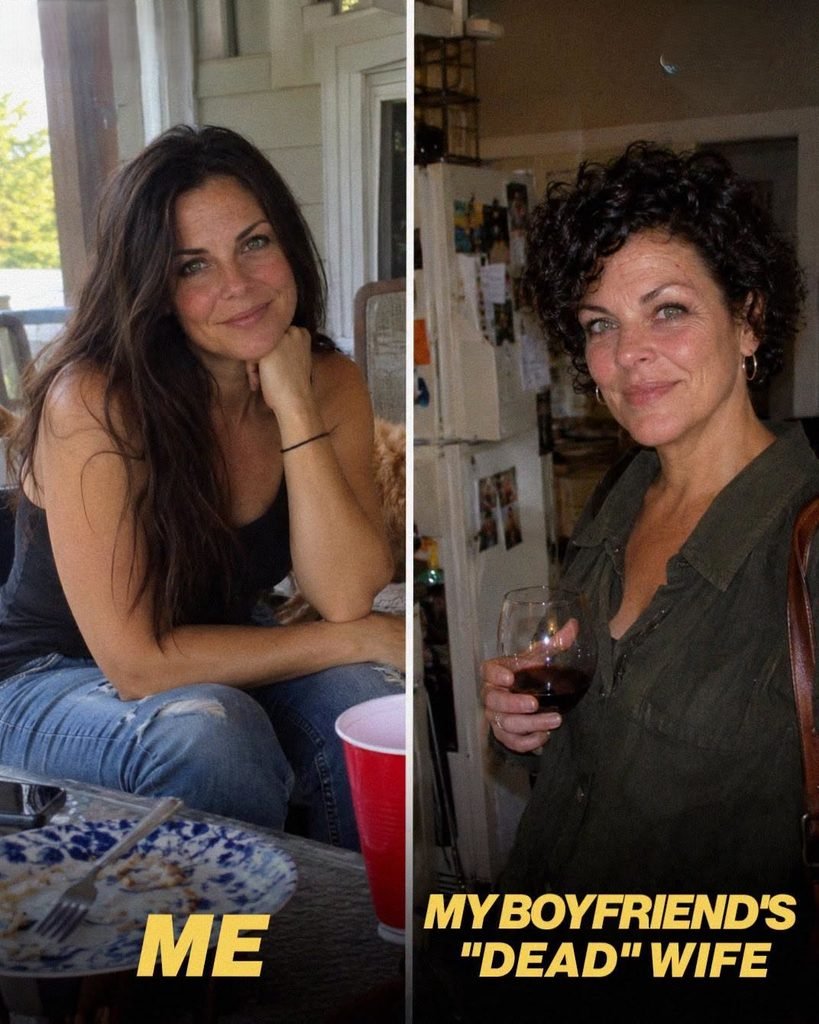
She had long dark hair, green eyes, and a tiny scar above her eyebrow.
I’d seen that face dozens of times in Thomas’s photographs.
It was Rebecca.
His supposedly dead wife.
And standing face to face with her, I realized she looked even more like me than she had in the pictures.
Our faces were almost identical.
Only our hairstyles were different: mine short, hers long and dark.
I nearly dropped the flowers.
“Thomas,” I whispered. “What is she doing here?”
He said nothing.
Rebecca looked at me, then at him.
“So you’re the woman he’s been dating.”
A teenage girl sat rigidly at the table.
Beside her, an older woman held a napkin so tightly her knuckles were white.
“You told me she died!” I said.
Thomas reached for my hand.
“Please. Just sit down. There’s something you need to understand.”
Rebecca’s voice cut through his. “No. Not this time. This time, I talk.”
She opened a drawer in the sideboard and took out a small wooden box.
When Thomas saw it, the color drained from his face.
“Rebecca, leave that alone.”
She placed it on the table.
Sophie pushed her chair back.
“Mom, please.”
Rebecca opened the lid.
Thomas lunged forward, but his mother rose and caught his arm.
“Let her speak, Thomas.”
Inside the box were photographs.
At first, I thought they were all of Rebecca.
Then I recognized my own coat, the restaurant where Thomas and I had our first dinner, and the blue scarf I’d worn on a walk through Boston Common.
He’d printed photographs of me.
Some had notes on their backs.
Rebecca picked up one and turned it toward me.
“Same face. Shorter hair.”
I felt my throat tighten.
There were more notes.
“Same smile.”
“Ask about children.”
“Needs time to grow hair.”
I looked at Thomas.
“What is this?”
He rubbed his forehead.
“It looks worse than it is.”
Rebecca gave a short, disbelieving laugh. “Then explain it.”
Nobody moved.
Rebecca sat down carefully, as though standing had taken more effort than she could spare.
She was thinner than in the photographs, and her hands trembled slightly.
“Clearly, I haven’t died,” she said. “I’m ill.”
Thomas closed his eyes.
Rebecca looked directly at me.
“I have advanced cancer. My doctors told me several months ago that treatment was no longer working. They couldn’t give me an exact date, but they said I might have about six months.”
“I’m sorry,” I whispered.
She nodded once. “So am I.”
“You told me she died in an accident,” I said to Thomas.
“I didn’t know how to explain everything.”
“So you told me she was dead?”
He leaned toward me.
“I love Rebecca. I’ve loved her for 20 years. When we got the news, I panicked.”
Rebecca lifted another sheet from the box.
It was a list written in Thomas’s handwriting.
At the top were the words “What Sophie will need.”
Underneath were things like someone who is “patient,” “likes children,” “good with routines,” and “comfortable with our home.”
Near the bottom, one phrase had been crossed out and rewritten.
“Someone familiar. Just like Rebecca.”
My stomach turned.
Sophie began crying silently.
Thomas reached toward her, but she pulled away.
“I told him not to do this,” she said.
Rebecca set the paper down.
“Thomas decided our daughter would need a new mother when I died. Not eventually. He wanted someone ready when I die.”
“That isn’t fair,” Thomas said. “I was trying to make sure Sophie wouldn’t be alone.”
“She has grandparents,” Rebecca replied. “She has friends. She has you. And she’s 16, not a little girl you can hand to a stranger.”
I stared at Thomas. He looked away.
Rebecca explained that he’d begun searching dating profiles after her doctors gave her the prognosis.
He had shown her my picture early on.
He was excited, telling her he’d found someone who looked remarkably like her.
At first she’d thought he was acting out of grief.
Then he started insisting I could become part of their household.
“He asked me to meet you,” Rebecca said. “He claimed you knew I was sick and wanted to help Sophie when the time came. I didn’t realize he’d lied to you, too.”
My mouth fell open. “I didn’t know any of this.”
“I know that now. I saw the messages on his tablet this afternoon.”
Thomas stood abruptly. “I was going to explain.”
“When?” I asked. “After I moved in? After she died?”
“Please don’t say it like that.”
“How else am I supposed to say it?”
Sophie wiped her cheeks with her sleeve.
“Dad asked me what I thought of you before I knew your name,” she said. “He showed me your picture and asked whether I’d be comfortable if you lived here.”
I looked at the girl. “What did you say?”
“I said I wanted my Mom.”
Rebecca reached for her hand.
Thomas looked broken.
“I can’t watch her lose you,” he told his wife. “I can’t go through losing you and then watch Sophie fall apart.”
Rebecca’s expression changed. For a moment, I saw how much she still loved him.
Then she said, “I’m still alive, Thomas. You don’t get to bury me early because you’re afraid of being alone.”
The room went silent.
He began to cry.
There was a time I would have felt sorry for him.
Instead, I thought of every dinner, every reassuring message, every time he’d praised my kindness.
Had he been getting to know me, or checking whether I fit his list?
“Did you ever care about who I was?” I asked.
He turned toward me. “Of course I did.”
“Then tell me something about me that has nothing to do with Rebecca.”
He opened his mouth.
I waited.
“You love books,” he said finally. “You take care of people. You’re thoughtful.”
“Those are things you knew after our first conversation.”
He shook his head. “Laura, please.”
“My name isn’t an answer to this, Thomas.”
His face went still.
I picked up my coat. “I can’t do this.”
Thomas moved toward the doorway.
“Laura, don’t go. Please.”
His mother stepped aside so I could pass.
Rebecca said, “I’m sorry he brought you here under a lie.”
I looked back at her. “You have nothing to apologize for.”
Then I left.
I sat in my car for nearly 20 minutes before I could drive.
I would later learn from Rebecca that the small Italian restaurant Thomas had taken me to was where they celebrated their anniversaries.
But nothing about my appearance had given Thomas the right to treat me like a replacement.
I sent him one message.
“Do not contact me again. Whatever happens with Rebecca and Sophie, you need to respect my decision.”
He replied several times. I didn’t read them.
Then I blocked his number.
Two days later, an unfamiliar number called.
“Laura? It’s Rebecca.”
I sat down.
“How did you get my number?”
“Thomas’s mother gave it to me. I’m sorry to call without asking first.”
I hesitated. “Is everything okay?”
“No. But that’s why I’m calling.”
She explained that she and Sophie had moved temporarily into her mother’s apartment.
“I can’t spend whatever time I have left explaining to Thomas why I’m a person and not a problem he’s trying to solve.”
“He’s been begging us to come back,” she continued. “I told him I need space.”
Then she paused.
“I wanted you to hear something from me. You didn’t cause this. He’d already made his plans before he met you.”
“I thought he loved me.”
“I’m sure he told himself he did.”
Her voice softened.
“But you deserve someone who knows the difference between loving you and needing you to look like somebody else.”
Rebecca and I began talking occasionally.
Then we discovered that we liked the same terrible detective shows and both hated raisins in baked goods.
One afternoon, she joked, “Apparently Thomas had excellent taste in faces and terrible judgment about people.”
I laughed so hard I cried.
Her illness progressed.
When she decided to enter hospice care, she called to tell me herself.
“Would you like a visitor?”
“I don’t want you feeling obligated,” she said. “You’ve already been dragged into enough.”
“I want to visit.”
There was a pause.
“Actually, yes.”
The first time I visited, I brought lemon cookies from a bakery near my apartment.
Sophie opened the door.
She looked exhausted.
“Mom said you’d come.”
“If it’s a bad time, I can leave.”
“No,” she said quickly. “Please stay.”
Rebecca was resting in a chair by the window, a blanket over her knees.
Her long dark hair had thinned, but she’d tied it back with a scarf.
When she saw me, she smiled.
“There’s my extremely confusing look-alike.”
“Hello to you too.”
We spent an hour talking about ordinary things.
Sophie joined us with tea.
She asked about my library work and told me she wanted to study art.
Afterward, she walked me to the door.
“Can I ask you something?”
“Of course.”
“Do you hate my dad?”
I took a breath.
“I hate what he did. That’s different from wanting anything bad to happen to him.”
She nodded. “Mom says she’s allowed to be angry and still care about him.”
“She’s right.”
Sophie looked relieved.
Over the next few months, I visited Rebecca whenever she felt well enough.
Sometimes I brought books.
Sometimes we watched television.
Once, Sophie taught me how to make the soup Rebecca liked, and we managed to burn the first batch.
Rebecca laughed from the next room.
“You’re both banned from the kitchen.”
Thomas visited Sophie on a schedule he’d worked out with Rebecca’s family.
They were still legally married, but Rebecca had chosen to live apart from him during her final months.
I didn’t see him.
Sophie knew I wasn’t there because of him.
One evening, Rebecca said something that stayed with me.
“I used to think my biggest fear was dying before Sophie finished growing up.”
“What is it now?”
“That she’ll spend her life believing love means letting somebody decide who you should be.”
I took her hand.
“Then keep telling her otherwise.”
Rebecca smiled.
“I think you have been too.”
As her strength faded, Sophie and I grew closer.
I helped her find a counselor and drove her to a school art exhibition when her grandmother was busy.
I listened when she wanted to talk about things that weren’t illness or death.
She was a good kid, bright and stubborn, with a sharp sense of humor.
I came to care about her because of who she was.
Not because Thomas had chosen me for a role.
Rebecca died a little over five months after that dinner.
Her mother called me early in the morning.
Sophie had been beside her.
I cried harder than I expected.
I’d only known Rebecca for a short time, but we’d shared conversations I would carry with me for the rest of my life.
I attended the funeral.
I sat with Sophie’s grandmother near the front, where Sophie had asked me to be.
Thomas was there too.
He looked older and exhausted.
When our eyes met across the room, he gave a small nod.
I returned it.
That was all.
After the service, Sophie found me outside.
“Thank you for coming.”
“Of course.”
She looked down at the flowers in her hands.
“Mom wanted me to tell you something.”
I waited.
“She said you gave her a few months where she could laugh without feeling guilty.”
Sophie hugged me.
I held her until she was ready to let go.
I still speak to Sophie.
We meet for coffee when she’s free, and she sends me photographs of her drawings.
Thomas has tried to contact me twice since Rebecca died. I haven’t responded.
I’m not going back to him.
For a long time, I wondered whether anything he’d said during our four months together had been real.
Maybe some of it was.
Maybe he genuinely liked my jokes and the way I listened.
But he had chosen me because I looked almost exactly like the woman he was losing, and he’d lied to keep me close.
He wasn’t preparing to love another woman.
He was trying to arrange his life so that, when Rebecca died, someone with her face would already be waiting at the dinner table.
Rebecca deserved better than to be replaced before she was gone.
I deserved to be loved as Laura, not as another Rebecca.
And Sophie deserved the freedom to remember her mother without being asked to accept a substitute.
But I can choose what I carry from it.
I carry Rebecca’s laughter, a friendship neither of us expected, and the knowledge that being there for Sophie doesn’t make me her new mother.
It simply makes me someone who cares about her.
And that is enough.